Pitt Hannah, Thomas Samantha L, Bestman Amy
Centre for Population Health Research, School of Health and Social Development, Faculty of Health, Deakin University, Geelong, Australia.
BMC Public Health. 2016 Sep 13;16(1):967. doi: 10.1186/s12889-016-3610-z.
Harmful gambling is a significant public health issue. Alongside the rapid diversification of gambling products, are rapid increases in the marketing for specific types of gambling products, such as online wagering. While concern has been raised about the impact of gambling promotions during sporting matches on the gambling beliefs and behaviours of adolescents, very little research has explored adolescents' and parents' attitudes towards the marketing of gambling products within sport.
A qualitative study was conducted with 59 family groups comprising of at least one parent and one adolescent (14-18 years old) in Victoria, Australia. Parents and adolescents were interviewed separately and asked questions relating to their gambling attitudes and behaviours. They were then brought together, and advertising reception techniques were utilised to prompt discussions about the marketing of gambling during sport. A thematic approach to analysis was used, constantly comparing similarities and differences between and across groups.
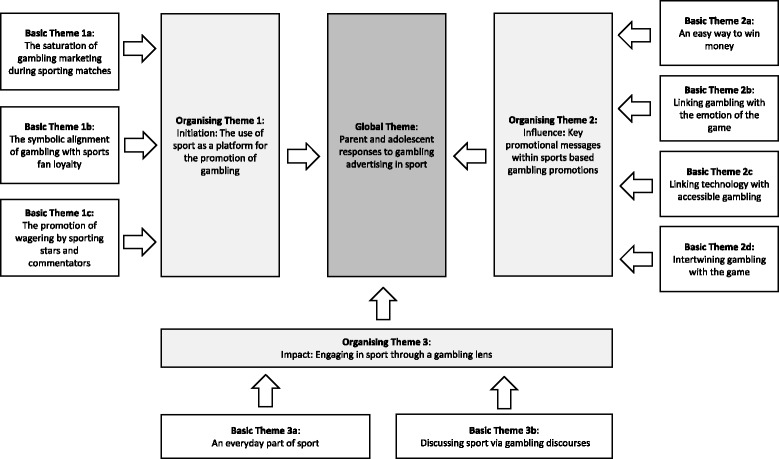
Three main themes emerged. First, was initiation of sport as a platform for the promotion of gambling. Adolescents perceived that the use of embedded promotions (for example during the match) and the use of athletes in gambling promotions were significant mechanisms for creating an alignment between gambling companies and sporting teams and codes. Second, was the influence of marketing messages in creating a perception that gambling was always accessible, and was an integral part of the sporting experience. Third was the impact of marketing messages on adolescent's discourses about sport. Parents described that they had noticed that wagering, and 'odds' discussions, had become embedded in adolescents narratives about sporting matches.
Gambling marketing during sport has significantly increased. While the gambling industry states that it does not aim to intentionally target young people, adolescents are increasingly aware of the relationship between gambling and sport. Future research should explore the impacts and influence of gambling promotions during sport on the gambling attitudes and consumption intentions of adolescents. Effective public health policy is needed to develop comprehensive regulatory frameworks to protect young people from unnecessary exposure to the marketing for this potentially harmful adult product.
有害赌博是一个重大的公共卫生问题。随着赌博产品的迅速多样化,特定类型赌博产品(如在线博彩)的营销也在迅速增加。虽然人们对体育赛事期间的赌博促销活动对青少年赌博观念和行为的影响表示担忧,但很少有研究探讨青少年及其父母对体育赛事中赌博产品营销的态度。
对澳大利亚维多利亚州的59个家庭组进行了定性研究,每个家庭组至少包括一名家长和一名青少年(14 - 18岁)。分别对家长和青少年进行访谈,询问他们与赌博态度和行为相关的问题。然后将他们召集在一起,运用广告接受技巧促使他们讨论体育赛事期间的赌博营销。采用主题分析法,不断比较不同组之间的异同。
出现了三个主要主题。第一,体育赛事被用作赌博促销的平台。青少年认为,嵌入式促销(例如在比赛期间)以及运动员参与赌博促销是使赌博公司与运动队及赛事建立联系的重要手段。第二,营销信息的影响在于营造一种赌博随时可得且是体育体验不可或缺一部分的认知。第三,营销信息对青少年关于体育赛事的话语产生影响。家长表示他们注意到,投注和“赔率”讨论已融入青少年对体育赛事的叙述中。
体育赛事期间的赌博营销显著增加。虽然赌博行业称其无意故意针对年轻人,但青少年越来越意识到赌博与体育赛事之间的关系。未来的研究应探讨体育赛事期间的赌博促销活动对青少年赌博态度和消费意愿的影响。需要有效的公共卫生政策来制定全面的监管框架,以保护年轻人免受这种潜在有害成人产品营销的不必要影响。