Lejarraga Tomás, Hertwig Ralph
Center for Adaptive Rationality, Max Planck Institute for Human Development, Lentzeallee 94, 14195, Berlin, Germany.
Psychon Bull Rev. 2017 Jun;24(3):708-720. doi: 10.3758/s13423-016-1158-7.
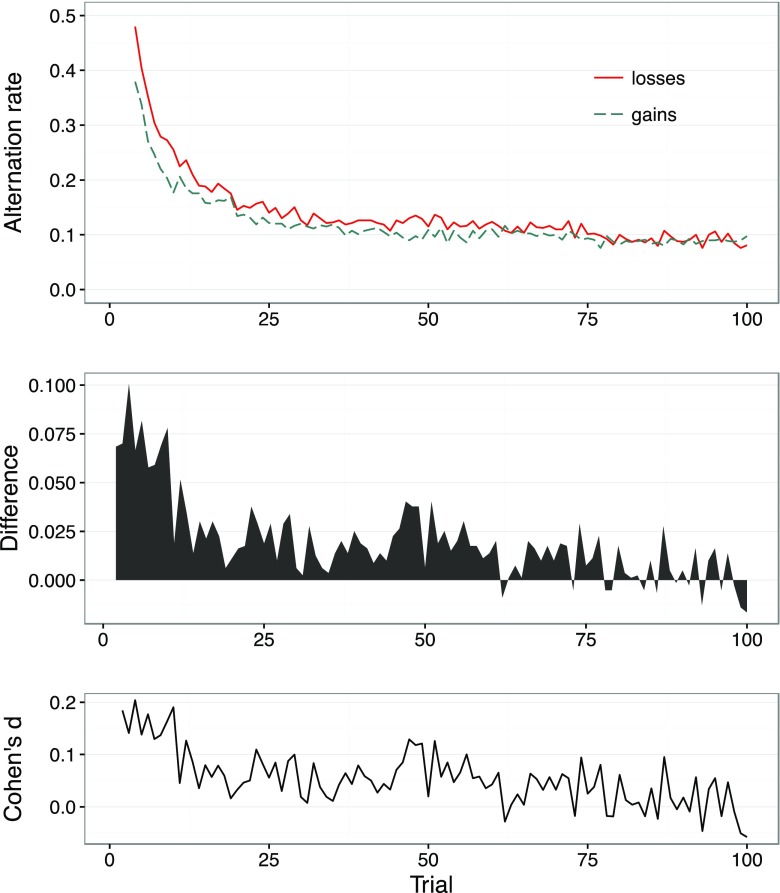
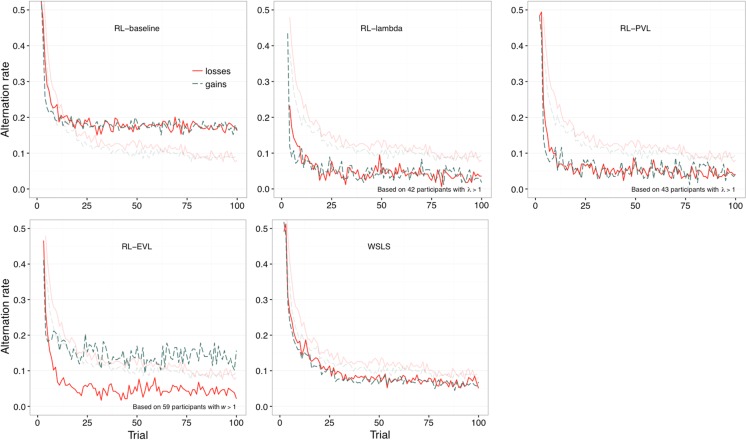
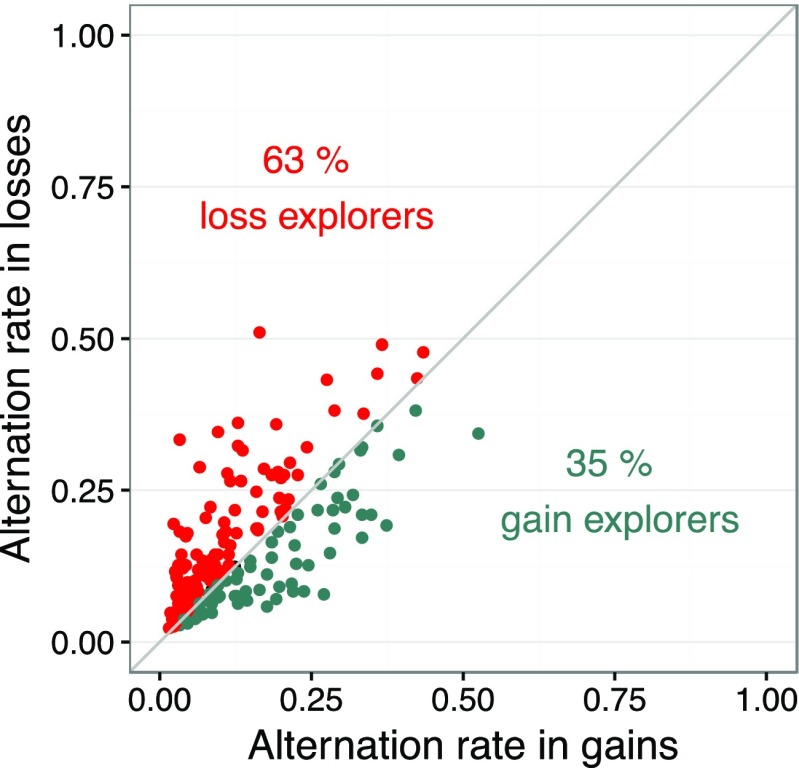
Until recently, loss aversion has been inferred exclusively from choice asymmetries in the loss and gain domains. This study examines the impact of the prospect of losses on exploratory search in a situation in which exploration is costly. Taking advantage of the largest available data set of decisions from experience, analyses showed that most people explore payoff distributions more under the threat of a loss than under the promise of a gain. This behavioral regularity thus occurs in both costly search and cost-free search (see Lejarraga, Hertwig, & Gonzalez, Cognition, 124, 334-342, 2012). Furthermore, a model comparison identified the simple win-stay-lose-shift heuristic as a likely candidate mechanism behind the loss-gain exploration asymmetry observed. In contrast, models assuming loss aversion failed to reproduce the asymmetry. Moreover, the asymmetry was not simply a precursor of loss aversion but a phenomenon separate from it. These findings are consistent with the recently proposed notion of intensified vigilance in the face of potential losses.
直到最近,损失厌恶一直完全是从损失和收益领域的选择不对称中推断出来的。本研究考察了在探索成本高昂的情况下,损失预期对探索性搜索的影响。利用来自经验的最大可用决策数据集,分析表明,大多数人在面临损失威胁时比在收益承诺下更愿意探索收益分布。因此,这种行为规律在成本高昂的搜索和无成本的搜索中都会出现(见Lejarraga、Hertwig和Gonzalez,《认知》,第124卷,第334 - 342页,2012年)。此外,通过模型比较确定,简单的赢则留、输则变启发式是观察到的损失 - 收益探索不对称背后可能的候选机制。相比之下,假设存在损失厌恶的模型无法重现这种不对称。此外,这种不对称并非仅仅是损失厌恶的先兆,而是一种与之不同的现象。这些发现与最近提出的面对潜在损失时增强警惕的观点一致。