Li Q S, Tian C, Seabrook G R, Drevets W C, Narayan V A
Neuroscience Therapeutic Area, Janssen Research & Development, LLC, Titusville, NJ, USA.
23andMe, Inc., Mountain View, CA, USA.
Transl Psychiatry. 2016 Sep 13;6(9):e889. doi: 10.1038/tp.2016.171.
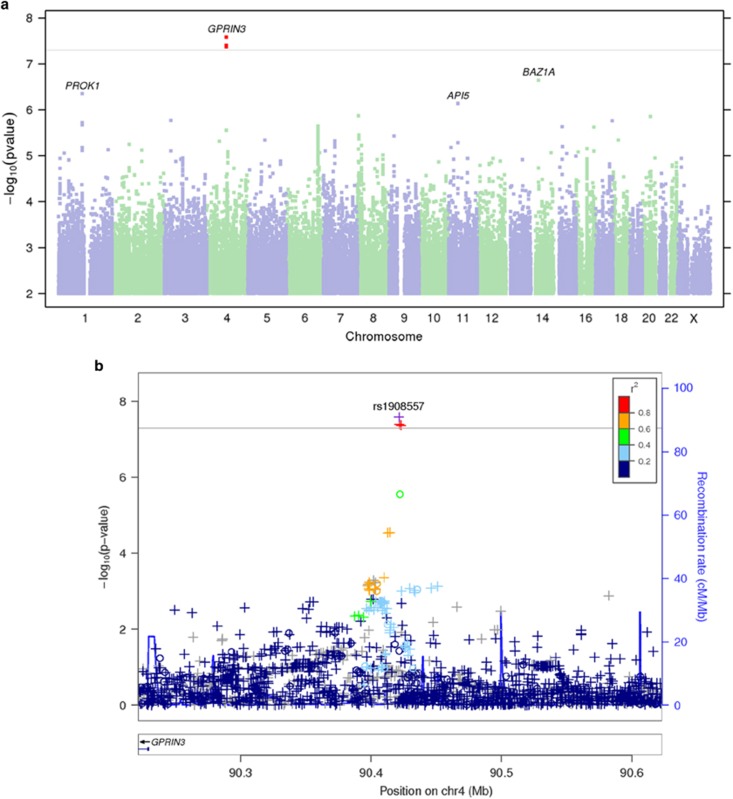
Genetic predisposition may contribute to the differences in drug-specific, class-specific or antidepressant-wide treatment resistance. Clinical studies with the genetic data are often limited in sample sizes. Drug response obtained from self-reports may offer an alternative approach to conduct a study with much larger sample size. Using the phenotype data collected from 23andMe 'Antidepressant Efficacy and Side Effects' survey and genotype data from 23andMe's research participants, we conducted genome-wide association study (GWAS) on subjects of European ancestry using four groups of phenotypes (a) non-treatment-resistant depression (n=7795) vs treatment-resistant depression (TRD, n=1311), (b) selective serotonin reuptake inhibitors (SSRI) responders (n=6348) vs non-responders (n=3340), (c) citalopram/escitalopram responders (n=2963) vs non-responders (n=2005), and (d) norepinephrine-dopamine reuptake inhibitor (NDRI, bupropion) responders (n=2675) vs non-responders (n=1861). Each of these subgroups was also compared with controls (n ~ 190 000). The most significant association was from bupropion responders vs non-responders analysis. Variant rs1908557 (P=2.6 × 10(-8), OR=1.35) passed the conventional genome-wide significance threshold (P=5 × 10(-8)) and was located within the intron of human spliced expressed sequence tags in chromosome 4. Gene sets associated with long-term depression, circadian rhythm and vascular endothelial growth factor (VEGF) pathway were enriched in the bupropion analysis. No single-nucleotide polymorphism passed genome-wide significance threshold in other analyses. The heritability estimates for each response group compared with controls were between 0.15 and 0.25, consistent with the known heritability for major depressive disorder.
遗传易感性可能导致药物特异性、类别特异性或抗抑郁药物整体治疗抵抗的差异。涉及遗传数据的临床研究样本量往往有限。从自我报告中获得的药物反应可能提供一种替代方法来开展样本量更大的研究。利用从23andMe“抗抑郁药疗效和副作用”调查中收集的表型数据以及23andMe研究参与者的基因型数据,我们对欧洲血统的受试者进行了全基因组关联研究(GWAS),使用了四组表型:(a)非治疗抵抗性抑郁症(n = 7795)与治疗抵抗性抑郁症(TRD,n = 1311);(b)选择性5-羟色胺再摄取抑制剂(SSRI)反应者(n = 6348)与无反应者(n = 3340);(c)西酞普兰/艾司西酞普兰反应者(n = 2963)与无反应者(n = 2005);以及(d)去甲肾上腺素-多巴胺再摄取抑制剂(NDRI,安非他酮)反应者(n = 2675)与无反应者(n = 1861)。这些亚组中的每一组也都与对照组(n≈190 000)进行了比较。最显著的关联来自安非他酮反应者与无反应者的分析。变体rs1908557(P = 2.6×10⁻⁸,OR = 1.35)超过了传统的全基因组显著性阈值(P = 5×10⁻⁸),位于4号染色体上人类剪接表达序列标签的内含子内。在安非他酮分析中,与长期抑郁、昼夜节律和血管内皮生长因子(VEGF)途径相关的基因集得到了富集。在其他分析中,没有单核苷酸多态性超过全基因组显著性阈值。与对照组相比,每个反应组的遗传力估计值在0.15至0.25之间,这与重度抑郁症已知的遗传力一致。