Hromatka Bethann S, Tung Joyce Y, Kiefer Amy K, Do Chuong B, Hinds David A, Eriksson Nicholas
Product Science, 23andMe, Inc., Mountain View, CA, USA
Product Science, 23andMe, Inc., Mountain View, CA, USA.
Hum Mol Genet. 2015 May 1;24(9):2700-8. doi: 10.1093/hmg/ddv028. Epub 2015 Jan 26.
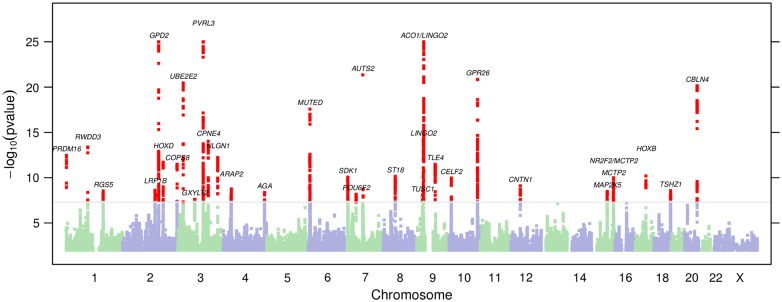
Roughly one in three individuals is highly susceptible to motion sickness and yet the underlying causes of this condition are not well understood. Despite high heritability, no associated genetic factors have been discovered. Here, we conducted the first genome-wide association study on motion sickness in 80 494 individuals from the 23andMe database who were surveyed about car sickness. Thirty-five single-nucleotide polymorphisms (SNPs) were associated with motion sickness at a genome-wide-significant level (P < 5 × 10(-8)). Many of these SNPs are near genes involved in balance, and eye, ear and cranial development (e.g. PVRL3, TSHZ1, MUTED, HOXB3, HOXD3). Other SNPs may affect motion sickness through nearby genes with roles in the nervous system, glucose homeostasis or hypoxia. We show that several of these SNPs display sex-specific effects, with up to three times stronger effects in women. We searched for comorbid phenotypes with motion sickness, confirming associations with known comorbidities including migraines, postoperative nausea and vomiting (PONV), vertigo and morning sickness and observing new associations with altitude sickness and many gastrointestinal conditions. We also show that two of these related phenotypes (PONV and migraines) share underlying genetic factors with motion sickness. These results point to the importance of the nervous system in motion sickness and suggest a role for glucose levels in motion-induced nausea and vomiting, a finding that may provide insight into other nausea-related phenotypes like PONV. They also highlight personal characteristics (e.g. being a poor sleeper) that correlate with motion sickness, findings that could help identify risk factors or treatments.
大约三分之一的人极易患晕动病,然而这种病症的潜在病因尚未得到充分了解。尽管晕动病具有高度遗传性,但尚未发现与之相关的遗传因素。在此,我们对23andMe数据库中80494名接受过晕车调查的个体进行了首次晕动病全基因组关联研究。35个单核苷酸多态性(SNP)在全基因组显著水平(P < 5×10⁻⁸)与晕动病相关。其中许多SNP位于参与平衡以及眼睛、耳朵和颅骨发育的基因附近(例如PVRL3、TSHZ1、MUTED、HOXB3、HOXD3)。其他SNP可能通过在神经系统、葡萄糖稳态或缺氧中起作用的附近基因影响晕动病。我们发现其中几个SNP表现出性别特异性效应,在女性中的效应强度高达三倍。我们搜索了与晕动病共病的表型,证实了与已知共病的关联,包括偏头痛、术后恶心呕吐(PONV)、眩晕和孕吐,并观察到与高原病和许多胃肠道疾病的新关联。我们还表明,这些相关表型中的两种(PONV和偏头痛)与晕动病共享潜在的遗传因素。这些结果表明神经系统在晕动病中的重要性,并提示葡萄糖水平在运动引起的恶心和呕吐中起作用,这一发现可能为深入了解其他与恶心相关的表型(如PONV)提供线索。它们还突出了与晕动病相关的个人特征(例如睡眠不好),这些发现有助于识别风险因素或治疗方法。