Musich Shirley, Wang Shaohung S, Hawkins Kevin, Greame Chris
1 Advanced Analytics, Optum, Ann Arbor, Michigan.
2 AARP Services, Inc., Washington, District of Columbia.
Popul Health Manag. 2017 Jun;20(3):199-207. doi: 10.1089/pop.2016.0071. Epub 2016 Sep 13.
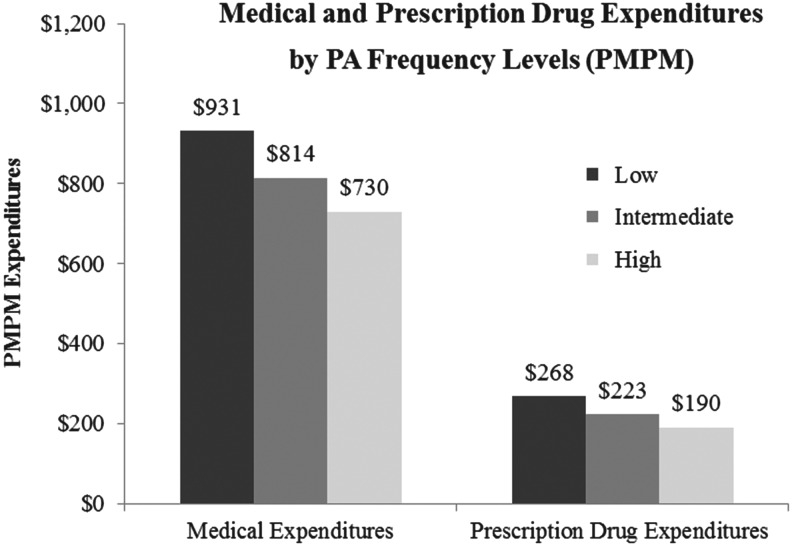
The benefits of physical activity (PA) for older adults have been demonstrated in reduced prevalence of common chronic conditions, improved mental health, decreased cognitive decline, and reduced mortality rates. Less is understood concerning the health impacts of light-to-moderate intensity PA. The purpose of this study was to estimate light-to-moderate PA frequency levels-low (0-2 days/week), intermediate (3-4 days/week) and high (≥5 days/week)-among AARP Medicare Supplement insureds, identify characteristics, and estimate the association of PA levels with the prevalence of selected chronic conditions, health care utilization, and expenditures. In 2015, surveys were sent to a random sample of insureds. PA was determined from survey responses querying self-reported days per week of at least 30 minutes of light-to-moderate PA. Multivariate regression models, adjusting for confounding covariates and survey nonresponse bias, were utilized to determine the characteristics and association of intermediate and high PA levels with health outcomes. In a second analysis, results were stratified by age groups: 65-69, 70-79, and ≥80 years. Among survey respondents (n = 17,676), 23.3%, 33.9%, and 42.9% engaged in low, intermediate, and high PA, respectively. The strongest predictors of intermediate and high PA included being male, younger, self-reporting better health, using fewer prescription drugs, and being less likely to be diagnosed with common chronic conditions or depression. Those engaged in intermediate and high PA, overall and across age groups, had significantly lower health care utilization and expenditures and lower prevalence of most chronic conditions. Efforts to increase intermediate and high levels of PA among older adults should be encouraged.
体育活动(PA)对老年人的益处已在以下方面得到证实:常见慢性病患病率降低、心理健康改善、认知能力下降减缓以及死亡率降低。关于轻度至中度强度PA对健康的影响,人们了解得较少。本研究的目的是估计美国退休人员协会(AARP)医保补充计划参保者中轻度至中度PA的频率水平——低(0 - 2天/周)、中(3 - 4天/周)和高(≥5天/周),确定其特征,并估计PA水平与选定慢性病患病率、医疗保健利用情况及支出之间的关联。2015年,向参保者的随机样本发送了调查问卷。PA是根据调查回复中询问的每周至少30分钟轻度至中度PA的自我报告天数来确定的。使用多变量回归模型,对混杂协变量和调查无应答偏差进行调整,以确定中等和高强度PA水平的特征及其与健康结果的关联。在第二项分析中,结果按年龄组进行分层:65 - 69岁、70 - 79岁和≥80岁。在调查受访者(n = 17,676)中,分别有23.3%、33.9%和42.9%的人进行低、中、高强度PA。中等和高强度PA的最强预测因素包括男性、较年轻、自我报告健康状况较好、使用处方药较少以及被诊断患有常见慢性病或抑郁症的可能性较小。总体而言以及在各个年龄组中,进行中等和高强度PA的人医疗保健利用率和支出显著较低,大多数慢性病的患病率也较低。应鼓励努力提高老年人中等和高强度PA的水平。