Mashima Ryuichi, Sakai Eri, Kosuga Motomichi, Okuyama Torayuki
Department of Clinical Laboratory Medicine, National Center for Child Health and Development, 2-10-1 Okura, Setagaya-ku, Tokyo 157-8535, Japan.
Department of Clinical Laboratory Medicine, National Center for Child Health and Development, 2-10-1 Okura, Setagaya-ku, Tokyo 157-8535, Japan; Center for Lysosomal Storage Disorders, National Center for Child Health and Development, 2-10-1 Okura, Setagaya-ku, Tokyo 157-8535, Japan; Division of Medical Genetics, National Center for Child Health and Development, 2-10-1 Okura, Setagaya-ku, Tokyo 157-8535, Japan.
Mol Genet Metab Rep. 2016 Aug 31;9:6-11. doi: 10.1016/j.ymgmr.2016.08.007. eCollection 2016 Dec.
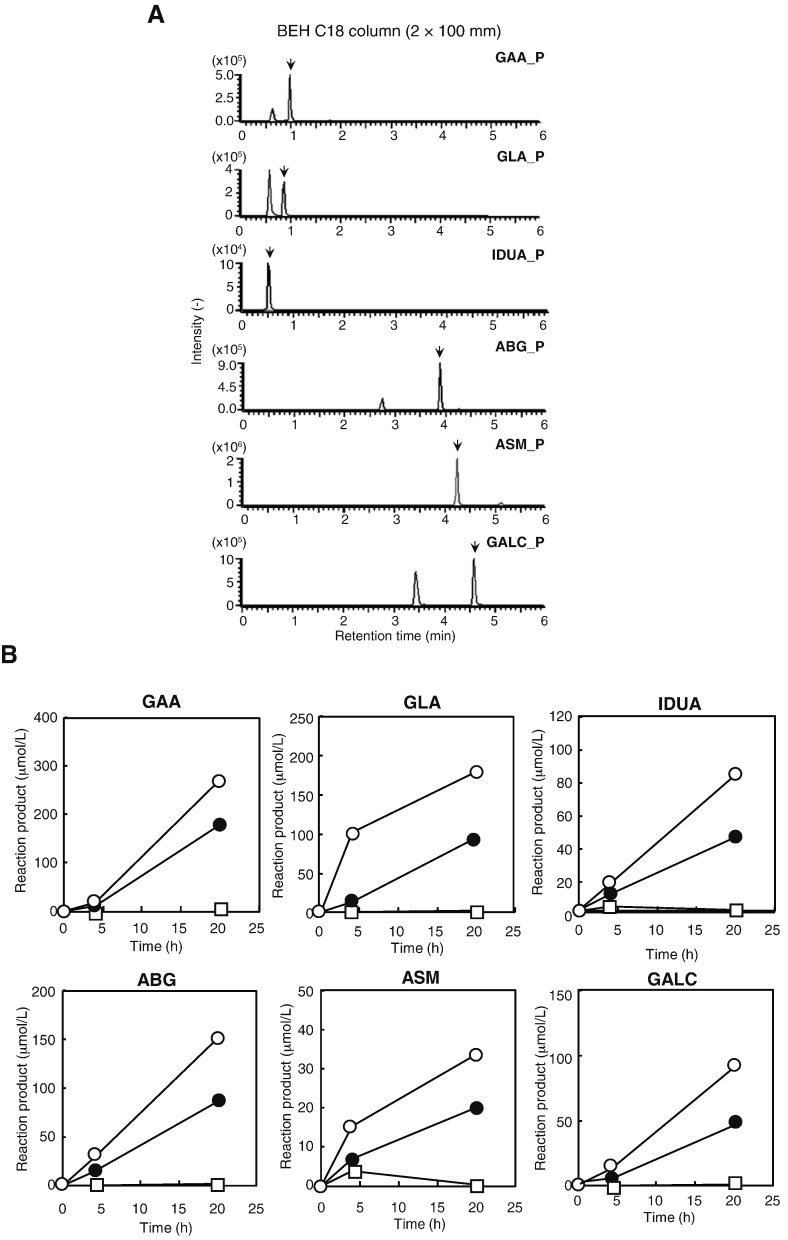
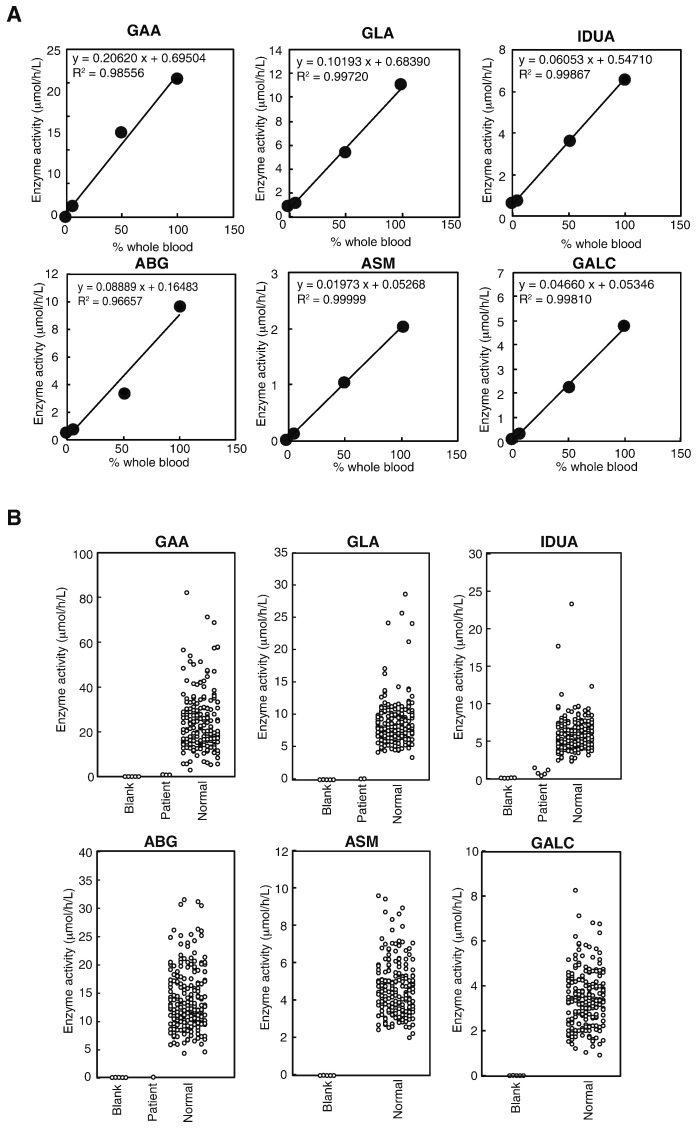
Lysosomal storage disorders (LSDs) are caused by defective enzyme activities in lysosomes, characterized by the accumulation of glycolipids, oligosaccharides, mucopolysaccharides, sphingolipids, and other biological substances. Accumulating evidence has suggested that early detection of individuals with LSDs, followed by the immediate initiation of appropriate therapy during the presymptomatic period, usually results in better therapeutic outcomes. The activities of individual enzymes are measured using fluorescent substrates. However, the simultaneous determination of multiple enzyme activities has been awaited in neonatal screening of LSDs because the prevalence of individual LSDs is rare. In this study, the activities of six enzymes associated with LSDs were examined with 6-plex enzyme assay using liquid chromatography-tandem mass spectrometry (LC-MS/MS). The accumulation of enzyme products was almost linear for 0-20 h at 37 °C. Dried blood spots (DBSs) provided by the Centers for Disease Control and Prevention (CDC) were used for quality control (QC). The intraday and interday coefficient of variance values were < 25%. The enzyme activities of healthy individuals were higher than those of LSD-confirmed individuals. These results suggest that the levels of enzyme activities of six LSDs in a Japanese population were comparable to those of a recent report [Elliott et al. Mol Genet Metab 118 (2016) 304-309], providing additional evidence that the 6-plex LSD enzyme assay is a reproducible analytical procedure for neonatal screening.
溶酶体贮积症(LSDs)是由溶酶体中酶活性缺陷引起的,其特征是糖脂、寡糖、粘多糖、鞘脂和其他生物物质的积累。越来越多的证据表明,对LSDs患者进行早期检测,并在症状前期立即开始适当治疗,通常会产生更好的治疗效果。使用荧光底物测量单个酶的活性。然而,由于单个LSDs的患病率很低,因此在LSDs的新生儿筛查中一直期待能够同时测定多种酶的活性。在本研究中,使用液相色谱-串联质谱(LC-MS/MS)通过6重酶测定法检测了与LSDs相关的六种酶的活性。在37℃下,酶产物的积累在0-20小时内几乎呈线性。由疾病控制和预防中心(CDC)提供的干血斑(DBSs)用于质量控制(QC)。日内和日间变异系数值均<25%。健康个体的酶活性高于确诊为LSDs的个体。这些结果表明,日本人群中六种LSDs的酶活性水平与最近的一份报告[Elliott等人,《分子遗传学与代谢》118(2016)304-309]中的水平相当,这进一步证明了6重LSD酶测定法是一种可重复的新生儿筛查分析方法。