Ohira Mari, Okuyama Torayuki, Mashima Ryuichi
Department of Clinical Laboratory Medicine, National Center for Child Health and Development, 2-10-1 Okura, Setagaya-ku, Tokyo 157-8535, Japan.
Mol Genet Metab Rep. 2018 Sep 7;17:9-15. doi: 10.1016/j.ymgmr.2018.08.005. eCollection 2018 Dec.
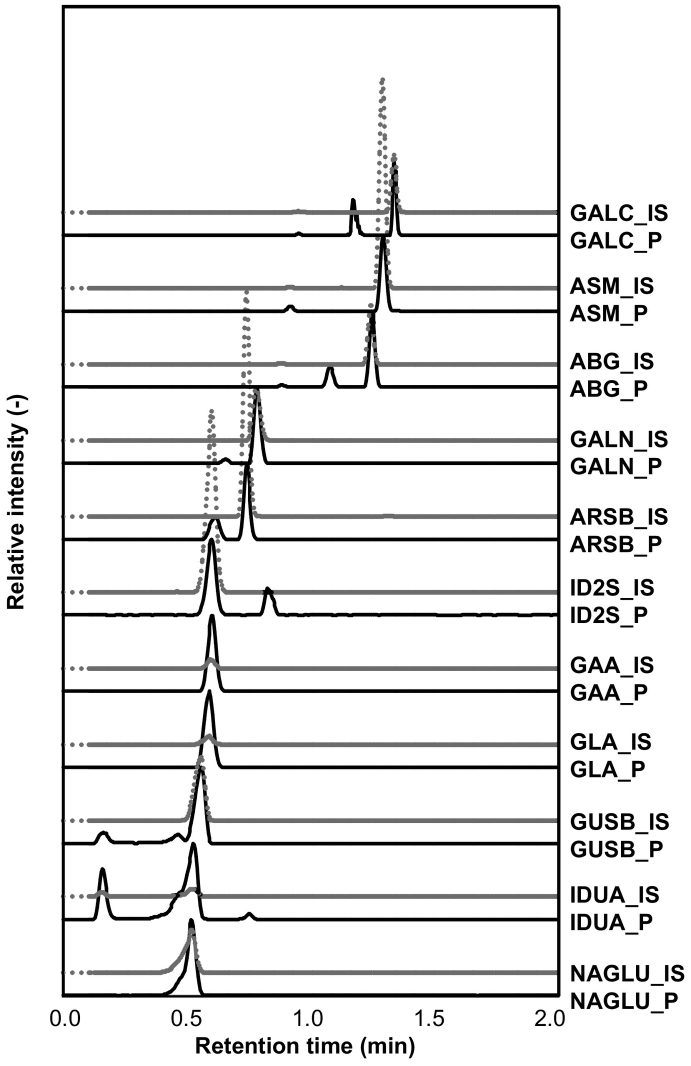
Lysosomal storage disorders (LSDs) are characterized by the accumulation of lipids, glycolipids, oligosaccharides, mucopolysaccharides, and other biological substances because of the pathogenic deficiency of lysosomal enzymes. Such diseases are rare; thus, a multiplex assay for these disorders is effective for the identification of affected individuals during the presymptomatic period. Previous studies have demonstrated that such assays can be performed using liquid chromatography-tandem mass spectrometry (LC-MS/MS) with multiple reaction monitoring (MRM) detection. An assay procedure to quantify the activity of 11 enzymes associated with LSDs was provided. First, a validation study was performed using dried blood spot (DBS) samples with 100% and 5% enzyme activity for quality control (QC). Under the assay condition, the analytical range, defined as the ratio of the peak area of the enzyme reaction products from the DBS for QC with 100% enzyme activity to that from the filter paper blank sample, was between 14 for GALN and 4561 for GLA. Based on these results, the distribution of the enzyme activity for the 11 LSD enzymes was further examined. Consistent with the previous data, the enzyme activity exhibited a bell-shaped distribution with a single peak. The averaged enzyme activity for the healthy neonates was as follows: GLA, 3.80 ± 1.6; GAA, 10.6 ± 4.8; IDUA, 6.4 ± 2.3; ABG, 8.6 ± 3.1; ASM, 3.3 ± 1.1; GALC, 2.8 ± 1.3; ID2S, 16.7 ± 6.1; GALN, 1.2 ± 0.5; ARSB, 17.0 ± 8.7; NAGLU, 4.6 ± 1.5; and GUSB, 46.6 ± 19.0 μmol/h/L (mean ± SD, n = 200). In contrast, the enzyme activity in disease-affected individuals was lower than the minimum enzyme activity in healthy neonates. The results demonstrate that the population of disease-affected individuals was distinguished from that of healthy individuals by the use of LC-MS/MS.
溶酶体贮积症(LSDs)的特征是由于溶酶体酶的致病性缺陷,导致脂质、糖脂、寡糖、粘多糖和其他生物物质的积累。这类疾病较为罕见;因此,针对这些疾病的多重检测对于在症状前期识别受影响个体是有效的。先前的研究表明,此类检测可使用液相色谱 - 串联质谱(LC-MS/MS)和多反应监测(MRM)检测来进行。提供了一种用于定量与溶酶体贮积症相关的11种酶活性的检测程序。首先,使用酶活性为100%和5%的干血斑(DBS)样本进行验证研究以进行质量控制(QC)。在该检测条件下,分析范围定义为来自酶活性为100%的QC的DBS的酶反应产物的峰面积与来自滤纸空白样本的峰面积之比,对于GALN为14,对于GLA为4561。基于这些结果,进一步研究了11种溶酶体贮积症酶的酶活性分布。与先前的数据一致,酶活性呈现出单峰的钟形分布。健康新生儿的平均酶活性如下:GLA,3.80±1.6;GAA,10.6±4.8;IDUA,6.4±2.3;ABG,8.6±3.1;ASM,3.3±1.1;GALC,2.8±1.3;ID2S,16.7±6.1;GALN,1.2±0.5;ARSB,17.0±8.7;NAGLU,4.6±1.5;和GUSB,46.6±19.0μmol/h/L(平均值±标准差,n = 200)。相比之下,疾病受影响个体的酶活性低于健康新生儿的最低酶活性。结果表明,通过使用LC-MS/MS可以区分疾病受影响个体和健康个体。