Chung Wen-Sung, Marshall N Justin
Queensland Brain Institute, The University of Queensland, St Lucia 4072, Australia
Queensland Brain Institute, The University of Queensland, St Lucia 4072, Australia.
Proc Biol Sci. 2016 Sep 14;283(1838). doi: 10.1098/rspb.2016.1346.
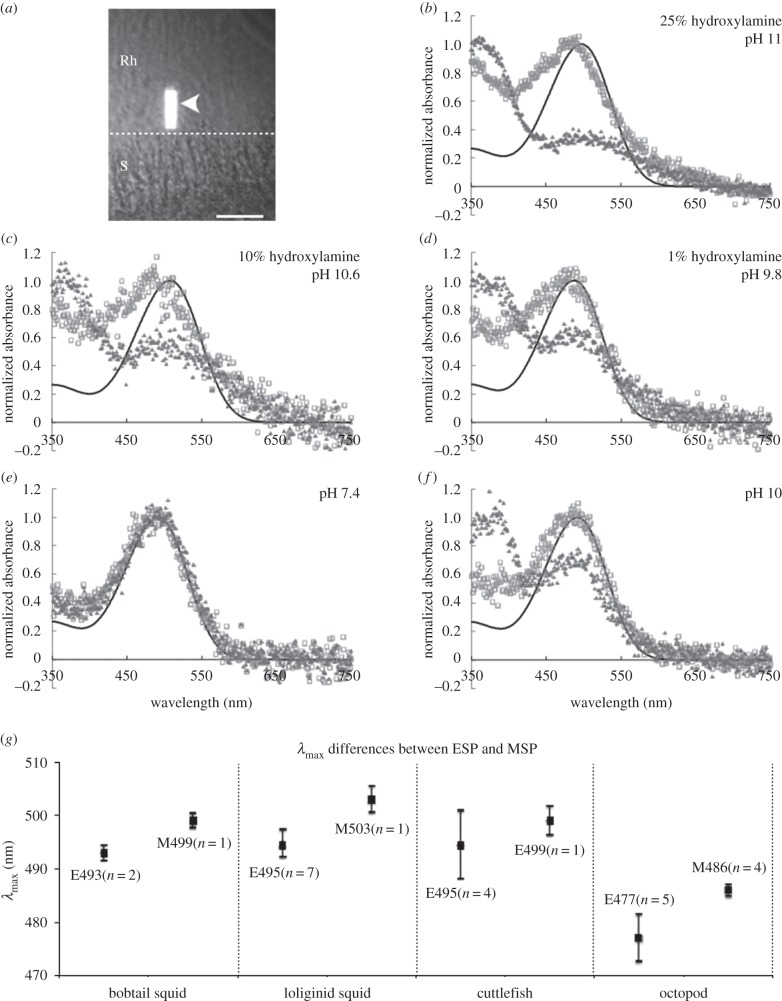
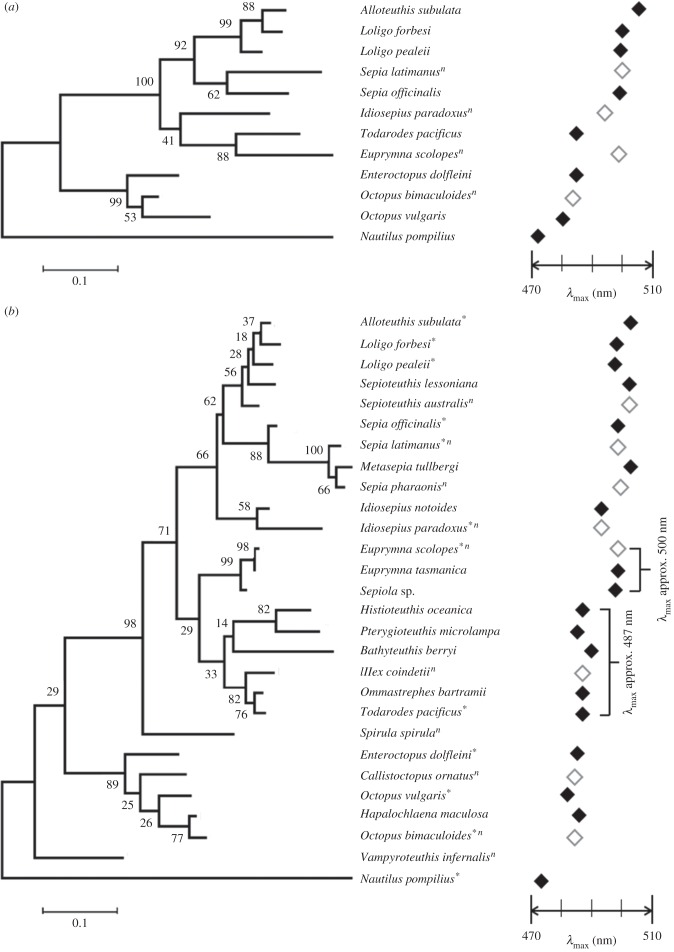
Previous investigations of vision and visual pigment evolution in aquatic predators have focused on fish and crustaceans, generally ignoring the cephalopods. Since the first cephalopod opsin was sequenced in late 1980s, we now have data on over 50 cephalopod opsins, prompting this functional and phylogenetic examination. Much of this data does not specifically examine the visual pigment spectral absorbance position (λmax) relative to environment or lifestyle, and cephalopod opsin functional adaptation and visual ecology remain largely unknown. Here we introduce a new protocol for photoreceptor microspectrophotometry (MSP) that overcomes the difficulty of bleaching the bistable visual pigment and that reveals eight coastal coleoid cephalopods to be monochromatic with λmax varying from 484 to 505 nm. A combination of current MSP results, the λmax values previously characterized using cephalopod retinal extracts (467-500 nm) and the corresponding opsin phylogenetic tree were used for systematic comparisons with an end goal of examining the adaptations of coleoid visual pigments to different light environments. Spectral tuning shifts are described in response to different modes of life and light conditions. A new spectral tuning model suggests that nine amino acid substitution sites may determine the direction and the magnitude of spectral shifts.
此前对水生食肉动物视觉及视觉色素进化的研究主要集中在鱼类和甲壳类动物上,通常忽略了头足类动物。自20世纪80年代末首个头足类视蛋白被测序以来,我们现在已有50多种头足类视蛋白的数据,从而促成了此次功能和系统发育研究。这些数据大多未专门研究视觉色素光谱吸收位置(λmax)与环境或生活方式的关系,头足类视蛋白的功能适应性和视觉生态学在很大程度上仍不为人知。在此,我们介绍一种用于光感受器显微分光光度测定法(MSP)的新方案,该方案克服了双稳态视觉色素漂白的困难,并且揭示出8种沿海头足类软体动物为单色,其λmax在484至505纳米之间变化。将当前MSP结果、先前使用头足类视网膜提取物测定的λmax值(467 - 500纳米)以及相应的视蛋白系统发育树相结合,用于系统比较,最终目的是研究头足类软体动物视觉色素对不同光照环境的适应性。针对不同的生活方式和光照条件描述了光谱调谐变化。一种新的光谱调谐模型表明,9个氨基酸替换位点可能决定光谱变化的方向和幅度。