Sun Baofa, Li Tong, Xiao Jinhua, Liu Li, Zhang Peng, Murphy Robert W, He Shunmin, Huang Dawei
Key Laboratory of Zoological Systematics and Evolution, Institute of Zoology, Chinese Academy of SciencesBeijing, China; CAS Key Laboratory of Genomics and Precision Medicine, Beijing Institute of Genomics, Chinese Academy of SciencesBeijing, China.
Key Laboratory of Crop Pests Control of Henan Province, Institute of Plant Protection, Henan Academy of Agricultural Sciences Zhengzhou, China.
Front Microbiol. 2016 Aug 31;7:1360. doi: 10.3389/fmicb.2016.01360. eCollection 2016.
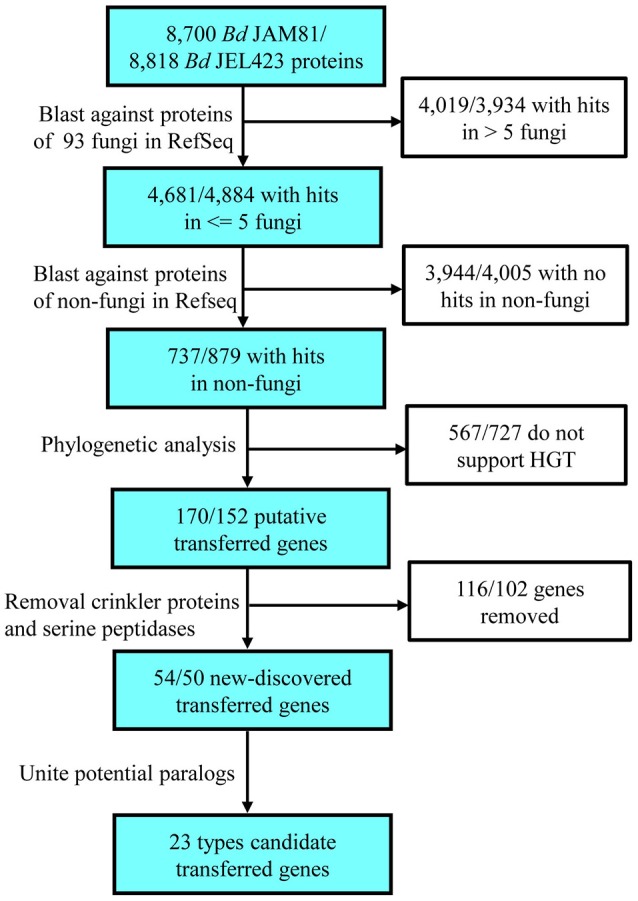
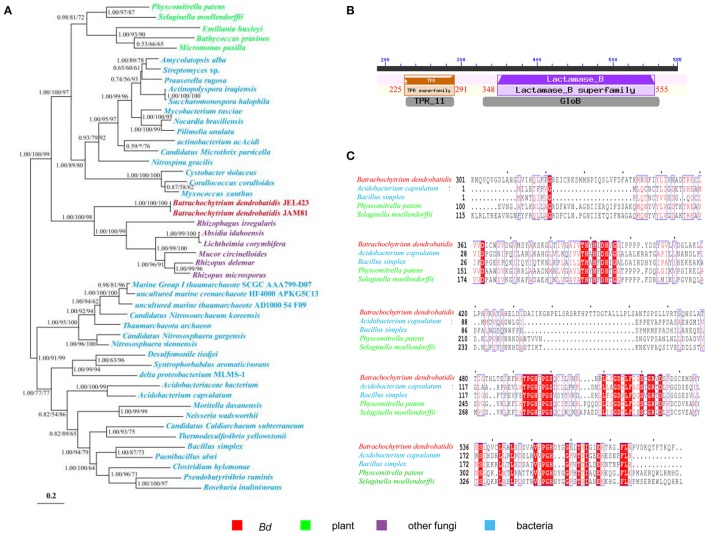
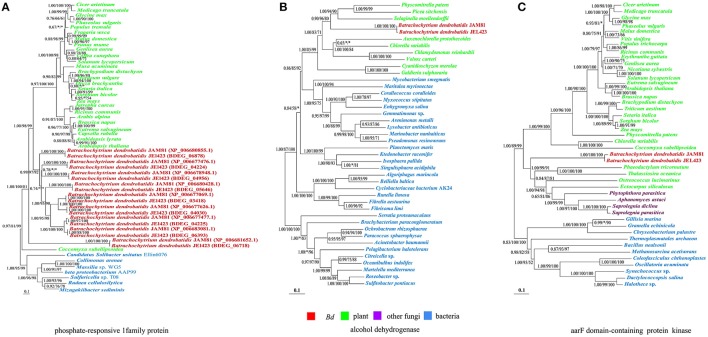
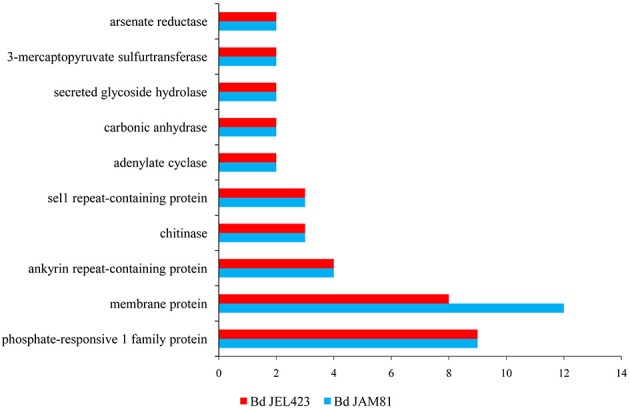
Amphibian populations are experiencing catastrophic declines driven by the fungal pathogen Batrachochytrium dendrobatidis (Bd). Although horizontal gene transfer (HGT) facilitates the evolution and adaptation in many fungi by conferring novel function genes to the recipient fungi, inter-kingdom HGT in Bd remains largely unexplored. In this study, our investigation detects 19 bacterial genes transferred to Bd, including metallo-beta-lactamase and arsenate reductase that play important roles in the resistance to antibiotics and arsenates. Moreover, three probable HGT gene families in Bd are from plants and one gene family coding the ankyrin repeat-containing protein appears to come from oomycetes. The observed multi-copy gene families associated with HGT are probably due to the independent transfer events or gene duplications. Five HGT genes with extracellular locations may relate to infection, and some other genes may participate in a variety of metabolic pathways, and in doing so add important metabolic traits to the recipient. The evolutionary analysis indicates that all the transferred genes evolved under purifying selection, suggesting that their functions in Bd are similar to those of the donors. Collectively, our results indicate that HGT from diverse donors may be an important evolutionary driver of Bd, and improve its adaptations for infecting and colonizing host amphibians.
两栖动物种群正因真菌病原体蛙壶菌(Batrachochytrium dendrobatidis,简称Bd)而经历灾难性的减少。虽然水平基因转移(HGT)通过赋予受体真菌新功能基因促进了许多真菌的进化和适应,但Bd中的跨王国HGT在很大程度上仍未得到探索。在本研究中,我们的调查检测到19个转移到Bd的细菌基因,包括在抗生素和砷酸盐抗性中起重要作用的金属β-内酰胺酶和砷酸盐还原酶。此外,Bd中三个可能的HGT基因家族来自植物,一个编码含锚蛋白重复序列蛋白的基因家族似乎来自卵菌纲。观察到的与HGT相关的多拷贝基因家族可能是由于独立的转移事件或基因复制。五个位于细胞外的HGT基因可能与感染有关,其他一些基因可能参与各种代谢途径,从而为受体增加重要的代谢特性。进化分析表明,所有转移的基因都在纯化选择下进化,这表明它们在Bd中的功能与供体的功能相似。总体而言,我们的结果表明,来自不同供体的HGT可能是Bd的一个重要进化驱动力,并改善其对宿主两栖动物的感染和定殖适应性。