Department of Clinical Sciences, College of Veterinary Medicine, Cornell University , Ithaca, NY , USA.
Front Vet Sci. 2016 Aug 31;3:68. doi: 10.3389/fvets.2016.00068. eCollection 2016.
To determine whether computed tomography (CT) and intraoral radiography are interchangeable for detecting signs of periodontitis and endodontic disease in dogs.
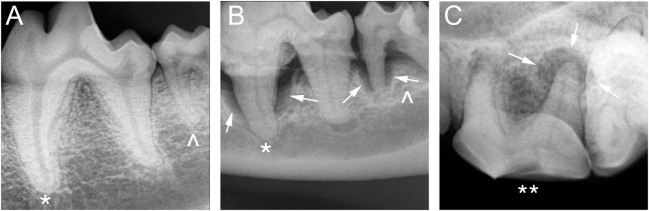
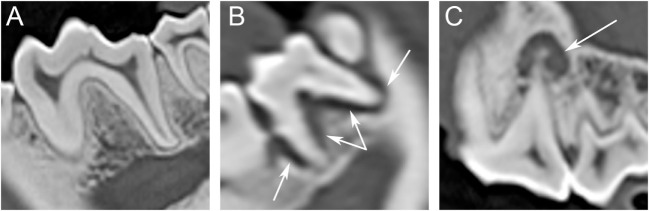
An agreement study was performed using 40 dogs that previously underwent intraoral radiography and CT during the same anesthetic episode. Images of each tooth were examined by two blinded observers for signs of periodontitis and/or endodontic disease. Agreement between imaging modalities and between observers was assessed using the Kappa statistic.
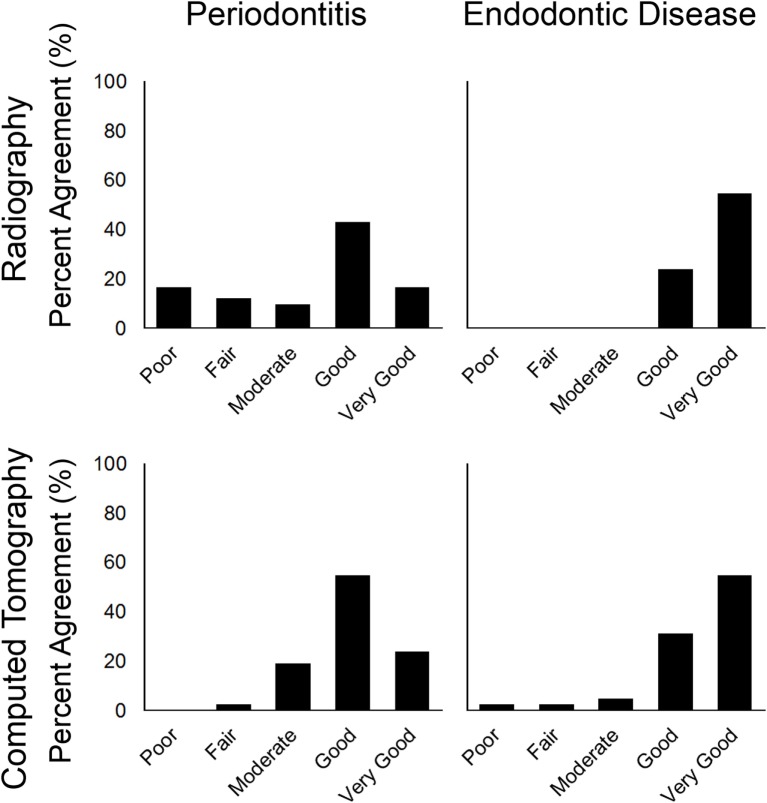
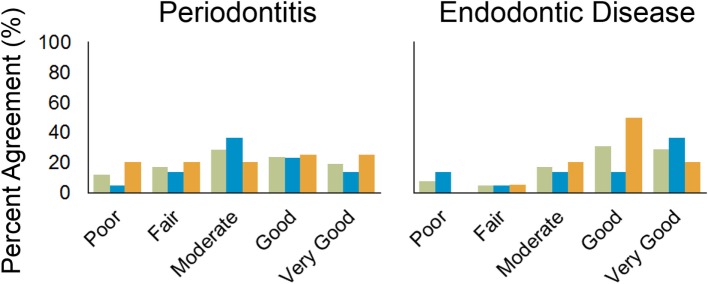
Agreement between modalities for detecting periodontitis in the maxillae ranged from poor to very good (κ 0.07-1.00) with 16/20 (80%) of the teeth having a score of moderate or better (κ ≥ 0.41). Agreement between modalities for detecting signs consistent with periodontitis in the mandibles ranged from poor to very good (κ 0.01-1.00) with 10/22 (45%) of the teeth having a score of good or better (κ ≥ 0.61); 50% of the disagreement was present in the incisors. Agreement between modalities for detecting signs consistent with endodontic disease in the whole mouth ranged from fair to very good (κ 0.21-1.00) with 30/42 (71%) of the teeth having a score of moderate or better (κ ≥ 0.41). Agreement between observers evaluating intraoral radiology ranged from poor to very good (κ 0.05-1) for detecting signs consistent with periodontitis and from fair to very good (κ 0.36-1) for detecting signs consistent with endodontic disease, in the whole mouth. Agreement between observers evaluating CT ranged from fair to very good (κ 0.35-1) for detecting signs consistent with periodontitis and from fair to very good (κ 0.36-1) for detecting signs consistent with endodontic disease, in the whole mouth.
Performing both CT and intraoral radiography may be unnecessary to detect signs consistent with periodontitis and endodontic disease in dogs based on the amount of agreement between modalities and observers when CT images are acquired and reconstructed in 0.5 or 1 mm slice thickness, except for diagnosing periodontitis in the mandibular incisors.
确定计算机断层扫描(CT)和口腔内放射摄影术是否可互换用于检测犬牙周炎和牙髓疾病的迹象。
使用 40 只先前在同一麻醉期内接受过口腔内放射摄影术和 CT 的犬进行了一项一致性研究。两名盲法观察者检查每颗牙齿的图像,以检测牙周炎和/或牙髓疾病的迹象。使用 Kappa 统计评估两种成像方式之间以及观察者之间的一致性。
上颌骨中,CT 与口腔内放射摄影术检测牙周炎的一致性范围从差到极好(κ 0.07-1.00),其中 16/20(80%)颗牙齿的评分中度或更好(κ≥0.41)。下颌骨中 CT 与口腔内放射摄影术检测与牙周炎一致的迹象的一致性范围从差到极好(κ 0.01-1.00),其中 10/22(45%)颗牙齿的评分较好或更好(κ≥0.61);50%的差异存在于切牙中。整个口腔中 CT 与口腔内放射摄影术检测与牙髓疾病一致的迹象的一致性范围从尚可到极好(κ 0.21-1.00),其中 30/42(71%)颗牙齿的评分中度或更好(κ≥0.41)。评估口腔内放射学的两名观察者之间的一致性范围为差到极好(κ 0.05-1),用于检测与牙周炎一致的迹象,以及尚可到极好(κ 0.36-1),用于检测与牙髓疾病一致的迹象,在整个口腔中。评估 CT 的两名观察者之间的一致性范围为差到极好(κ 0.35-1),用于检测与牙周炎一致的迹象,以及尚可到极好(κ 0.36-1),用于检测与牙髓疾病一致的迹象,在整个口腔中。
根据两种成像方式和观察者之间的一致性程度,在获得 CT 图像并以 0.5 或 1 毫米切片厚度重建时,除了诊断下颌切牙的牙周炎外,对犬进行 CT 和口腔内放射摄影术可能都没有必要来检测与牙周炎和牙髓疾病一致的迹象。