Bagis Nilsun, Kolsuz Mehmet Eray, Kursun Sebnem, Orhan Kaan
Faculty of Dentistry, Department of Periodontology, Ankara University, 06560, Besevler, Ankara, Turkey.
Faculty of Dentistry, Department of Dentomaxillofacial Radiology, Ankara University, 06560, Ankara, Turkey.
BMC Oral Health. 2015 May 28;15:64. doi: 10.1186/s12903-015-0046-2.
This study aimed to compare the diagnostic accuracy of cone-beam computed tomography (CBCT) unit with digital intraoral radiography technique for detecting periodontal defects.
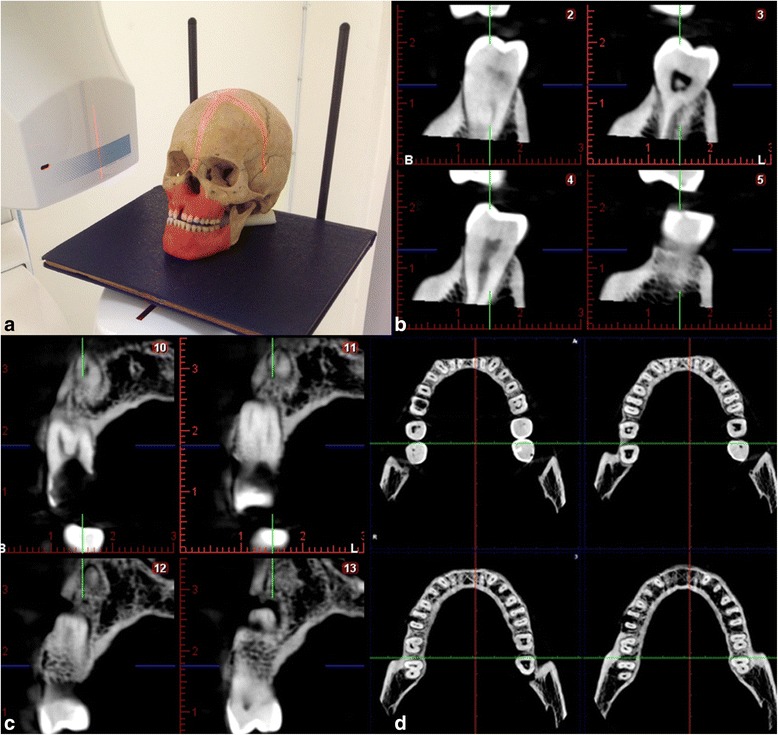
The study material comprised 12 dry skulls with maxilla and mandible. Artificial defects (dehiscence, tunnel, and fenestration) were created on anterior, premolar and molar teeth separately using burs. In total 14 dehiscences, 13 fenestrations, eight tunnel and 16 without periodontal defect were used in the study. These were randomly created on dry skulls. Each teeth with and without defects were images at various vertical angles using each of the following modalities: a Planmeca Promax Cone Beam CT and a Digora photostimulable phosphor plates. Specificity and sensitivity for assessing periodontal defects by each radiographic technique were calculated. Chi-square statistics were used to evaluate differences between modalities. Kappa statistics assessed the agreement between observers. Results were considered significant at P < 0.05.
The kappa values for inter-observer agreement between observers ranged between 0.78 and 0.96 for the CBCT, and 0.43 and 0.72 of intraoral images. The Kappa values for detecting defects on anterior teeth was the least, following premolar and molar teeth both CBCT and intraoral imaging.
CBCT has the highest sensitivity and diagnostic accuracy for detecting various periodontal defects among the radiographic modalities examined.
本研究旨在比较锥形束计算机断层扫描(CBCT)设备与数字化口腔内放射成像技术在检测牙周缺损方面的诊断准确性。
研究材料包括12个带有上颌骨和下颌骨的干燥颅骨。使用牙钻分别在前牙、前磨牙和磨牙上制造人工缺损(骨开裂、骨隧道和骨开窗)。本研究共使用了14处骨开裂、13处骨开窗、8处骨隧道以及16处无牙周缺损的样本。这些样本随机设置在干燥颅骨上。使用以下每种方式在不同垂直角度对有缺损和无缺损的牙齿进行成像:Planmeca Promax锥形束CT和Digora光激励荧光板。计算每种放射成像技术评估牙周缺损的特异性和敏感性。采用卡方统计评估不同方式之间的差异。kappa统计评估观察者之间的一致性。P < 0.05时结果被认为具有显著性。
CBCT观察者间一致性的kappa值在0.78至0.96之间,口腔内图像的kappa值在0.43至0.72之间。CBCT和口腔内成像检测前牙缺损的kappa值最低,其次是前磨牙和磨牙。
在本研究的放射成像方式中,CBCT检测各种牙周缺损的敏感性和诊断准确性最高。