Leng Junhong, Hay John, Liu Gongshu, Zhang Jing, Wang Jing, Liu Huihuan, Yang Xilin, Liu Jian
Tianjin Women and Children's Health Center, Tianjin, China.
Brock University, St. Catharines, Ontario, Canada.
BMJ Open. 2016 Sep 15;6(9):e010984. doi: 10.1136/bmjopen-2015-010984.
To examine whether maternal low blood glucose (BG), low body mass index (BMI) and small stature have a joint effect on the risk of delivery of a small-for-gestational age (SGA) infant.
Women from a perinatal cohort were followed up from receiving perinatal healthcare to giving birth.
Beichen District, Tianjin, China between June 2011 and October 2012.
1572 women aged 19-39 years with valid values of stature, BMI and BG level at gestational diabetes mellitus screening (gestational weeks 24-28), glucose challenge test <7.8 mmol/L and singleton birth (≥37 weeks' gestation).
SGA was defined as birth weight <10th centile for gender separated gestational age of Tianjin singletons.
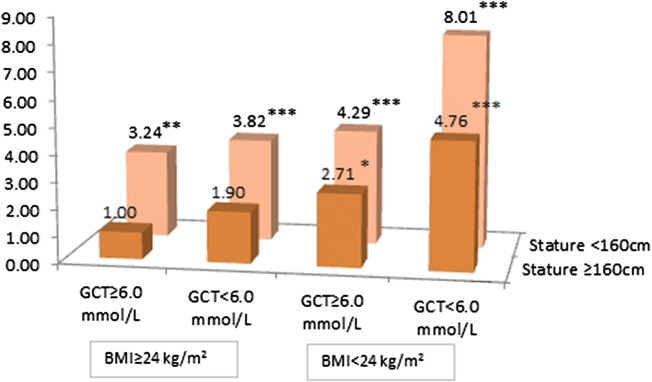
164 neonates (10.4%) were identified as SGA. From multiple logistic regression models, the ORs (95% CI) of delivery of SGA were 0.84 (0.72 to 0.98), 0.61 (0.49 to 0.74) and 0.64 (0.54 to 0.76) for every 1 SD increase in maternal BG, BMI and stature, respectively. When dichotomises, maternal BG (<6.0 vs ≥6.0 mmol/L), BMI (<24 vs ≥24 kg/m(2)) and stature (<160.0 vs ≥160.0 cm), those with BG, BMI and stature all in the lower categories had ∼8 times higher odds of delivering an SGA neonate (OR (95% CI) 8.01 (3.78 to 16.96)) relative to the reference that had BG, BMI and stature all in the high categories. The odds for an SGA delivery among women who had any 2 variables in the lower categories were ∼2-4 times higher.
Low maternal BG is associated with an increased risk of having an SGA infant. The risk of SGA is significantly increased when the mother is also short and has a low BMI. This may be a useful clinical tool to identify women at higher risk for having an SGA infant at delivery.
探讨母亲低血糖(BG)、低体重指数(BMI)和身材矮小是否对小于胎龄儿(SGA)分娩风险存在联合影响。
对围产期队列中的女性从接受围产期保健直至分娩进行随访。
2011年6月至2012年10月期间中国天津北辰区。
1572名年龄在19 - 39岁的女性,她们在妊娠期糖尿病筛查(孕24 - 28周)时身高、BMI和BG水平值有效,葡萄糖耐量试验<7.8 mmol/L且为单胎分娩(孕周≥37周)。
SGA定义为出生体重低于天津单胎按性别和孕周划分的第10百分位数。
164例新生儿(10.4%)被确定为SGA。在多个逻辑回归模型中,母亲BG、BMI和身高每增加1个标准差,SGA分娩的比值比(OR)(95%可信区间)分别为0.84(0.72至0.98)、0.61(0.49至0.74)和0.64(0.54至0.76)。当进行二分法时,母亲BG(<6.0 vs≥6.0 mmol/L)、BMI(<24 vs≥24 kg/m²)和身高(<160.0 vs≥160.0 cm),BG、BMI和身高均处于较低类别者分娩SGA新生儿的几率比(OR)(95%可信区间)为8.01(3.78至16.96),相对于BG、BMI和身高均处于较高类别的参考组。任何两个变量处于较低类别的女性中SGA分娩的几率高约2 - 4倍。
母亲BG低与SGA婴儿出生风险增加有关。当母亲身材矮小且BMI低时,SGA风险显著增加。这可能是识别分娩时SGA婴儿风险较高女性的有用临床工具。