Bustamante Valles Karla, Montes Sandra, Madrigal Maria de Jesus, Burciaga Adan, Martínez María Elena, Johnson Michelle J
Orthopaedic and Rehabilitation Engineering Center (OREC), Marquette University, Milwaukee, WI, USA.
Biomedical Engineering, ITESM, Campus Chihuahua, Chihuahua, Chihuahua, Mexico.
J Neuroeng Rehabil. 2016 Sep 15;13(1):83. doi: 10.1186/s12984-016-0190-1.
Stroke rehabilitation in low- and middle-income countries, such as Mexico, is often hampered by lack of clinical resources and funding. To provide a cost-effective solution for comprehensive post-stroke rehabilitation that can alleviate the need for one-on-one physical or occupational therapy, in lower and upper extremities, we proposed and implemented a technology-assisted rehabilitation gymnasium in Chihuahua, Mexico. The Gymnasium for Robotic Rehabilitation (Robot Gym) consisted of low- and high-tech systems for upper and lower limb rehabilitation. Our hypothesis is that the Robot Gym can provide a cost- and labor-efficient alternative for post-stroke rehabilitation, while being more or as effective as traditional physical and occupational therapy approaches.
A typical group of stroke patients was randomly allocated to an intervention (n = 10) or a control group (n = 10). The intervention group received rehabilitation using the devices in the Robot Gym, whereas the control group (n = 10) received time-matched standard care. All of the study subjects were subjected to 24 two-hour therapy sessions over a period of 6 to 8 weeks. Several clinical assessments tests for upper and lower extremities were used to evaluate motor function pre- and post-intervention. A cost analysis was done to compare the cost effectiveness for both therapies.
No significant differences were observed when comparing the results of the pre-intervention Mini-mental, Brunnstrom Test, and Geriatric Depression Scale Test, showing that both groups were functionally similar prior to the intervention. Although, both training groups were functionally equivalent, they had a significant age difference. The results of all of the upper extremity tests showed an improvement in function in both groups with no statistically significant differences between the groups. The Fugl-Meyer and the 10 Meters Walk lower extremity tests showed greater improvement in the intervention group compared to the control group. On the Time Up and Go Test, no statistically significant differences were observed pre- and post-intervention when comparing the control and the intervention groups. For the 6 Minute Walk Test, both groups presented a statistically significant difference pre- and post-intervention, showing progress in their performance. The robot gym therapy was more cost-effective than the traditional one-to-one therapy used during this study in that it enabled therapist to train up to 1.5 to 6 times more patients for the approximately same cost in the long term.
The results of this study showed that the patients that received therapy using the Robot Gym had enhanced functionality in the upper extremity tests similar to patients in the control group. In the lower extremity tests, the intervention patients showed more improvement than those subjected to traditional therapy. These results support that the Robot Gym can be as effective as traditional therapy for stroke patients, presenting a more cost- and labor-efficient option for countries with scarce clinical resources and funding.
ISRCTN98578807 .
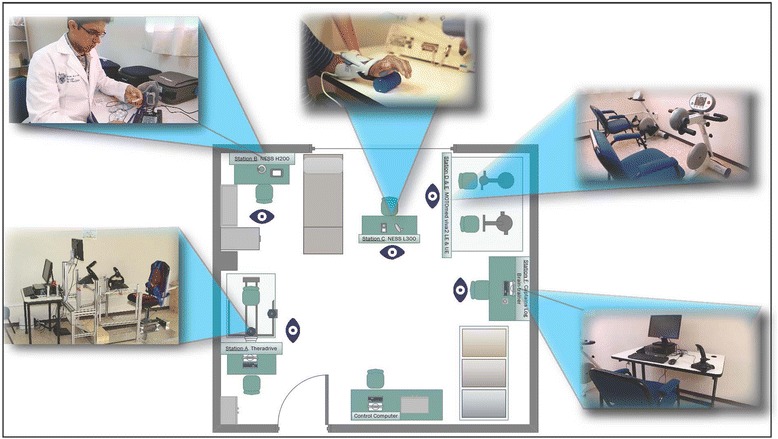
在墨西哥等低收入和中等收入国家,中风康复常常因缺乏临床资源和资金而受阻。为了提供一种具有成本效益的全面中风后康复解决方案,以减少一对一的上肢和下肢物理治疗或职业治疗需求,我们在墨西哥奇瓦瓦州提出并实施了一个技术辅助康复健身房。机器人康复健身房(Robot Gym)由用于上肢和下肢康复的高科技和低科技系统组成。我们的假设是,Robot Gym可以为中风后康复提供一种经济高效的替代方案,同时与传统的物理和职业治疗方法一样有效或更有效。
一组典型的中风患者被随机分配到干预组(n = 10)或对照组(n = 10)。干预组使用Robot Gym中的设备进行康复,而对照组(n = 10)接受时间匹配的标准护理。所有研究对象在6至8周的时间内接受24次每次两小时的治疗。使用几种上肢和下肢的临床评估测试来评估干预前后的运动功能。进行了成本分析以比较两种疗法的成本效益。
在比较干预前的简易精神状态检查表、布伦斯特伦测试和老年抑郁量表测试结果时,未观察到显著差异,表明两组在干预前功能相似。虽然,两个训练组在功能上相当,但他们在年龄上有显著差异。所有上肢测试的结果显示两组的功能均有改善,组间无统计学显著差异。与对照组相比,Fugl-Meyer测试和10米步行下肢测试显示干预组有更大的改善。在计时起立行走测试中,比较对照组和干预组干预前后未观察到统计学显著差异。对于6分钟步行测试,两组在干预前后均呈现出统计学显著差异,表明其表现有所进步。从长远来看,机器人健身房疗法比本研究中使用的传统一对一疗法更具成本效益,因为它能使治疗师以大致相同的成本培训多达1.5至6倍的患者。
本研究结果表明,使用Robot Gym接受治疗的患者在上肢测试中的功能增强,与对照组患者相似。在下肢测试中,干预组患者比接受传统治疗的患者改善更大。这些结果支持Robot Gym对中风患者可以与传统疗法一样有效,为临床资源和资金稀缺的国家提供了一种更具成本效益和劳动力效率的选择。
ISRCTN98578807 。

