McAlearney Ann Scheck, Walker Daniel M, Livaudais-Toman Jennifer, Parides Michael, Bickell Nina A
Department of Family Medicine, College of Medicine, The Ohio State University, Columbus, OH, USA.
Department of Health Evidence and Policy, Icahn School of Medicine at Mount Sinai, New York, NY, USA.
SAGE Open Med. 2016 Sep 1;4:2050312116666215. doi: 10.1177/2050312116666215. eCollection 2016.
Implementation of interventions designed to improve the quality of medical care often proceeds differently from what is planned. Improving existing conceptual models to better understand the sources of these differences can help future projects avoid these pitfalls and achieve desired effectiveness. To inform an adaptation of an existing theoretical model, we examined unanticipated changes that occurred in an intervention designed to improve reporting of adjuvant therapies for breast cancer patients at a large, urban academic medical center.
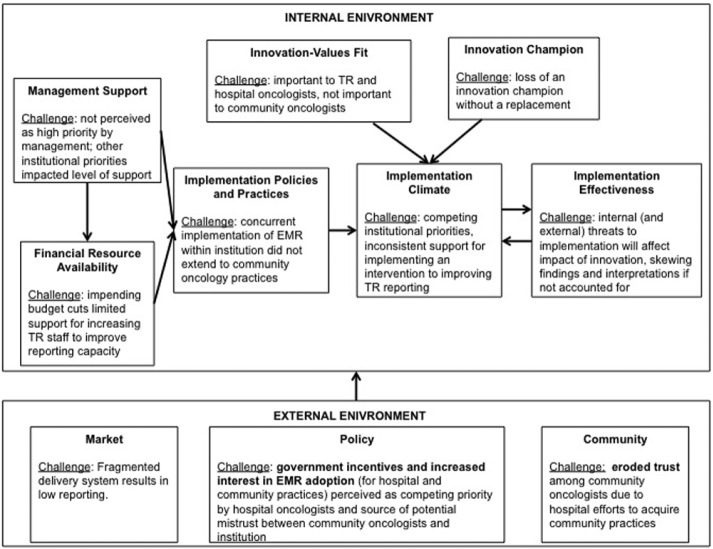
Guided by the complex innovation implementation conceptual framework, our study team observed and evaluated the implementation of an intervention designed to improve reporting to a tumor registry. Findings were assessed against the conceptual framework to identify boundary conditions and modifications that could improve implementation effectiveness.
The intervention successfully increased identification of the managing medical oncologist and treatment reporting. During implementation, however, unexpected external challenges including hospital acquisitions of community practices and practices' responses to government incentives to purchase electronic medical record systems led to unanticipated changes and associated threats to implementation. We present a revised conceptual model that incorporates the sources of these unanticipated challenges.
This report of our experience highlights the importance of monitoring implementation over time and accounting for changes that affect both implementation and measurement of intervention impact. In this article, we use our study to examine the challenges of implementation research in health care, and our experience can help future implementation efforts.
旨在提高医疗质量的干预措施的实施情况往往与计划不同。改进现有的概念模型以更好地理解这些差异的根源,有助于未来的项目避免这些陷阱并实现预期效果。为了对现有的理论模型进行调整,我们研究了在一家大型城市学术医疗中心开展的旨在改善乳腺癌患者辅助治疗报告情况的干预措施中出现的意外变化。
在复杂创新实施概念框架的指导下,我们的研究团队观察并评估了一项旨在改善向肿瘤登记处报告情况的干预措施的实施情况。根据概念框架对研究结果进行评估,以确定能够提高实施效果的边界条件和调整措施。
该干预措施成功提高了负责治疗的肿瘤内科医生的识别率和治疗报告率。然而,在实施过程中,意外的外部挑战包括医院收购社区医疗机构以及医疗机构对政府购买电子病历系统激励措施的反应,导致了意外变化以及对实施的相关威胁。我们提出了一个修订后的概念模型,纳入了这些意外挑战的根源。
我们的经验报告强调了长期监测实施情况以及考虑影响实施和干预效果衡量的变化的重要性。在本文中,我们利用我们的研究来审视医疗保健领域实施研究的挑战,我们的经验可为未来的实施工作提供帮助。