Shenoy Anukul T, Orihuela Carlos J
Pneumonia (Nathan). 2016;8. doi: 10.1186/s41479-016-0007-9. Epub 2016 Jun 3.
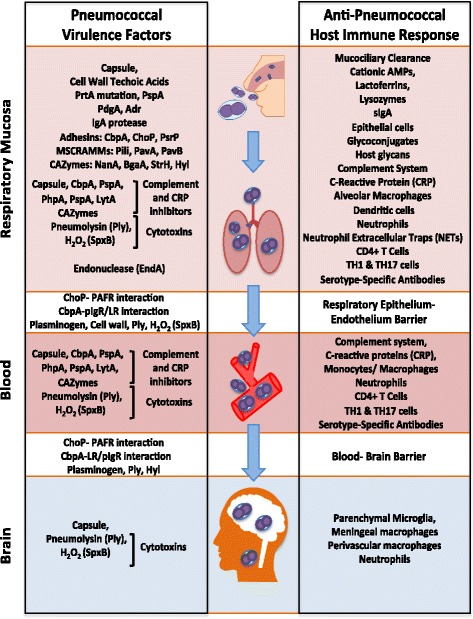
is an opportunistic pathogen globally associated with significant morbidity and mortality. It is capable of causing a wide range of diseases including sinusitis, conjunctivitis, otitis media, pneumonia, bacteraemia, sepsis, and meningitis. While its capsular polysaccharide is indispensible for invasive disease, and opsonising antibodies against the capsule are the basis for the current vaccines, a long history of biomedical research indicates that other components of this Gram-positive bacterium are also critical for virulence. Herein we review the contribution of pneumococcal virulence determinants to survival and persistence in the context of distinct anatomical sites. We discuss how these determinants allow the pneumococcus to evade mucociliary clearance during colonisation, establish lower respiratory tract infection, resist complement deposition and opsonophagocytosis in the bloodstream, and invade secondary tissues such as the central nervous system leading to meningitis. We do so in a manner that highlights both the critical role of the capsular polysaccharide and the accompanying and necessary protein determinants. Understanding the complex interplay between host and pathogen is necessary to find new ways to prevent pneumococcal infection. This review is an attempt to do so with consideration for the latest research findings.
是一种在全球范围内与严重发病和死亡相关的机会致病菌。它能够引发多种疾病,包括鼻窦炎、结膜炎、中耳炎、肺炎、菌血症、败血症和脑膜炎。虽然其荚膜多糖对于侵袭性疾病不可或缺,并且针对荚膜的调理抗体是当前疫苗的基础,但长期的生物医学研究表明,这种革兰氏阳性细菌的其他成分对于毒力也至关重要。在此,我们综述肺炎球菌毒力决定因素在不同解剖部位背景下对生存和持续存在的贡献。我们讨论这些决定因素如何使肺炎球菌在定植期间逃避黏液纤毛清除、引发下呼吸道感染、抵抗血液中的补体沉积和调理吞噬作用,以及侵入诸如中枢神经系统等继发组织导致脑膜炎。我们以突出荚膜多糖的关键作用以及伴随的必要蛋白质决定因素的方式进行阐述。了解宿主与病原体之间的复杂相互作用对于寻找预防肺炎球菌感染的新方法至关重要。本综述旨在结合最新研究结果进行这方面的探讨。