Pisani Cinzia, Onori Annalisa, Gabanella Francesca, Delle Monache Francesca, Borreca Antonella, Ammassari-Teule Martine, Fanciulli Maurizio, Di Certo Maria Grazia, Passananti Claudio, Corbi Nicoletta
CNR-Institute of Molecular Biology and Pathology, Department of Molecular Medicine, Sapienza University, Viale Regina Elena 291, 00161, Rome, Italy.
CNR -Institute of Cell Biology and Neurobiology, Rome, Italy.
J Exp Clin Cancer Res. 2016 Sep 17;35(1):146. doi: 10.1186/s13046-016-0424-x.
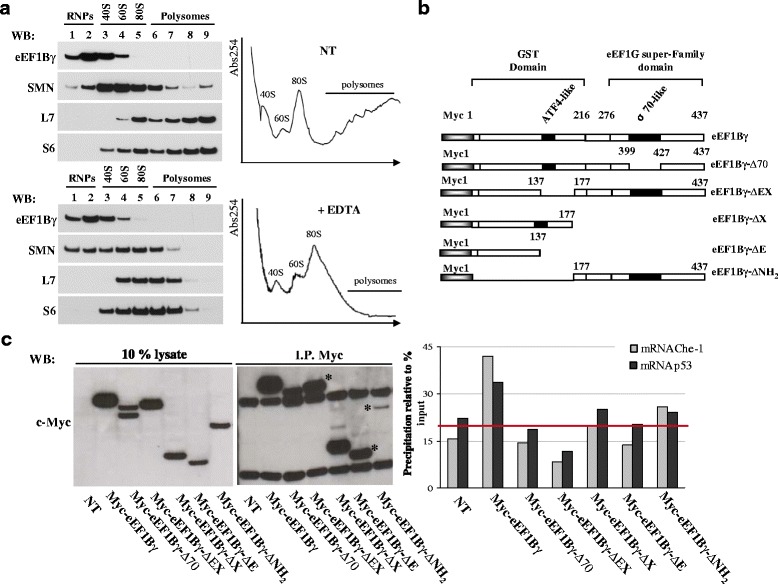
We have previously shown that the eukaryotic elongation factor subunit 1B gamma (eEF1Bγ) interacts with the RNA polymerase II (pol II) alpha-like subunit "C" (POLR2C), alone or complexed, in the pol II enzyme. Moreover, we demonstrated that eEF1Bγ binds the promoter region and the 3' UTR mRNA of the vimentin gene. These events contribute to localize the vimentin transcript and consequentially its translation, promoting a proper mitochondrial network.
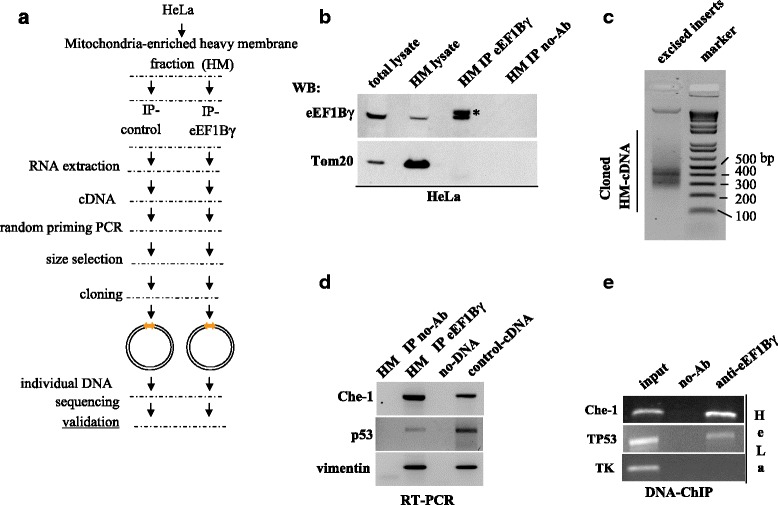
With the intent of identifying additional transcripts that complex with the eEF1Bγ protein, we performed a series of ribonucleoprotein immunoprecipitation (RIP) assays using a mitochondria-enriched heavy membrane (HM) fraction.
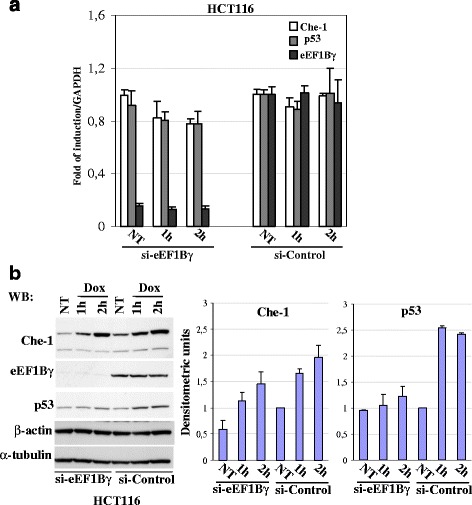
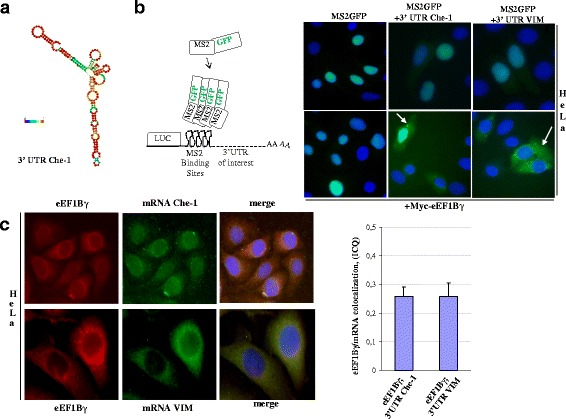
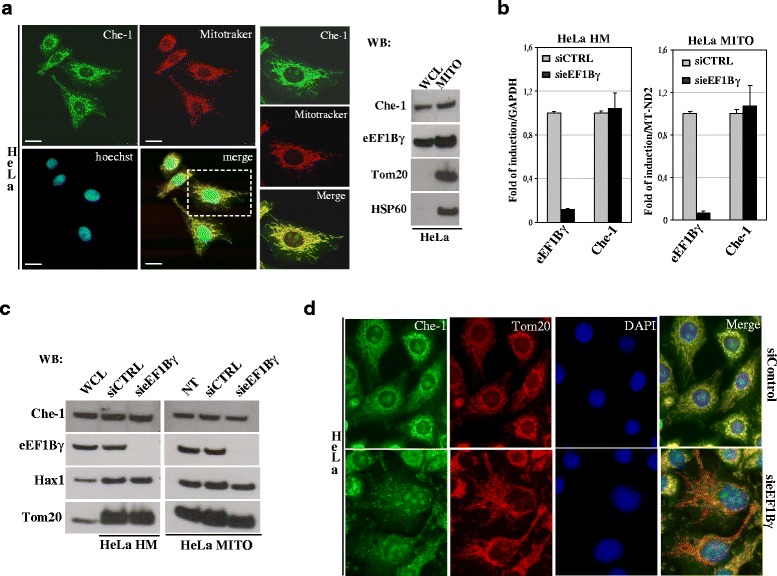
Among the eEF1Bγ complexed transcripts, we found the mRNA encoding the Che-1/AATF multifunctional protein. As reported by other research groups, we found the tumor suppressor p53 transcript complexed with the eEF1Bγ protein. Here, we show for the first time that eEF1Bγ binds not only Che-1 and p53 transcripts but also their promoters. Remarkably, we demonstrate that both the Che-1 transcript and its translated product localize also to the mitochondria and that eEF1Bγ depletion strongly perturbs the mitochondrial network and the correct localization of Che-1. In a doxorubicin (Dox)-induced DNA damage assay we show that eEF1Bγ depletion significantly decreases p53 protein accumulation and slightly impacts on Che-1 accumulation. Importantly, Che-1 and p53 proteins are components of the DNA damage response machinery that maintains genome integrity and prevents tumorigenesis.
Our data support the notion that eEF1Bγ, besides its canonical role in translation, is an RNA-binding protein and a key player in cellular stress responses. We suggest for eEF1Bγ a role as primordial transcription/translation factor that links fundamental steps from transcription control to local translation.
我们之前已经表明,真核生物延伸因子亚基1Bγ(eEF1Bγ)在RNA聚合酶II(pol II)酶中单独或复合存在时,会与RNA聚合酶II的α样亚基“C”(POLR2C)相互作用。此外,我们证明了eEF1Bγ结合波形蛋白基因的启动子区域和3'UTR mRNA。这些事件有助于波形蛋白转录本的定位以及随后的翻译,促进适当的线粒体网络形成。
为了鉴定与eEF1Bγ蛋白复合的其他转录本,我们使用富含线粒体的重膜(HM)组分进行了一系列核糖核蛋白免疫沉淀(RIP)实验。
在与eEF1Bγ复合的转录本中,我们发现了编码Che-1/AATF多功能蛋白的mRNA。正如其他研究小组所报道的,我们发现肿瘤抑制因子p53转录本与eEF1Bγ蛋白复合在一起。在此,我们首次表明eEF1Bγ不仅结合Che-1和p53转录本,还结合它们的启动子。值得注意的是,我们证明Che-1转录本及其翻译产物也定位于线粒体,并且eEF1Bγ的缺失强烈扰乱线粒体网络以及Che-1的正确定位。在阿霉素(Dox)诱导的DNA损伤实验中,我们表明eEF1Bγ的缺失显著降低p53蛋白的积累,并对Che-1的积累有轻微影响。重要的是,Che-1和p53蛋白是维持基因组完整性和预防肿瘤发生的DNA损伤反应机制的组成部分。
我们的数据支持这样一种观点,即eEF1Bγ除了在翻译中具有经典作用外,还是一种RNA结合蛋白,并且是细胞应激反应中的关键参与者。我们认为eEF1Bγ是一种原始转录/翻译因子,它将从转录控制到局部翻译的基本步骤联系起来。