Meyle Kathrine Damm, Gamborg Michael, Hölmich Lisbet Rosenkrantz, Baker Jennifer Lyn
Institute of Preventive Medicine, Bispebjerg and Frederiksberg Hospital, The Capital Region, Copenhagen, Denmark.
Department of Plastic Surgery, University Hospital Herlev, Herlev, Denmark.
Eur J Cancer. 2016 Nov;67:99-105. doi: 10.1016/j.ejca.2016.08.002. Epub 2016 Sep 16.
Melanoma subtypes have different aetiological characteristics. Child height is positively associated with adult melanoma; however, a clarification of associations with specific melanoma variants is necessary for an improved understanding of risk factors underlying the histologic entities. This study investigated associations between childhood height and future development of cutaneous melanoma variants.
A cohort study of 316,193 individuals from the Copenhagen School Health Records Register, with measured heights at ages 7-13 years who were born from 1930 to 1989. Melanoma cases were identified via linkage to the national Danish Cancer Registry and subdivided into subtypes. Cox proportional hazards regressions were performed.
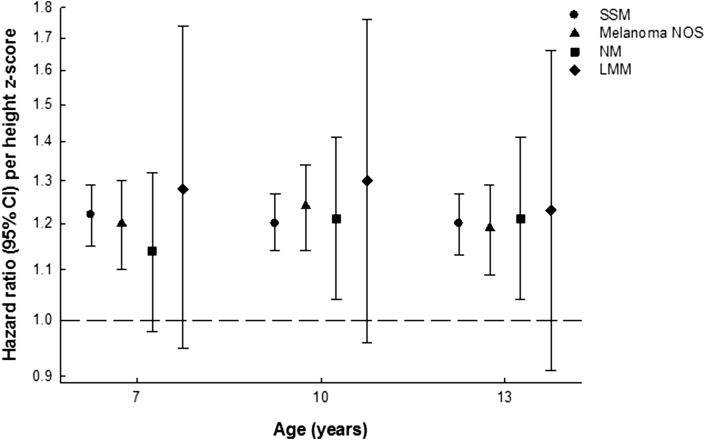
A total of 2223 cases of melanoma distributed as 60% superficial spreading melanoma (SSM), 27.5% melanoma not otherwise specified (NOS), 8.5% nodular melanoma (NM), and 2% lentigo maligna melanoma (LMM). The remaining rare melanoma forms were not analysed. Childhood height was positively and significantly associated with SSM, melanoma NOS, and NM, but not LMM, in adulthood. Per height z-score at age 13 years, the hazard ratios were 1.20 (95% confidence intervals [CI]: 1.13-1.27) for SSM, 1.19 (95% CI: 1.09-1.29) for melanoma NOS, and 1.21 (95% CI: 1.04-1.41) for NM. Further, growth patterns were linked to the melanoma variants with persistently tall children having an increased risk of developing SSM, melanoma NOS, or NM.
Childhood height is positively associated with the majority of the melanoma variants. These results suggest that the underlying processes contributing to childhood height and growth patterns interconnect early-life events with the predisposition to melanomagenesis in adulthood.
黑色素瘤亚型具有不同的病因学特征。儿童身高与成人黑色素瘤呈正相关;然而,为了更好地理解这些组织学实体潜在的危险因素,有必要明确与特定黑色素瘤变体的关联。本研究调查了儿童身高与皮肤黑色素瘤变体未来发展之间的关联。
对哥本哈根学校健康记录登记处的316,193名个体进行队列研究,这些个体在1930年至1989年出生,7至13岁时测量了身高。通过与丹麦国家癌症登记处的链接识别黑色素瘤病例,并将其细分为不同亚型。进行了Cox比例风险回归分析。
共2223例黑色素瘤病例,其中60%为浅表扩散性黑色素瘤(SSM),27.5%为未另行指定的黑色素瘤(NOS),8.5%为结节性黑色素瘤(NM),2%为恶性雀斑样痣黑色素瘤(LMM)。其余罕见的黑色素瘤形式未进行分析。儿童期身高与成年期的SSM、NOS黑色素瘤和NM呈显著正相关,但与LMM无关。13岁时每身高z评分,SSM的风险比为1.20(95%置信区间[CI]:1.13 - 1.27),NOS黑色素瘤为1.19(95%CI:1.09 - 1.29),NM为1.21(95%CI:1.04 - 1.41)。此外,生长模式与黑色素瘤变体相关,持续较高的儿童患SSM、NOS黑色素瘤或NM的风险增加。
儿童身高与大多数黑色素瘤变体呈正相关。这些结果表明,导致儿童身高和生长模式的潜在过程将早期生活事件与成年期黑色素瘤发生的易感性联系起来。