Svendsen Julie Lillebostad, Osnes Berge, Binder Per-Einar, Dundas Ingrid, Visted Endre, Nordby Helge, Schanche Elisabeth, Sørensen Lin
Department of Biological and Medical Psychology, Faculty of Psychology, University of Bergen, Jonas Lies vei 91, Bergen, 5009 Norway ; Bjørgvin District Psychiatic Centre, Knarvik, Haukeland University Hospital, Kvassnesvegen 63, 5914 Isdalstø, Norway.
Department of Biological and Medical Psychology, Faculty of Psychology, University of Bergen, Jonas Lies vei 91, Bergen, 5009 Norway.
Mindfulness (N Y). 2016;7(5):1103-1113. doi: 10.1007/s12671-016-0549-1. Epub 2016 Jun 2.
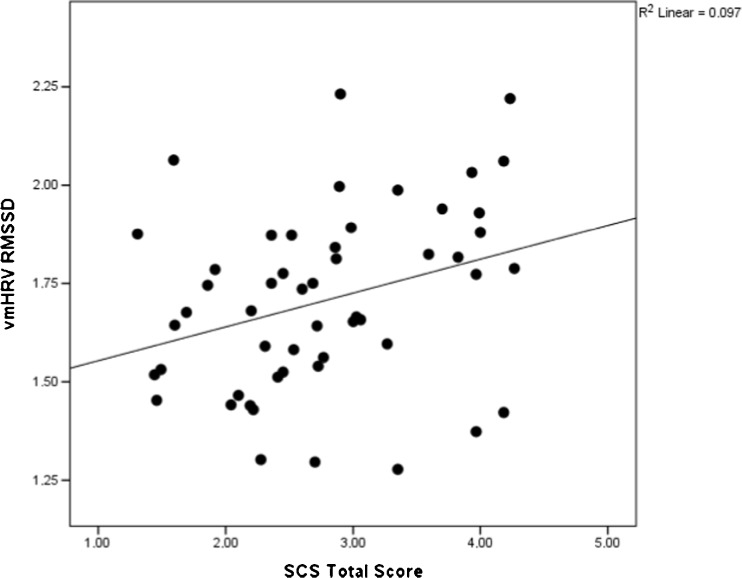
Converging evidence shows a positive effect of self-compassion on self-reported well-being and mental health. However, few studies have examined the relation between self-compassion and psychophysiological measures. In the present study, we therefore examined the relation between trait self-compassion and vagally mediated heart rate variability (vmHRV) in 53 students (39 female, mean age = 23.63). Trait self-compassion was assessed using the Self-Compassion Scale, and resting vmHRV was measured during a 5-min ECG baseline period. We hypothesized that higher levels of trait self-compassion would predict higher levels of resting vmHRV. Controlling for potential covariates (including age, gender, and BMI), the results confirmed our hypotheses, showing that higher levels of trait self-compassion predicted higher vmHRV. These results were validated with a 24-h measure of vmHRV, acquired from a subsample of the participants ( = 26, 16 female, mean age = 23.85), confirming the positive correlation between high trait self-compassion and higher vmHRV. The relation between trait self-compassion, vmHRV, self-reported trait anxiety (the trait scale of the State-Trait Anxiety Inventory; STAI) and self-reported rumination (the Rumination subscale of the Rumination-Reflection Questionnaire; RRQ-Rum) was also investigated. Higher levels of trait anxiety and rumination were highly correlated with low levels of trait self-compassion. Trait anxiety, but not rumination, correlated marginally significantly with the level of vmHRV. The findings of the present study indicate that trait self-compassion predicts a better ability to physiologically and psychologically adapt emotional responses. Possible implications and limitations of the study are discussed.
越来越多的证据表明,自我同情对自我报告的幸福感和心理健康有积极影响。然而,很少有研究探讨自我同情与心理生理指标之间的关系。因此,在本研究中,我们调查了53名学生(39名女性,平均年龄 = 23.63岁)的特质自我同情与迷走神经介导的心率变异性(vmHRV)之间的关系。使用自我同情量表评估特质自我同情,并在5分钟的心电图基线期测量静息vmHRV。我们假设,较高水平的特质自我同情将预测较高水平的静息vmHRV。在控制潜在协变量(包括年龄、性别和BMI)后,结果证实了我们的假设,表明较高水平的特质自我同情预测了较高的vmHRV。这些结果通过对参与者子样本(n = 26,16名女性,平均年龄 = 23.85岁)进行的24小时vmHRV测量得到验证,证实了高特质自我同情与较高vmHRV之间的正相关。我们还研究了特质自我同情、vmHRV、自我报告的特质焦虑(状态-特质焦虑量表的特质量表;STAI)和自我报告的沉思(沉思-反思问卷的沉思子量表;RRQ-Rum)之间的关系。较高水平的特质焦虑和沉思与较低水平的特质自我同情高度相关。特质焦虑与vmHRV水平有微弱的显著相关性,但沉思与vmHRV水平无显著相关性。本研究结果表明,特质自我同情预示着在生理和心理上更好地适应情绪反应的能力。讨论了该研究可能的意义和局限性。