Zhai Yuanmei, Zhang Jing, Wang Hui, Lu Wei, Liu Sihong, Yu Yehua, Weng Wei, Ding Zhiyong, Zhu Qi, Shi Jun
Department of Hematology, Shanghai Jiao Tong University Affiliated Sixth People's Hospital, Shanghai, 200233, China.
Department of Hematology, Tongren Hospital, Shanghai Jiao Tong University School of Medicine, Shanghai, 200336, China.
J Exp Clin Cancer Res. 2016 Sep 19;35(1):147. doi: 10.1186/s13046-016-0405-0.
Chemo-resistance is still a major obstacle in efforts to overcome acute myeloid leukemia (AML). An emerging concept has proposed that interactions between the bone marrow (BM) microenvironment and leukemia cells reduce the sensitivity of the leukemia cells to chemotherapy. As an important element of the tumor microenvironment, the cancer-associated fibroblasts (CAFs) are considered to be activated modulators in the chemo-resistance of many solid tumors. But their contribution to AML has yet to be fully understood. Here we report a critical role for CAFs which were thought to be a survival and chemo-protective factor for leukemia cells.
A retrospective study on the BM biopsies from 63 primary AML patients and 59 normal controls was applied to quantitative analysis the fiber stroma in the BM sections. Then immunohistochemistry on the BM biopsies were used to detect the makers of the CAFs. Their effects on drug resistance of leukemia cells were further to be assessed by co-cultured experiments in vitro. Moreover, the possible mechanisms involved in CAF-mediated chemo-protection of AML cells was investigated by antibody neutralization and siRNA knockdown experiments, with particular emphasis on the role of GDF15.
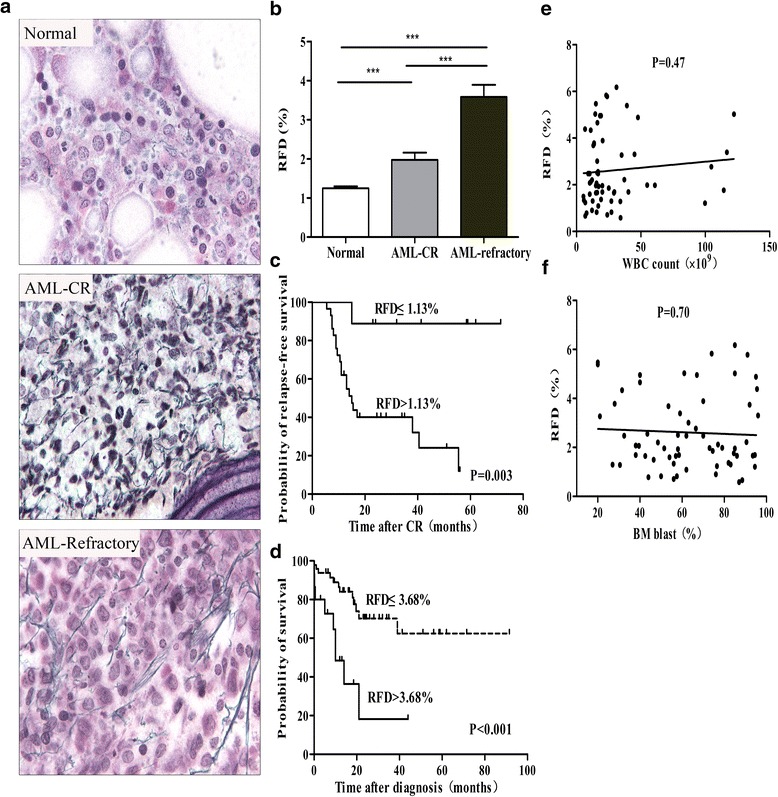
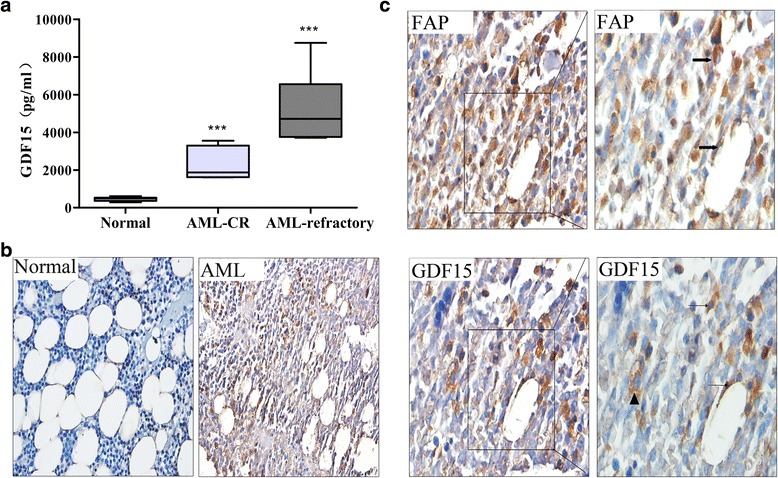
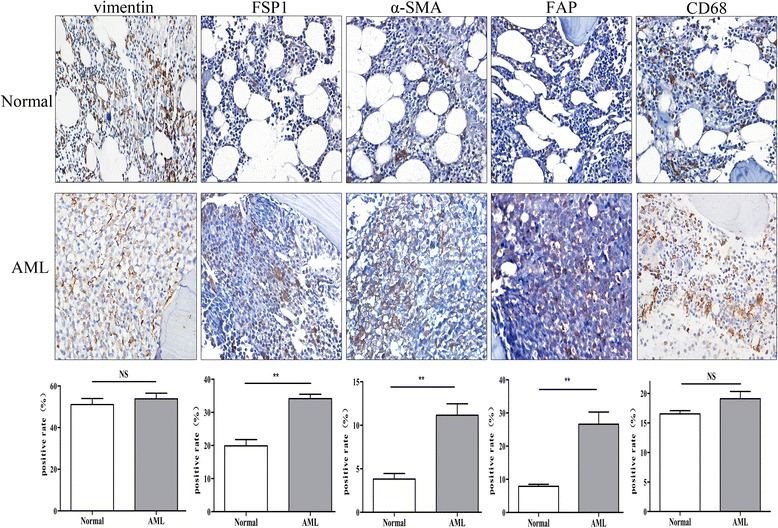
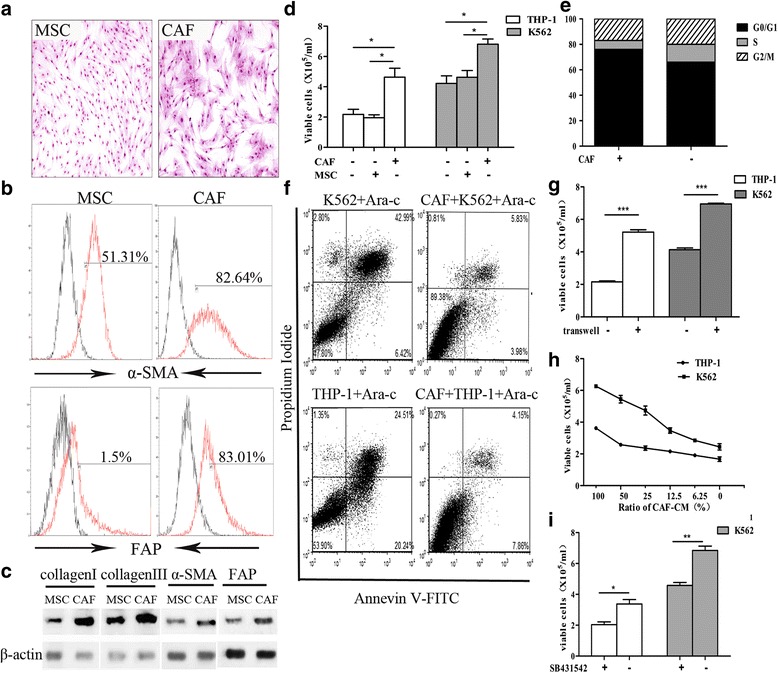
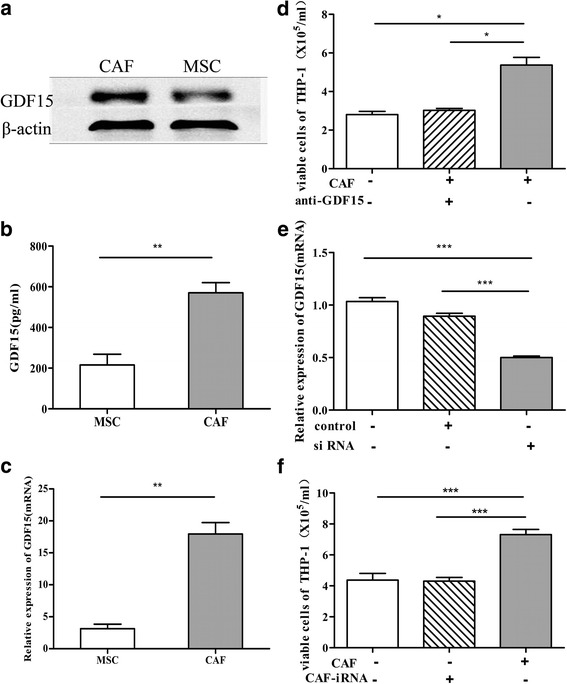
In our study, excessive reticular fibers in the BM led to higher frequency of relapse and mortality in primary AML patients, bringing the inspiration for us to investigate the functional roles of the fiber-devied cells. We declared that the CAF cells which expressed higher levels of FSP1, α-SMA or FAP protein were widely distributed in the marrow of AML. Then in vitro co-cultured tests showed that these CAFs could protect leukemia cell lines (THP-1/K562) from chemotherapy. Interestingly, this effect could be decreased by either treatment with a neutralizing anti-GDF15 antibody or knockdown GDF15 (with siGDF15) in CAFs. Furthermore, we also confirmed that the GDF15(+) cells mainly co-localized with FAP, which was identified as the typical phenotype of CAFs in the BM stroma.
We firstly demonstrate that the functional CAFs are widespread within the BM of AML patients and should be a critical chemo-protective element for AML cells by producing amount of GDF15.
化疗耐药仍然是克服急性髓系白血病(AML)的主要障碍。一个新出现的概念提出,骨髓(BM)微环境与白血病细胞之间的相互作用会降低白血病细胞对化疗的敏感性。作为肿瘤微环境的重要组成部分,癌症相关成纤维细胞(CAFs)被认为是许多实体瘤化疗耐药中的激活调节因子。但其对AML的作用尚未完全明确。在此,我们报告了CAFs的关键作用,其被认为是白血病细胞的生存和化疗保护因子。
对63例原发性AML患者和59例正常对照的骨髓活检进行回顾性研究,以定量分析骨髓切片中的纤维基质。然后对骨髓活检进行免疫组织化学检测CAFs的标志物。通过体外共培养实验进一步评估它们对白血病细胞耐药性的影响。此外,通过抗体中和和siRNA敲低实验研究CAF介导的AML细胞化疗保护的可能机制,特别强调生长分化因子15(GDF15)的作用。
在我们的研究中,骨髓中过多的网状纤维导致原发性AML患者更高的复发率和死亡率,这促使我们研究纤维衍生细胞的功能作用。我们发现,表达较高水平的FSP1、α -平滑肌肌动蛋白(α - SMA)或成纤维细胞活化蛋白(FAP)的CAF细胞广泛分布于AML患者的骨髓中。然后体外共培养试验表明,这些CAFs可以保护白血病细胞系(THP - 1/K562)免受化疗。有趣的是,用中和抗GDF15抗体处理或在CAFs中敲低GDF15(用siGDF15)均可降低这种作用。此外,我们还证实GDF15(+)细胞主要与FAP共定位,FAP被确定为骨髓基质中CAFs的典型表型。
我们首次证明功能性CAFs广泛存在于AML患者的骨髓中,并且通过产生大量GDF15应该是AML细胞关键的化疗保护元件。