Zeller Meidell Krystin, Robinson Ryan, Vieira-de-Abreu Adriana, Gormley Adam J, Ghandehari Hamidreza, W Grainger David, A Campbell Robert
Department of Pharmaceutics and Pharmaceutical Chemistry, Health Sciences, University of Utah, Salt Lake City, Utah, 84112.
Department of Bioengineering, University of Utah, Salt Lake City, Utah, 84112.
J Biomed Mater Res A. 2017 Jan;105(1):209-217. doi: 10.1002/jbm.a.35902. Epub 2016 Oct 11.
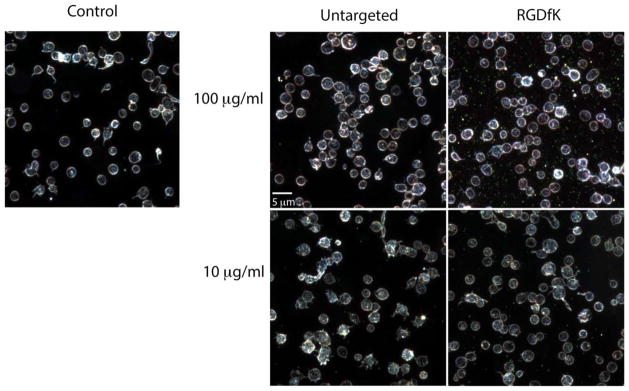
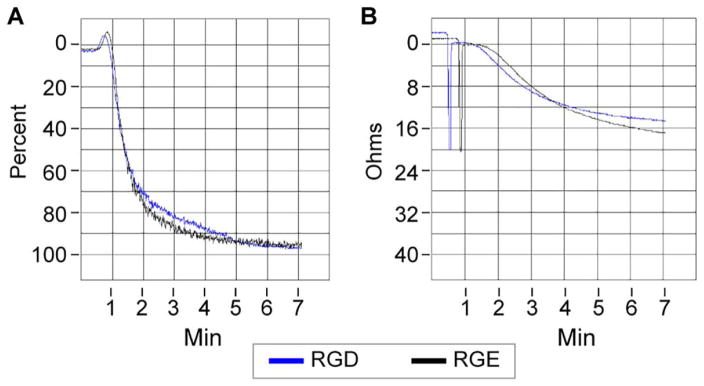
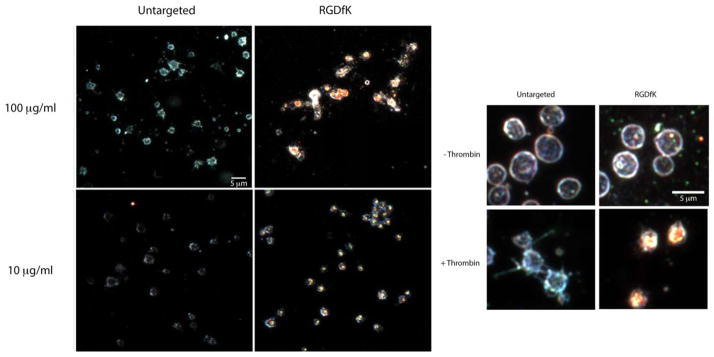
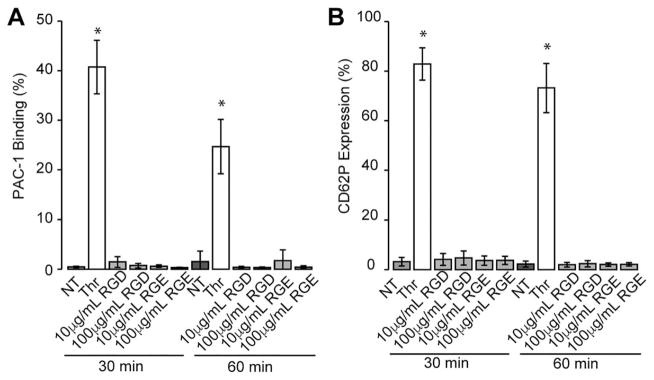
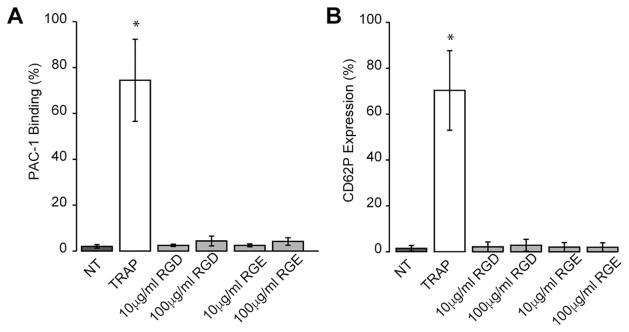
Integrin-targeting peptide RGDfK-labeled gold nanorods (GNR) seek to improve hyperthermia targeted to solid tumors by exploiting the known up-regulation of integrin αvβ3 cell membrane proteins on solid tumor vasculature surfaces. Tumor binding specificity might be expected since surrounding tissues and endothelial cells have limited numbers of these receptors. However, RGD peptide binding to many proteins is promiscuous, with known affinity to several families of cell integrin receptors, and also possible binding to platelets after intravenous infusion via a different integrin receptor, αIIbβ3, on platelets. Binding of RGDfK-targeted GNR could considerably impact platelet function, ultimately leading to increased risk of bleeding or thrombosis depending on the degree of interaction. We sought to determine if RGDfK-labeled GNR could interact with platelets and alter platelet function. Targeted and untargeted nanorods exhibited little interaction with resting platelets in platelet rich plasma (PRP) preparations. However, upon platelet activation, peptide-targeted nanorods bound actively to platelets. Addition of RGDfK-GNR to unactivated platelets had little effect on markers of platelet activation, indicating that RGDfK-nanorods were incapable of inducing platelet activation. We next tested whether activated platelet function was altered in the presence of peptide-targeted nanorods. Platelet aggregation in whole blood and PRP in the presence of targeted nanorods had no significant effect on platelet aggregation. These data suggest that RGDfK-GNR alone have little impact on platelet function in plasma. However, nonspecific nanorod binding may occur in vascular beds where activated platelets are normally cleared, such as the spleen and liver, producing a possible toxicity risk for these nanomaterials. © 2016 Wiley Periodicals, Inc. J Biomed Mater Res Part A: 105A: 209-217, 2017.
整合素靶向肽RGDfK标记的金纳米棒(GNR)旨在通过利用实体瘤脉管系统表面已知的整合素αvβ3细胞膜蛋白上调来改善针对实体瘤的热疗。由于周围组织和内皮细胞中这些受体的数量有限,因此有望实现肿瘤结合特异性。然而,RGD肽与许多蛋白质的结合是杂乱的,已知它对几种细胞整合素受体家族具有亲和力,并且在静脉内输注后还可能通过血小板上不同的整合素受体αIIbβ3与血小板结合。RGDfK靶向的GNR的结合可能会对血小板功能产生重大影响,最终根据相互作用的程度导致出血或血栓形成风险增加。我们试图确定RGDfK标记的GNR是否会与血小板相互作用并改变血小板功能。靶向和非靶向纳米棒在富血小板血浆(PRP)制剂中与静息血小板的相互作用很小。然而,在血小板激活后,肽靶向纳米棒会主动与血小板结合。将RGDfK-GNR添加到未激活的血小板中对血小板激活标志物几乎没有影响,这表明RGDfK纳米棒无法诱导血小板激活。接下来,我们测试了在存在肽靶向纳米棒的情况下激活的血小板功能是否会改变。在存在靶向纳米棒的情况下,全血和PRP中的血小板聚集对血小板聚集没有显著影响。这些数据表明,单独的RGDfK-GNR对血浆中的血小板功能影响很小。然而,非特异性纳米棒结合可能发生在正常清除激活血小板的血管床中,如脾脏和肝脏,从而对这些纳米材料产生潜在的毒性风险。©2016威利期刊公司。《生物医学材料研究杂志》A部分:105A:209 - 217,2017年。