Lee Junga, Giovannucci Edward, Jeon Justin Y
Department of Sport and Leisure Studies, Yonsei University, Seoul, South Korea ; Exercise Medicine Center for Diabetes and Cancer Patients, Yonsei University, Seoul, South Korea.
Departments of Nutrition and Epidemiology, Harvard School of Public Health, Boston, MA USA.
Springerplus. 2016 Sep 13;5(1):1548. doi: 10.1186/s40064-016-3233-y. eCollection 2016.
There are conflicting results as to the association between pre-existing diabetes and the risk of mortality in patients with prostate cancer. The purpose of this study is to estimate the influence of pre-existing diabetes on prostate cancer-specific mortality and all-cause mortality.
We searched PubMed and Embase to identify studies that investigated the association between pre-existing diabetes and risk of death among men with prostate cancer. Pooled risk estimates and 95 % confidence intervals were calculated using fixed-effects models or random-effects models. Heterogeneity tests were conducted between studies. Publication bias was analyzed by using the Egger's test, Begg's test, and the trim and fill method.
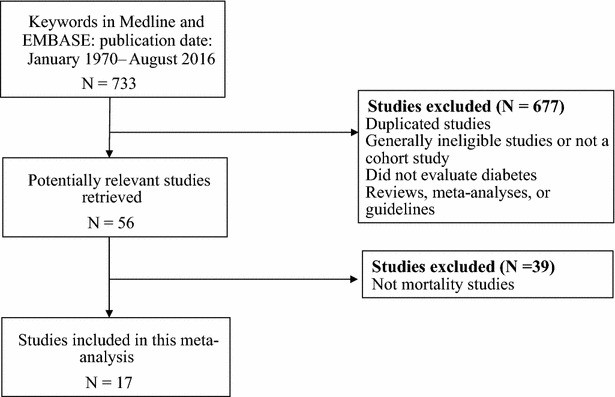
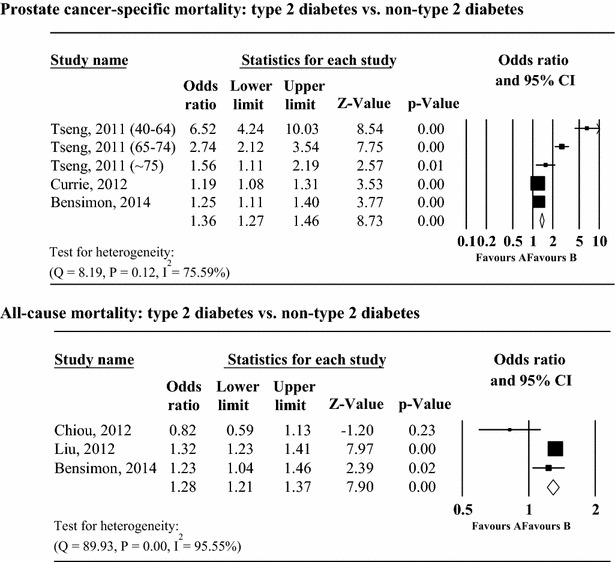
Of the 733 articles identified, 17 cohort studies that had 274,677 male patients were included in this meta-analysis. Pre-existing diabetes was associated with a 29 % increase in prostate cancer-specific mortality [relative risk (RR) 1.29, 95 % CI 1.22-1.38, I(2) = 66.68 %], and with a 37 % increase in all-cause mortality (RR 1.37, 95 % CI 1.29-1.45, p < 0.01, I(2) = 90.26 %). Additionally, in a subgroup analysis that was a type specific analysis focusing on type 2 diabetes and was conducted only with three cohort studies, pre-existing type 2 diabetes was associated with all-cause mortality (RR 2.01, 95 % CI 1.37-2.96, I(2) = 95.55 %) and no significant association with prostate cancer-specific mortality was detected (RR 1.17, 95 % CI 0.96-1.42, I(2) = 75.59 %). There was significant heterogeneity between studies and no publication bias was found.
This meta-analysis suggests diabetes may result in a worse prognosis for men with prostate cancer. Considering heterogeneity between studies, additional studies should be conducted to confirm these findings, and to allow generalization regarding the influence that each type of diabetes has on prostate cancer mortality.
关于前列腺癌患者中既往糖尿病与死亡风险之间的关联,存在相互矛盾的结果。本研究的目的是评估既往糖尿病对前列腺癌特异性死亡率和全因死亡率的影响。
我们检索了PubMed和Embase,以确定调查前列腺癌男性患者中既往糖尿病与死亡风险之间关联的研究。使用固定效应模型或随机效应模型计算合并风险估计值和95%置信区间。对各研究进行异质性检验。采用Egger检验、Begg检验和修剪填充法分析发表偏倚。
在检索到的733篇文章中,本荟萃分析纳入了17项队列研究,共274,677例男性患者。既往糖尿病与前列腺癌特异性死亡率增加29%相关[相对风险(RR)1.29,95%置信区间1.22 - 1.38,I² = 66.68%],与全因死亡率增加37%相关(RR 1.37,95%置信区间1.29 - 1.45,p < 0.01,I² = 90.26%)。此外,在一项仅针对2型糖尿病的亚组分析(仅纳入三项队列研究)中,既往2型糖尿病与全因死亡率相关(RR 2.01,95%置信区间1.37 - 2.96,I² = 95.55%),未检测到与前列腺癌特异性死亡率有显著关联(RR 1.17,95%置信区间0.96 - 1.42,I² = 75.59%)。各研究之间存在显著异质性,未发现发表偏倚。
本荟萃分析表明糖尿病可能导致前列腺癌男性患者预后更差。考虑到各研究之间的异质性,应开展更多研究以证实这些发现,并就每种类型糖尿病对前列腺癌死亡率的影响进行归纳总结。