Runge-Ranzinger Silvia, Kroeger Axel, Olliaro Piero, McCall Philip J, Sánchez Tejeda Gustavo, Lloyd Linda S, Hakim Lokman, Bowman Leigh R, Horstick Olaf, Coelho Giovanini
Institute of Public Health, University of Heidelberg, Heidelberg, Germany.
Special Programme for Research and Training WHO-TDR, Geneva, Switzerland.
PLoS Negl Trop Dis. 2016 Sep 21;10(9):e0004916. doi: 10.1371/journal.pntd.0004916. eCollection 2016 Sep.
Dengue is an increasingly incident disease across many parts of the world. In response, an evidence-based handbook to translate research into policy and practice was developed. This handbook facilitates contingency planning as well as the development and use of early warning and response systems for dengue fever epidemics, by identifying decision-making processes that contribute to the success or failure of dengue surveillance, as well as triggers that initiate effective responses to incipient outbreaks.
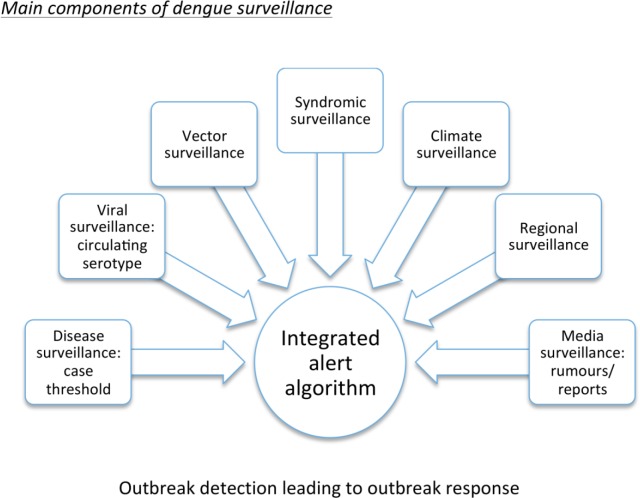
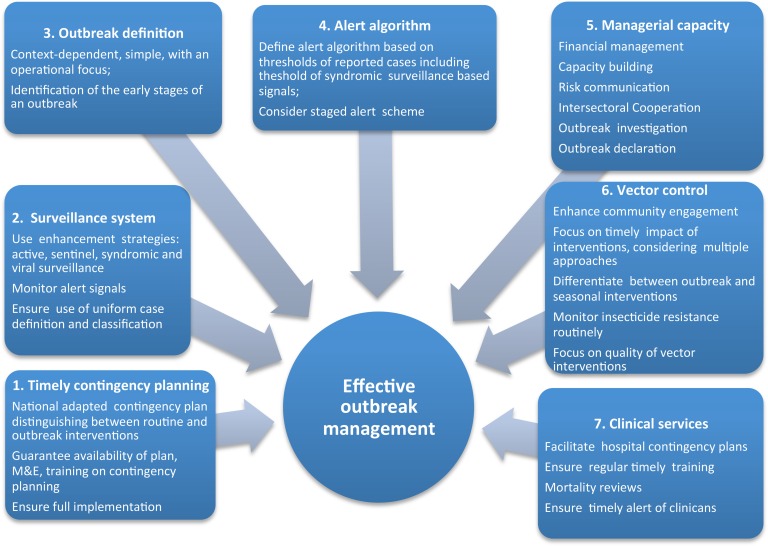
METHODOLOGY/PRINCIPAL FINDINGS: Available evidence was evaluated using a step-wise process that included systematic literature reviews, policymaker and stakeholder interviews, a study to assess dengue contingency planning and outbreak management in 10 countries, and a retrospective logistic regression analysis to identify alarm signals for an outbreak warning system using datasets from five dengue endemic countries. Best practices for managing a dengue outbreak are provided for key elements of a dengue contingency plan including timely contingency planning, the importance of a detailed, context-specific dengue contingency plan that clearly distinguishes between routine and outbreak interventions, surveillance systems for outbreak preparedness, outbreak definitions, alert algorithms, managerial capacity, vector control capacity, and clinical management of large caseloads. Additionally, a computer-assisted early warning system, which enables countries to identify and respond to context-specific variables that predict forthcoming dengue outbreaks, has been developed.
CONCLUSIONS/SIGNIFICANCE: Most countries do not have comprehensive, detailed contingency plans for dengue outbreaks. Countries tend to rely on intensified vector control as their outbreak response, with minimal focus on integrated management of clinical care, epidemiological, laboratory and vector surveillance, and risk communication. The Technical Handbook for Surveillance, Dengue Outbreak Prediction/ Detection and Outbreak Response seeks to provide countries with evidence-based best practices to justify the declaration of an outbreak and the mobilization of the resources required to implement an effective dengue contingency plan.
登革热在世界许多地区的发病率日益上升。作为应对措施,制定了一本将研究转化为政策和实践的循证手册。该手册通过确定有助于登革热监测成败的决策过程以及引发对初期疫情有效应对的触发因素,促进应急规划以及登革热疫情预警和应对系统的开发与使用。
方法/主要发现:采用逐步流程评估现有证据,该流程包括系统的文献综述、政策制定者和利益相关者访谈、一项评估10个国家登革热应急规划和疫情管理的研究,以及一项回顾性逻辑回归分析,以利用来自五个登革热流行国家的数据集确定疫情预警系统的警报信号。针对登革热应急计划的关键要素提供了管理登革热疫情的最佳做法,包括及时的应急规划、详细的、因地制宜的登革热应急计划的重要性,该计划应明确区分常规干预和疫情干预、疫情防范监测系统、疫情定义、警报算法、管理能力、病媒控制能力以及大量病例的临床管理。此外,还开发了一个计算机辅助预警系统,使各国能够识别和应对预测即将发生的登革热疫情的特定背景变量。
结论/意义:大多数国家没有针对登革热疫情的全面、详细的应急计划。各国往往将加强病媒控制作为应对疫情的手段,而对临床护理、流行病学、实验室和病媒监测以及风险沟通的综合管理关注甚少。《登革热监测、疫情预测/检测及疫情应对技术手册》旨在为各国提供循证最佳做法,以证明宣布疫情的合理性并调动实施有效的登革热应急计划所需的资源。