Dory Magdalena, Doleschall Zoltán, Nagy Szilvia K, Ambrus Helga, Mészáros Tamás, Barnabás Beáta, Dóczi Róbert
Department of Plant Cell Biology, Centre for Agricultural Research of the Hungarian Academy of Sciences, H-2462, Brunszvik u. 2, Martonvásár, Hungary.
Department of Pathogenetics, National Institute of Oncology, H-1122, Ráth György u. 7-9, Budapest, Hungary.
BMC Plant Biol. 2016 Sep 21;16(1):204. doi: 10.1186/s12870-016-0894-1.
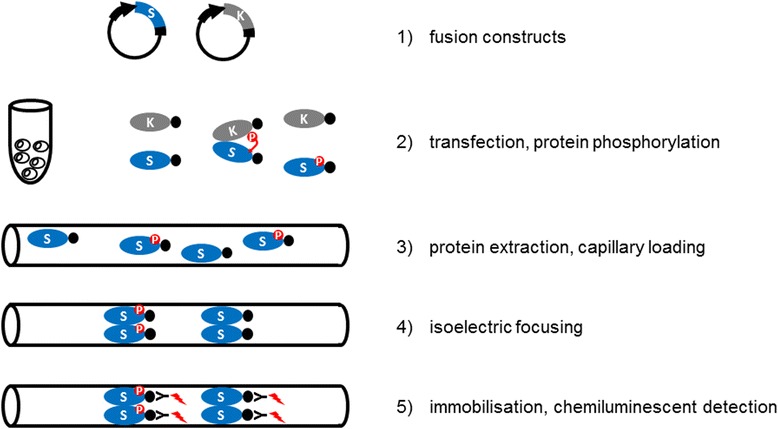
Protein kinases are important components of signalling pathways, and kinomes have remarkably expanded in plants. Yet, our knowledge of kinase substrates in plants is scarce, partly because tools to analyse protein phosphorylation dynamically are limited. Here we describe Kinase-Associated Phosphoisoform Assay, a flexible experimental method for directed experiments to study specific kinase-substrate interactions in vivo. The concept is based on the differential phosphoisoform distribution of candidate substrates transiently expressed with or without co-expression of activated kinases. Phosphorylation status of epitope-tagged proteins is subsequently detected by high-resolution capillary isoelectric focusing coupled with nanofluidic immunoassay, which is capable of detecting subtle changes in isoform distribution.
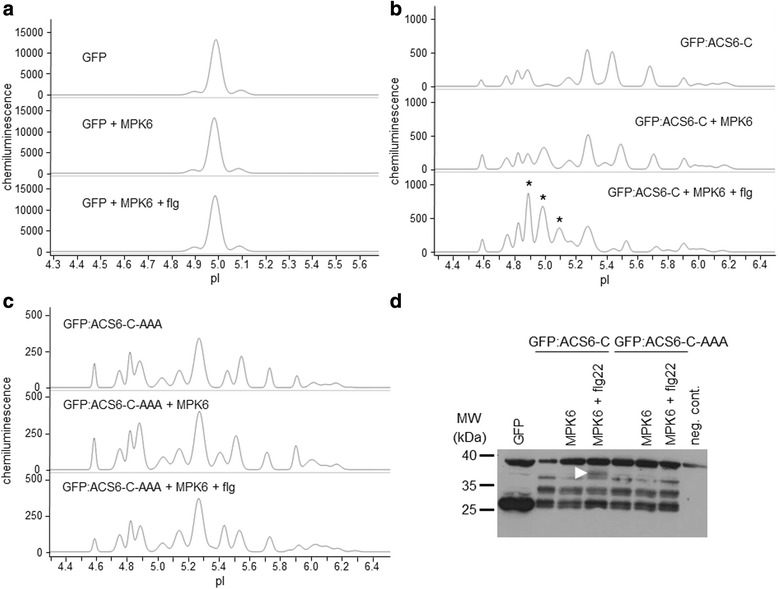
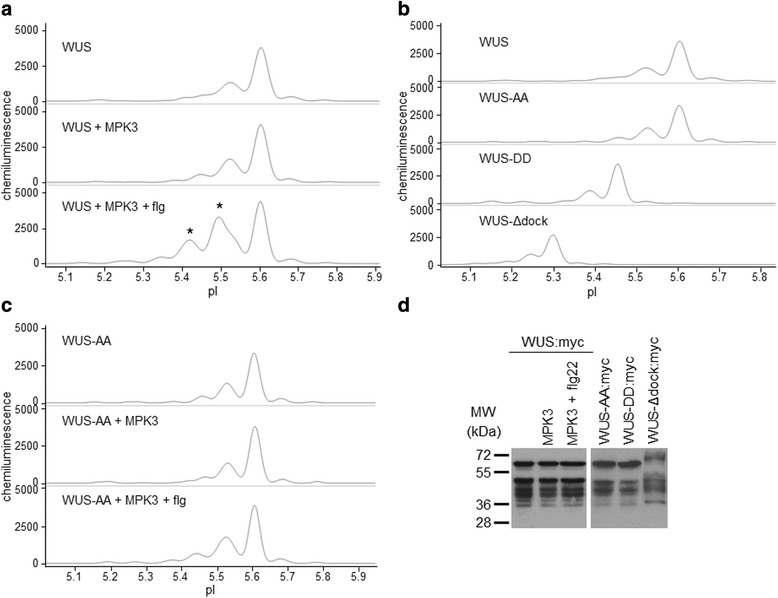
The concept is validated by showing phosphorylation of the known mitogen-activated protein kinase (MAPK) substrate, ACS6, by MPK6. Next, we demonstrate that two transcription factors, WUS and AP2, both of which are shown to be master regulators of plant development by extensive genetic studies, exist in multiple isoforms in plant cells and are phosphorylated by activated MAPKs.
As plant development flexibly responds to environmental conditions, phosphorylation of developmental regulators by environmentally-activated kinases may participate in linking external cues to developmental regulation. As a counterpart of advances in unbiased screening methods to identify potential protein kinase substrates, such as phosphoproteomics and computational predictions, our results expand the candidate-based experimental toolkit for kinase research and provide an alternative in vivo approach to existing in vitro methodologies.
蛋白激酶是信号通路的重要组成部分,植物中的激酶组显著扩张。然而,我们对植物中激酶底物的了解却很少,部分原因是动态分析蛋白质磷酸化的工具有限。在此,我们描述了激酶相关磷酸异构体分析方法,这是一种灵活的实验方法,用于在体内进行定向实验以研究特定的激酶-底物相互作用。该概念基于候选底物在有或没有共表达活化激酶的情况下瞬时表达时磷酸异构体的差异分布。随后通过高分辨率毛细管等电聚焦结合纳米流体免疫测定法检测表位标记蛋白的磷酸化状态,该方法能够检测异构体分布的细微变化。
通过显示已知的促分裂原活化蛋白激酶(MAPK)底物ACS6被MPK6磷酸化,验证了该概念。接下来,我们证明了两个转录因子WUS和AP2,通过广泛的遗传学研究表明它们都是植物发育的主要调节因子,在植物细胞中以多种异构体形式存在,并被活化的MAPK磷酸化。
由于植物发育能灵活响应环境条件,环境激活的激酶对发育调节因子的磷酸化可能参与将外部信号与发育调节联系起来。作为鉴定潜在蛋白激酶底物的无偏筛选方法(如磷酸化蛋白质组学和计算预测)进展的对应物,我们的结果扩展了基于候选物的激酶研究实验工具包,并为现有的体外方法提供了一种替代的体内方法。