Payne Sophie, Tsakiris Manos
Laboratory of Action & Body, Department of Psychology, Royal Holloway, University of London, Egham, Surrey, TW20 0EX, London, UK.
Department of Psychology, Royal Holloway, University of London, Egham, Surrey, TW20 0EX, London, UK.
Cogn Affect Behav Neurosci. 2017 Feb;17(1):1-8. doi: 10.3758/s13415-016-0461-0.
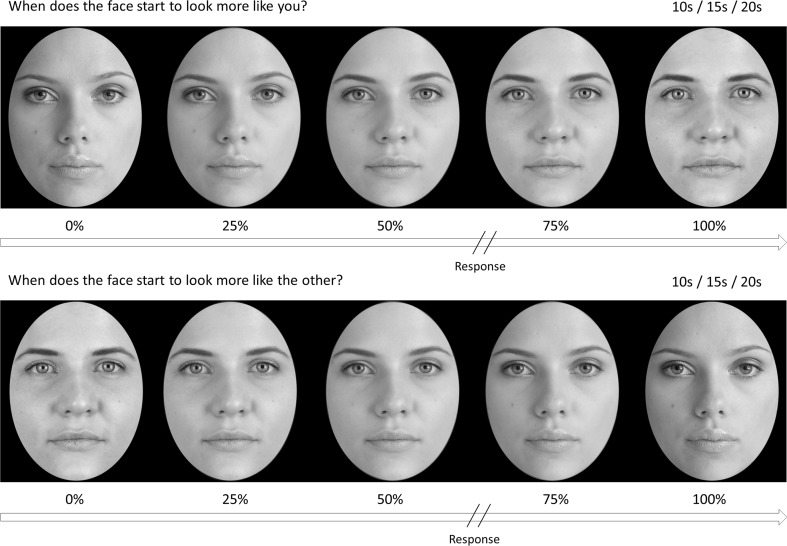
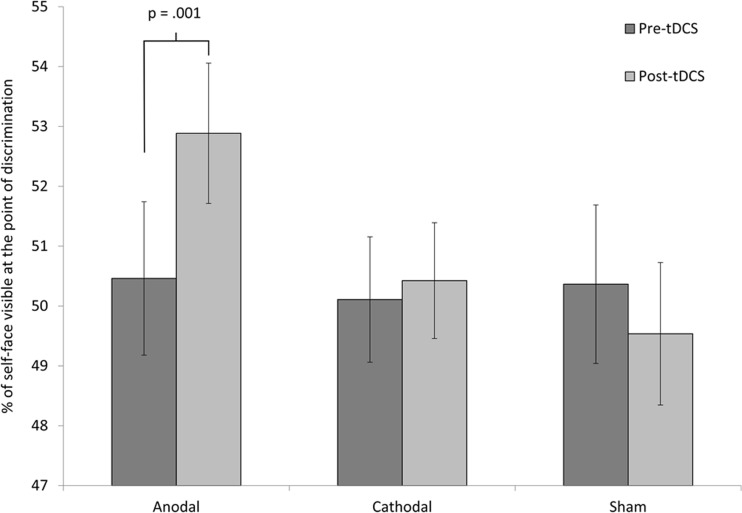
Self-other discrimination is a crucial mechanism for social cognition. Neuroimaging and neurostimulation research has pointed to the involvement of the right temporoparietal region in a variety of self-other discrimination tasks. Although repetitive transcranial magnetic stimulation over the right temporoparietal area has been shown to disrupt self-other discrimination in face-recognition tasks, no research has investigated the effect of increasing the cortical excitability in this region on self-other face discrimination. Here we used transcranial direct current stimulation (tDCS) to investigate changes in self-other discrimination with a video-morphing task in which the participant's face morphed into, or out of, a familiar other's face. The task was performed before and after 20 min of tDCS targeting the right temporoparietal area (anodal, cathodal, or sham stimulation). Differences in task performance following stimulation were taken to indicate a change in self-other discrimination. Following anodal stimulation only, we observed a significant increase in the amount of self-face needed to distinguish between self and other. The findings are discussed in relation to the control of self and other representations and to domain-general theories of social cognition.
自我与他人辨别是社会认知的关键机制。神经影像学和神经刺激研究表明,右侧颞顶叶区域参与了各种自我与他人辨别任务。尽管经颅磁刺激右侧颞顶叶区域已被证明会干扰面部识别任务中的自我与他人辨别,但尚无研究探讨增强该区域皮质兴奋性对自我与他人面部辨别的影响。在此,我们使用经颅直流电刺激(tDCS),通过视频变形任务来研究自我与他人辨别能力的变化,在该任务中,参与者的面部会变形为或变形出一张熟悉他人的脸。在针对右侧颞顶叶区域进行20分钟的tDCS(阳极、阴极或假刺激)前后执行该任务。刺激后任务表现的差异被视为自我与他人辨别能力的变化。仅在阳极刺激后,我们观察到区分自我与他人所需的自我面部量显著增加。我们结合自我与他人表征的控制以及社会认知的领域通用理论对这些发现进行了讨论。