Nam Eun Ji, Kim Sunghoon, Lee Taek Sang, Kim Hee Jung, Lee Jung Yun, Kim Sang Wun, Kim Jae Hoon, Kim Young Tae
Institute of Women's Life Medical Science, Women's Cancer Clinic, Department of Obstetrics and Gynecology, Yonsei University College of Medicine, Seoul, Korea.
Department of Obstetrics and Gynecology, SMG-SNU Boramae Medical Center, Seoul, Korea.
Oncotarget. 2016 Oct 25;7(43):70524-70534. doi: 10.18632/oncotarget.12045.
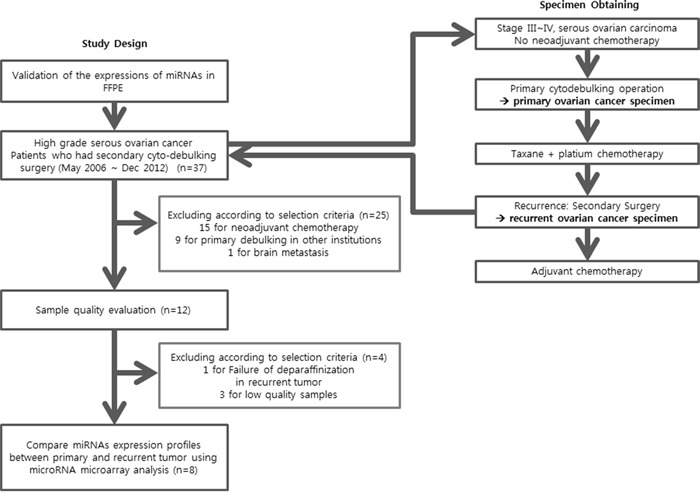
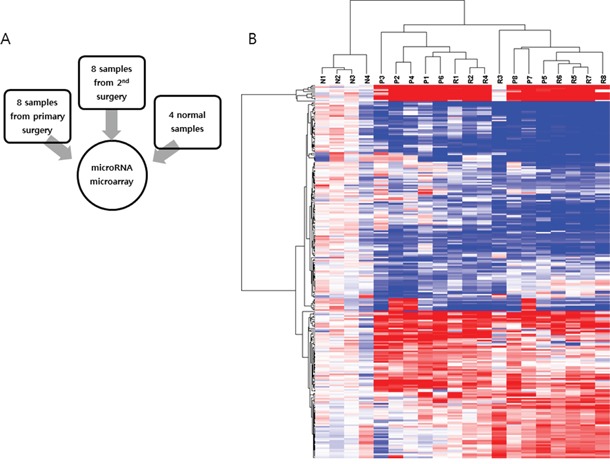
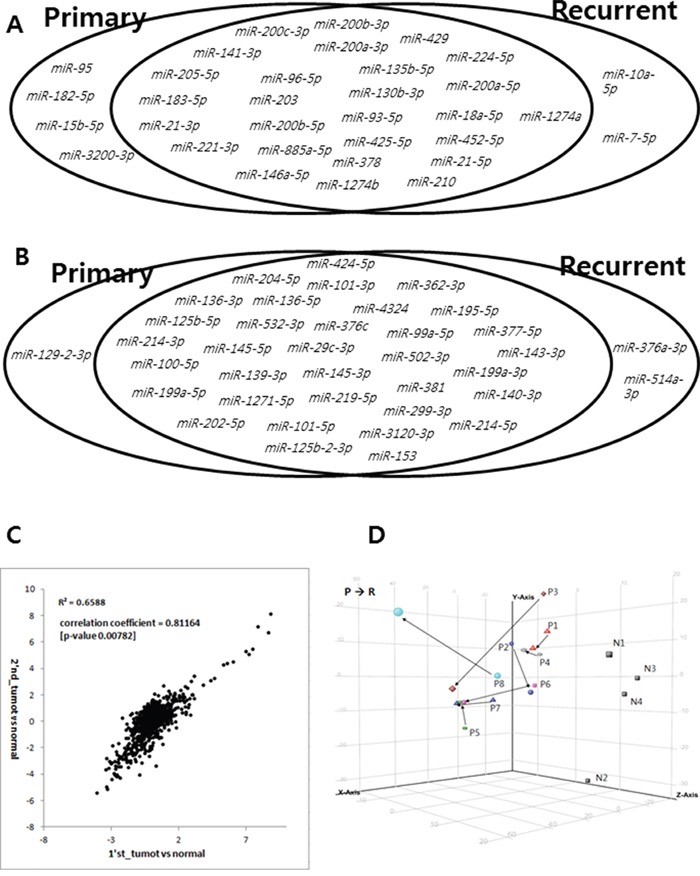
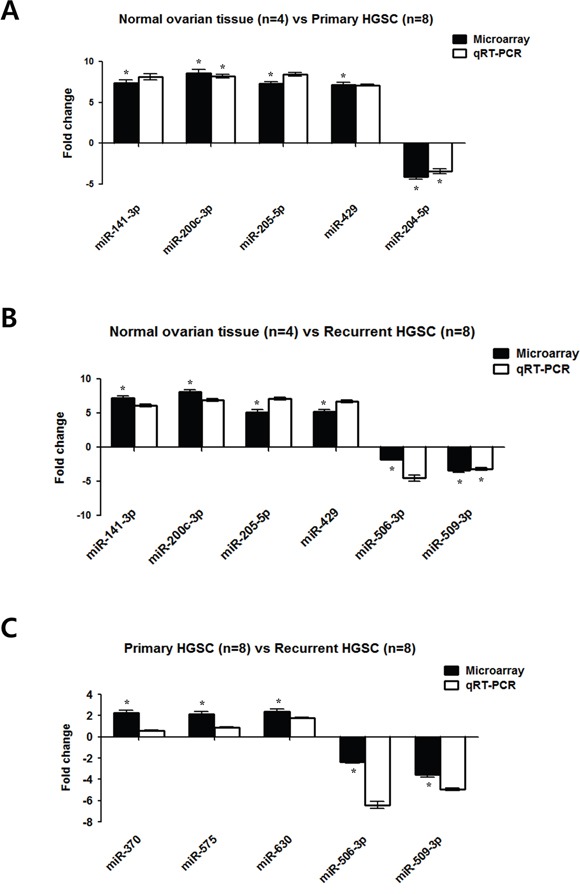
Most patients with epithelial ovarian cancer eventually die due to recurrence. However, little is known about the microRNA (miRNA) expression pattern and its involvement in recurrent ovarian cancer. We analyzed miRNA expression profiles related to the recurrence of advanced ovarian high-grade serous carcinoma (HGSC) using miRNA microarrays. Between May 2006 and December 2012, 37 ovarian HGSC patients underwent secondary cyto-debulking surgery at recurrence. Among them, only 8 pairs of primary and recurrent tumor samples were deemed to be adequate for analysis. The expression profiles of primary ovarian HGSC compared with normal ovarian tissue were significantly consistent with those of recurrent ovarian HGSC compared with normal ovarian tissue (correlation coefficient = 0.81, P = 0.0078). Among 31 miRNAs that increased by more than 4-fold in primary tumors compared with normal ovarian tissue, 27 were also significantly increased in recurrent tumor samples. Likewise, among 35 miRNAs that decreased by more than 4-fold in primary tumors compared with normal ovarian tissue, 34 were also significantly decreased in recurrent tumor samples. We identified 60 miRNAs that were significantly increased in recurrent serous ovarian carcinoma compared with primary tumor tissue, including miR-630, miR-370, and miR-575. Additionally, 52 miRNAs were significantly decreased in recurrent samples, including miR-509-3p, miR-514a-3p, and miR-506-3p. Our results demonstrate that primary and recurrent ovarian HGSC displayed similar miRNA expression patterns. Nevertheless, altered miRNA expression could be implicated in the recurrence of ovarian HGSC, and further study is needed to validate these data in independent cases using a homogeneous methodology.
大多数上皮性卵巢癌患者最终因复发而死亡。然而,关于微小RNA(miRNA)的表达模式及其在复发性卵巢癌中的作用知之甚少。我们使用miRNA微阵列分析了与晚期卵巢高级别浆液性癌(HGSC)复发相关的miRNA表达谱。2006年5月至2012年12月期间,37例卵巢HGSC患者在复发时接受了二次肿瘤细胞减灭术。其中,只有8对原发性和复发性肿瘤样本被认为适合进行分析。原发性卵巢HGSC与正常卵巢组织相比的表达谱,与复发性卵巢HGSC与正常卵巢组织相比的表达谱显著一致(相关系数=0.81,P=0.0078)。与正常卵巢组织相比,原发性肿瘤中增加超过4倍的31种miRNA中,有27种在复发性肿瘤样本中也显著增加。同样,与正常卵巢组织相比,原发性肿瘤中减少超过4倍的35种miRNA中,有34种在复发性肿瘤样本中也显著减少。我们鉴定出60种在复发性浆液性卵巢癌中与原发性肿瘤组织相比显著增加的miRNA,包括miR-630、miR-370和miR-575。此外,52种miRNA在复发性样本中显著减少,包括miR-509-3p、miR-514a-3p和miR-506-3p。我们的结果表明,原发性和复发性卵巢HGSC表现出相似的miRNA表达模式。然而,miRNA表达的改变可能与卵巢HGSC的复发有关,需要进一步研究以使用统一方法在独立病例中验证这些数据。