Caraballo Pedro J, Hodge Lucy S, Bielinski Suzette J, Stewart A Keith, Farrugia Gianrico, Schultz Cloann G, Rohrer-Vitek Carolyn R, Olson Janet E, St Sauver Jennifer L, Roger Veronique L, Parkulo Mark A, Kullo Iftikhar J, Nicholson Wayne T, Elliott Michelle A, Black John L, Weinshilboum Richard M
Division of General Internal Medicine, Mayo Clinic, Rochester, Minnesota, USA.
Office of Information and Knowledge Management, Rochester, Minnesota, USA.
Genet Med. 2017 Apr;19(4):421-429. doi: 10.1038/gim.2016.120. Epub 2016 Sep 22.
Despite potential clinical benefits, implementation of pharmacogenomics (PGx) faces many technical and clinical challenges. These challenges can be overcome with a comprehensive and systematic implementation model.
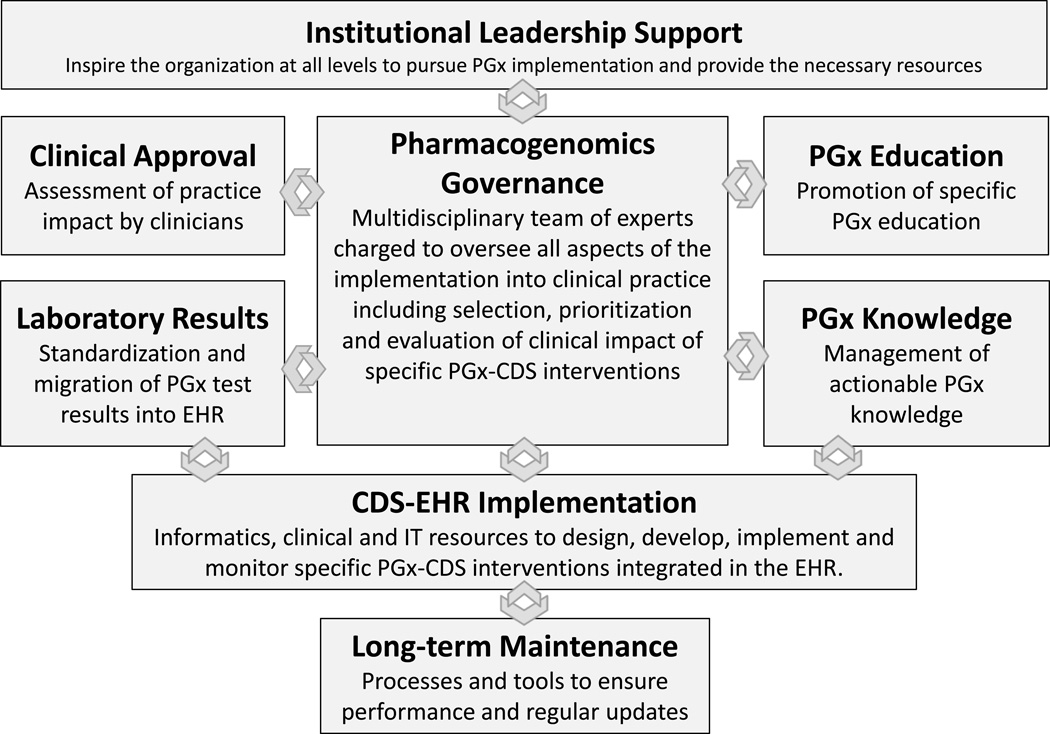
The development and implementation of PGx were organized into eight interdependent components addressing resources, governance, clinical practice, education, testing, knowledge translation, clinical decision support (CDS), and maintenance. Several aspects of implementation were assessed, including adherence to the model, production of PGx-CDS interventions, and access to educational resources.
Between August 2012 and June 2015, 21 specific drug-gene interactions were reviewed and 18 of them were implemented in the electronic medical record as PGx-CDS interventions. There was complete adherence to the model with variable production time (98-392 days) and delay time (0-148 days). The implementation impacted approximately 1,247 unique providers and 3,788 unique patients. A total of 11 educational resources complementary to the drug-gene interactions and 5 modules specific for pharmacists were developed and implemented.
A comprehensive operational model can support PGx implementation in routine prescribing. Institutions can use this model as a roadmap to support similar efforts. However, we also identified challenges that will require major multidisciplinary and multi-institutional efforts to make PGx a universal reality.Genet Med 19 4, 421-429.
尽管药物基因组学(PGx)具有潜在的临床益处,但其实施面临诸多技术和临床挑战。通过全面系统的实施模型可克服这些挑战。
PGx的开发与实施被组织为八个相互依存的组成部分,涉及资源、治理、临床实践、教育、检测、知识转化、临床决策支持(CDS)和维护。对实施的几个方面进行了评估,包括对模型的依从性、PGx-CDS干预措施的产生以及教育资源的获取。
在2012年8月至2015年6月期间,对21种特定药物-基因相互作用进行了审查,其中18种作为PGx-CDS干预措施在电子病历中得以实施。完全依从该模型,生产时间各异(98 - 392天),延迟时间也不同(0 - 148天)。该实施影响了约1247名不同的医疗服务提供者和3788名不同的患者。共开发并实施了11种与药物-基因相互作用互补的教育资源以及5个针对药剂师的模块。
一个全面的运营模型可支持PGx在常规处方中的实施。各机构可将此模型作为路线图来支持类似工作。然而,我们也发现了一些挑战,需要多学科、多机构的重大努力才能使PGx成为普遍现实。《基因医学》19卷4期,421 - 429页