Stawczyk-Macieja Marta, Rębała Krzysztof, Szczerkowska-Dobosz Aneta, Wysocka Joanna, Cybulska Lidia, Kapińska Ewa, Haraś Agnieszka, Miniszewska Paulina, Nowicki Roman
Department of Dermatology, Venereology and Allergology, Medical University of Gdańsk, Gdańsk, Poland.
Department of Forensic Medicine, Medical University of Gdańsk, Gdańsk, Poland.
PLoS One. 2016 Sep 22;11(9):e0163185. doi: 10.1371/journal.pone.0163185. eCollection 2016.
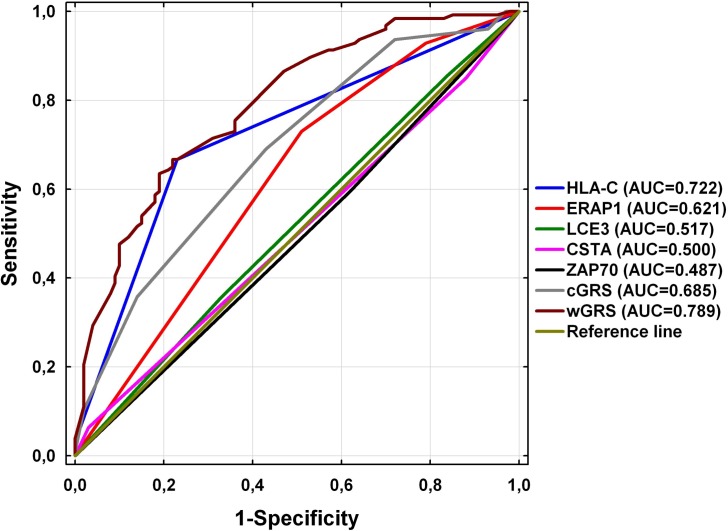
Psoriasis genetic background depends on polygenic and multifactorial mode of inheritance. As in other complex disorders, the estimation of the disease risk based on individual genetic variants is impossible. For this reason, recent investigations have been focused on combinations of known psoriasis susceptibility markers in order to improve the disease risk evaluation. Our aim was to compare psoriasis genetic risk score (GRS) for five susceptibility loci involved in the immunological response (HLA-C, ERAP1, ZAP70) and in the skin barrier function (LCE3, CSTA) between patients with chronic plaque psoriasis (n = 148) and the control group (n = 146). A significantly higher number of predisposing alleles was observed in patients with psoriasis in comparison to healthy individuals (6.1 vs. 5.2, respectively; P = 8.8×10⁻⁷). The statistical significance was even more profound when GRS weighted by logarithm odds ratios was evaluated (P = 9.9×10⁻¹⁴). Our results demonstrate the developed panel of five susceptibility loci to be more efficient in predicting psoriasis risk in the Polish population and to possess higher sensitivity and specificity for the disease than any of the markers analyzed separately, including the most informative HLA-C*06 allele.
银屑病的遗传背景取决于多基因和多因素的遗传模式。与其他复杂疾病一样,基于个体基因变异来估计疾病风险是不可能的。因此,最近的研究集中在已知的银屑病易感性标志物的组合上,以改善疾病风险评估。我们的目的是比较慢性斑块状银屑病患者(n = 148)和对照组(n = 146)中涉及免疫反应(HLA-C、ERAP1、ZAP70)和皮肤屏障功能(LCE3、CSTA)的五个易感基因座的银屑病遗传风险评分(GRS)。与健康个体相比,银屑病患者中观察到的易感等位基因数量明显更多(分别为6.1和5.2;P = 8.8×10⁻⁷)。当评估以对数优势比加权的GRS时,统计学意义更加显著(P = 9.9×10⁻¹⁴)。我们的结果表明,所开发的包含五个易感基因座的组合在预测波兰人群的银屑病风险方面更有效,并且对该疾病具有比单独分析的任何标志物更高的敏感性和特异性,包括最具信息性的HLA-C*06等位基因。