Berber Patricia, Grassmann Felix, Kiel Christina, Weber Bernhard H F
Institute of Human Genetics, University of Regensburg, Franz-Josef-Strauss-Allee 11, 93053, Regensburg, Germany.
Mol Diagn Ther. 2017 Feb;21(1):31-43. doi: 10.1007/s40291-016-0234-z.
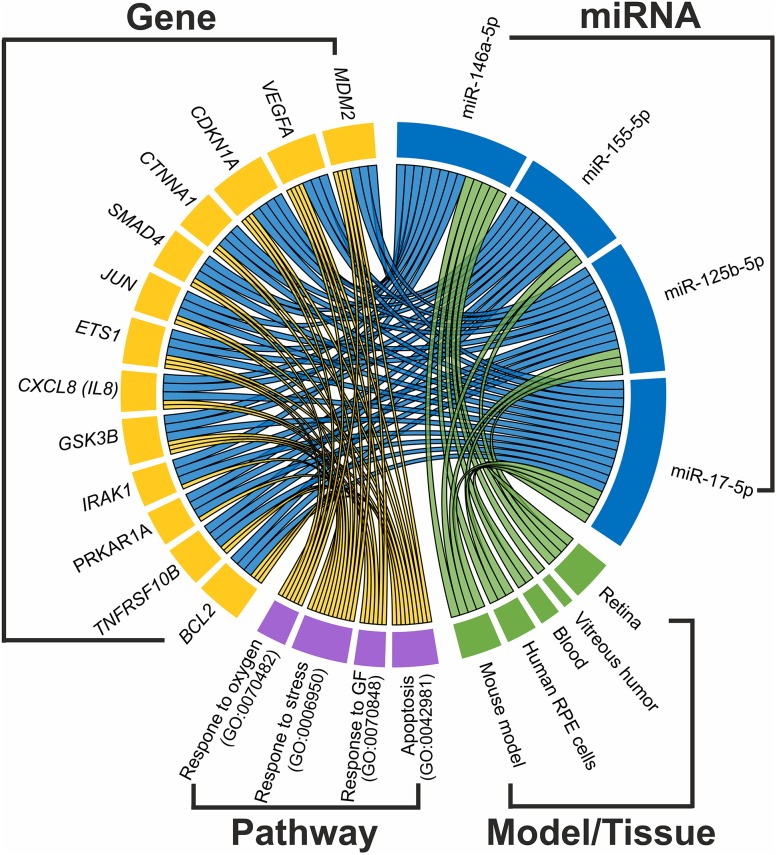
Age-related macular degeneration (AMD) is the primary cause of blindness in developed countries, and is the third leading cause worldwide. Emerging evidence suggests that beside environmental and genetic factors, epigenetic mechanisms, such as microRNA (miRNA) regulation of gene expression, are relevant to AMD providing an exciting new avenue for research and therapy. MiRNAs are short, non-coding RNAs thought to be imperative for coping with cellular stress. Numerous studies have analyzed miRNA dysregulation in AMD patients, although with varying outcomes. Four studies which profiled dysregulated circulating miRNAs in AMD yielded unique sets, and there is only minimal overlap in ocular miRNA profiling of AMD. Mouse models of AMD, including oxygen-induced retinopathy and laser-induced choroidal neovascularization, showed similarities to some extent with miRNA patterns in AMD. For example, miR-146a is an extensively researched miRNA thought to modulate inflammation, and was found to be upregulated in AMD mice and cellular systems, but also in human AMD retinae and vitreous humor. Similarly, mir-17, miR-125b and miR-155 were dysregulated in multiple AMD mouse models as well as in human AMD plasma or retinae. These miRNAs are thought to regulate angiogenesis, apoptosis, phagocytosis, and inflammation. A promising avenue of research is the modulation of such miRNAs, as the phenotype of AMD mice could be ameliorated with antagomirs or miRNA-mimic treatment. However, before meaningful strides can be made to develop miRNAs as a diagnostic or therapeutic tool, reproducible miRNA profiles need to be established for the various clinical outcomes of AMD.
年龄相关性黄斑变性(AMD)是发达国家失明的主要原因,在全球范围内是第三大致盲原因。新出现的证据表明,除了环境和遗传因素外,表观遗传机制,如微小RNA(miRNA)对基因表达的调控,与AMD相关,为研究和治疗提供了一个令人兴奋的新途径。miRNA是短的非编码RNA,被认为对应对细胞应激至关重要。许多研究分析了AMD患者中miRNA的失调情况,尽管结果各不相同。四项对AMD患者循环中失调的miRNA进行分析的研究得出了独特的结果集,而AMD眼部miRNA分析中只有极少的重叠。AMD的小鼠模型,包括氧诱导性视网膜病变和激光诱导性脉络膜新生血管形成,在一定程度上与AMD中的miRNA模式相似。例如,miR-146a是一种经过广泛研究的miRNA,被认为可调节炎症,在AMD小鼠和细胞系统中以及人类AMD视网膜和玻璃体液中均被发现上调。同样,miR-17、miR-125b和miR-155在多个AMD小鼠模型以及人类AMD血浆或视网膜中也失调。这些miRNA被认为可调节血管生成、细胞凋亡、吞噬作用和炎症。一个有前景的研究途径是对这类miRNA进行调节,因为使用抗miRNA或miRNA模拟物治疗可改善AMD小鼠的表型。然而,在将miRNA开发为诊断或治疗工具方面取得有意义的进展之前,需要为AMD的各种临床结果建立可重复的miRNA谱。