Wu Tingting, Dufford Alexander J, Mackie Melissa-Ann, Egan Laura J, Fan Jin
Department of Psychology, Queens College, The City University of New York, Queens, NY 11367, USA.
Departments of Psychiatry, Icahn School of Medicine at Mount Sinai, New York, NY 10029, USA.
Sci Rep. 2016 Sep 23;6:34025. doi: 10.1038/srep34025.
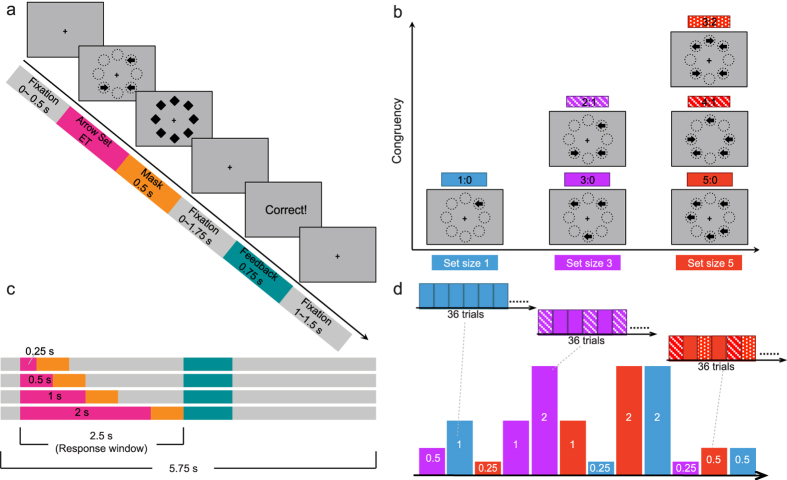
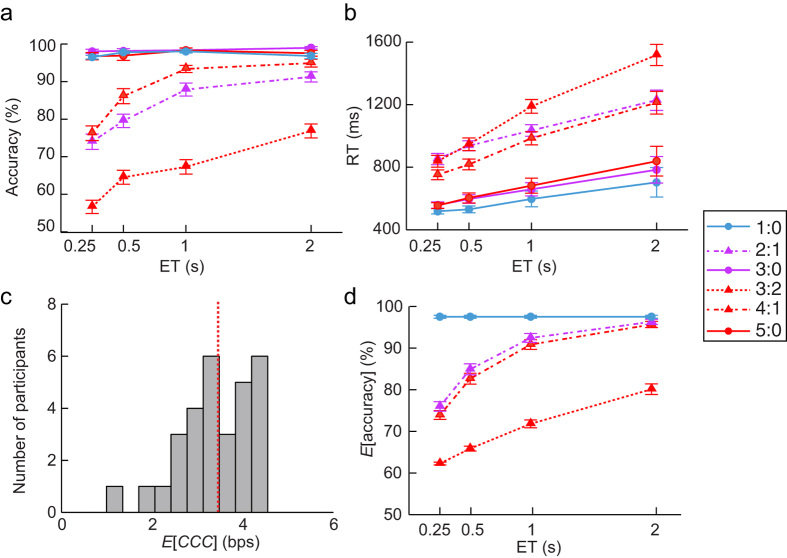
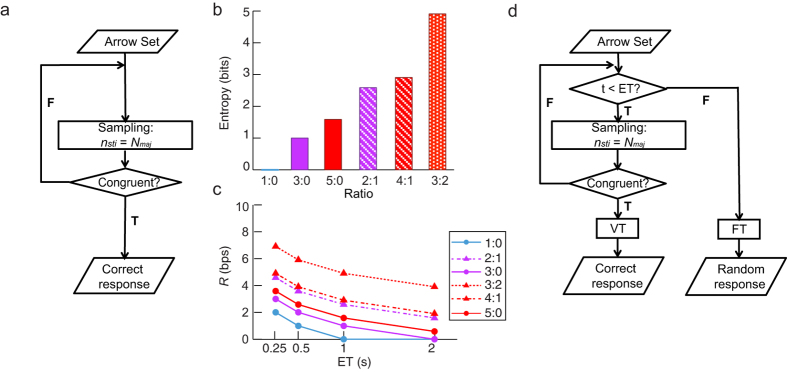
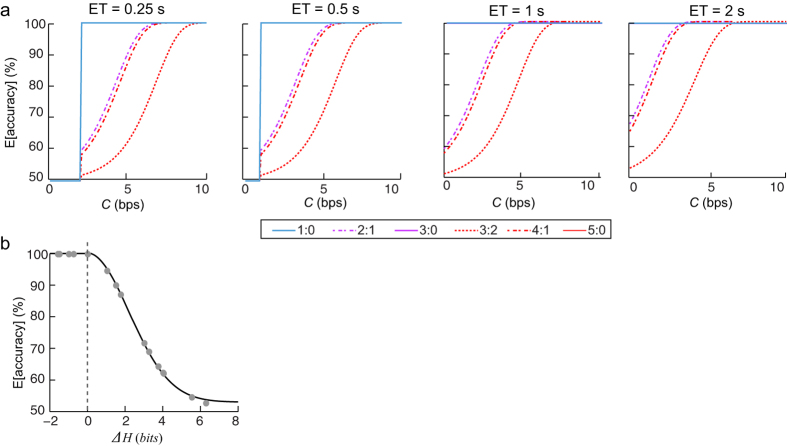
Cognitive control refers to the processes that permit selection and prioritization of information processing in different cognitive domains to reach the capacity-limited conscious mind. Although previous studies have suggested that the capacity of cognitive control itself is limited, a direct quantification of this capacity has not been attempted. In this behavioral study, we manipulated the information rate of cognitive control by parametrically varying both the uncertainty of stimul measured as information entropy and the exposure time of the stimuli. We used the relationship between the participants' response accuracy and the information rate of cognitive control (in bits per second, bps) in the model fitting to estimate the capacity of cognitive control. We found that the capacity of cognitive control was approximately 3 to 4 bps, demonstrating that cognitive control as a higher-level function has a remarkably low capacity. This quantification of the capacity of cognitive control may have significant theoretical and clinical implications.
认知控制是指在不同认知领域中允许对信息处理进行选择和优先级排序,以抵达容量有限的意识思维的过程。尽管先前的研究表明认知控制本身的容量是有限的,但尚未有人尝试对这种容量进行直接量化。在这项行为研究中,我们通过参数化改变以信息熵衡量的刺激不确定性和刺激的暴露时间,来操纵认知控制的信息速率。我们在模型拟合中使用参与者的反应准确性与认知控制信息速率(以每秒比特数,bps为单位)之间的关系,来估计认知控制的容量。我们发现认知控制的容量约为3至4 bps,这表明作为一种高级功能的认知控制具有非常低的容量。这种对认知控制容量的量化可能具有重要的理论和临床意义。