Department of Melanoma Medical Oncology, University of Texas - MD Anderson Cancer Center, South Campus Research Building 1, 1515 Holcombe Blvd, Houston, TX 77030 USA ; Immunology program - University of Texas - Graduate School of Biomedical Sciences at Houston, 6767 Bertner Ave, Houston, TX 77030 USA.
J Immunother Cancer. 2016 Sep 20;4:56. doi: 10.1186/s40425-016-0160-y. eCollection 2016.
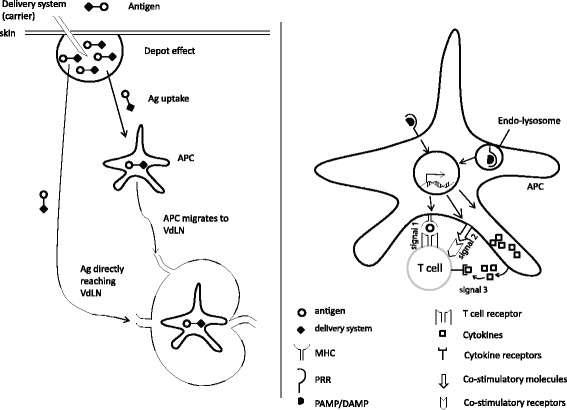
Cancer therapies based on T cells have shown impressive clinical benefit. In particular, immune checkpoint blockade therapies with anti-CTLA-4 and anti-PD-1/PD-L1 are causing dramatic tumor shrinkage and prolonged patient survival in a variety of cancers. However, many patients do not benefit, possibly due to insufficient spontaneous T cell reactivity against their tumors and/or lacking immune cell infiltration to tumor site. Such tumor-specific T cell responses could be induced through anti-cancer vaccination; but despite great success in animal models, only a few of many cancer vaccine trials have demonstrated robust clinical benefit. One reason for this difference may be the use of potent, effective vaccine adjuvants in animal models, vs. the use of safe, but very weak, vaccine adjuvants in clinical trials. As vaccine adjuvants dictate the type and magnitude of the T cell response after vaccination, it is critical to understand how they work to design safe, but also effective, cancer vaccines for clinical use. Here we discuss current insights into the mechanism of action and practical application of vaccine adjuvants, with a focus on peptide-based cancer vaccines.
基于 T 细胞的癌症疗法已经显示出令人印象深刻的临床益处。特别是,抗 CTLA-4 和抗 PD-1/PD-L1 的免疫检查点阻断疗法在多种癌症中引起了显著的肿瘤缩小和患者生存时间延长。然而,许多患者并没有从中受益,这可能是由于他们的肿瘤对自发 T 细胞反应不足,和/或缺乏免疫细胞浸润到肿瘤部位。这种肿瘤特异性 T 细胞反应可以通过抗癌疫苗来诱导;但是,尽管在动物模型中取得了巨大的成功,许多癌症疫苗试验中只有少数显示出了强大的临床获益。造成这种差异的一个原因可能是在动物模型中使用了强效有效的疫苗佐剂,而在临床试验中使用了安全但非常弱的疫苗佐剂。由于疫苗佐剂决定了接种疫苗后 T 细胞反应的类型和幅度,因此了解它们的作用机制对于设计安全但有效的临床用癌症疫苗至关重要。在这里,我们讨论了疫苗佐剂的作用机制和实际应用的最新见解,重点是基于肽的癌症疫苗。