Bengtson Angela M, Pence Brian W, Gaynes Bradley N, Quinlivan E Byrd, Heine Amy D, OʼDonnell Julie K, Crane Heidi M, Mathews W Christopher, Moore Richard D, Westreich Daniel, OʼCleirigh Conall, Christopoulos Katerina, Mimiaga Matthew J, Mugavero Michael J
Departments of *Epidemiology; †Psychiatry, University of North Carolina, Chapel Hill, NC; ‡Division of Infectious Diseases, University of North Carolina, Chapel Hill, NC; §Division of Allergy and Infectious Diseases, University of Washington, Seattle, WA; ‖Department of Medicine, University of California, San Diego, CA; ¶School of Medicine, Johns Hopkins University, Baltimore, MD; #Department of Psychiatry, Massachusetts General Hospital, Boston, MA; **School of Medicine, University of California, San Francisco, CA; ††Departments of Epidemiology and Behavioral and Social Sciences, Brown University School of Public Health, Providence, RI; ‡‡Institute for Community Health Promotion, Brown University, Providence, RI; §§The Fenway Institute, Fenway Health, Boston, MA; and ‖‖Division of Infectious Diseases, University of Alabama-Birmingham, Birmingham, AL.
J Acquir Immune Defic Syndr. 2016 Dec 1;73(4):482-488. doi: 10.1097/QAI.0000000000001131.
Depression affects 20%-30% of people with HIV. Randomized controlled trials (RCTs) have demonstrated the effectiveness of interventions to improve depression among HIV-infected adults, but typically have highly selected populations which may limit generalizability. Inverse probability of sampling weights (IPSW) is a recently proposed method to transport (or standardize) findings from RCTs to a specific external target population.
We used IPSW to transport the 6-month effect of the Measurement-Based Care (MBC) intervention on depression from the SLAM DUNC trial to a population of HIV-infected, depressed adults in routine care in the United States between 2010 and 2014.
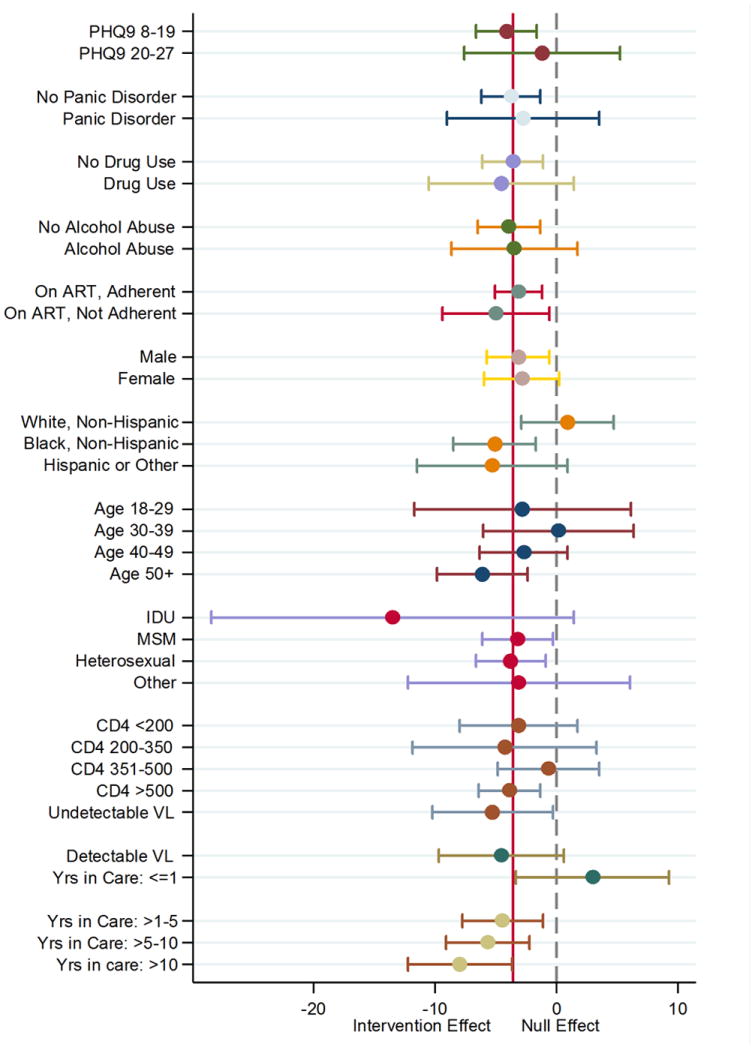
In the RCT, MBC was associated with an improvement in depression at 6 months of 3.6 points on the Hamilton Depression Rating scale [95% confidence interval (CI): -5.9 to -1.3]. When IPSW were used to standardize results from the trial to the target population, the intervention effect was attenuated by 1.2 points (mean improvement 2.4 points; 95% CI: -6.1 to 1.3).
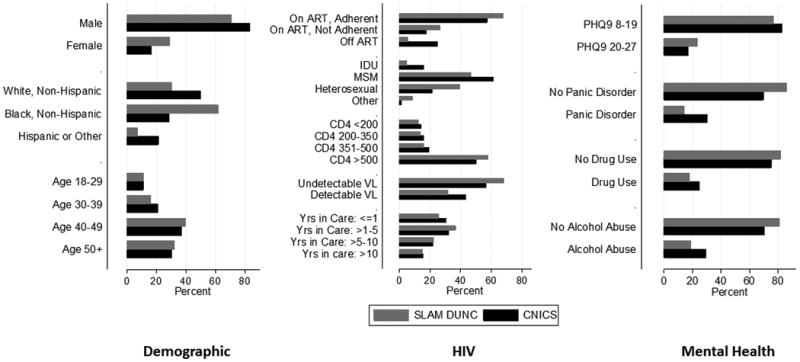
If implemented among HIV-infected, depressed adults in routine care, MBC may be less effective than in the RCT but can still be expected to reduce depression. Attenuation of the intervention effect among adults in routine care reflects the fact that the trial enrolled a larger proportion of individuals for whom the intervention was more effective. Given the burden of depression among HIV-infected adults, more effective interventions to improve depression are urgently needed. However, examining the transportability of trial findings is essential to understand whether similar effects can be expected if interventions are scaled-up.
抑郁症影响20%-30%的艾滋病毒感染者。随机对照试验(RCT)已证明干预措施对改善艾滋病毒感染成年人的抑郁症有效,但通常研究对象选择范围较窄,这可能会限制研究结果的普遍性。逆概率抽样权重(IPSW)是最近提出的一种将RCT结果转移(或标准化)到特定外部目标人群的方法。
我们使用IPSW将基于测量的护理(MBC)干预对抑郁症的6个月效果从SLAM DUNC试验转移到2010年至2014年在美国接受常规护理的艾滋病毒感染且患有抑郁症的成年人群体。
在RCT中,MBC与汉密尔顿抑郁量表评分在6个月时改善3.6分相关[95%置信区间(CI):-5.9至-1.3]。当使用IPSW将试验结果标准化到目标人群时,干预效果减弱了1.2分(平均改善2.4分;95%CI:-6.1至1.3)。
如果在接受常规护理的艾滋病毒感染且患有抑郁症的成年人中实施,MBC可能不如在RCT中有效,但仍有望减轻抑郁症状。常规护理成年人中干预效果的减弱反映了这样一个事实,即试验纳入了较大比例的对干预更有效的个体。鉴于艾滋病毒感染成年人中抑郁症的负担,迫切需要更有效的干预措施来改善抑郁症状。然而,检验试验结果的可转移性对于了解扩大干预规模时是否能预期类似效果至关重要。