Klotz James L, Aiken Glen E, Bussard Jessica R, Foote Andrew P, Harmon David L, Goff Ben M, Schrick F Neal, Strickland James R
USDA-ARS, Forage-Animal Production Research Unit, Lexington, KY 40546, USA.
Department of Plant and Soil Sciences, University of Kentucky, Lexington, KY 40546, USA.
Toxins (Basel). 2016 Sep 22;8(10):271. doi: 10.3390/toxins8100271.
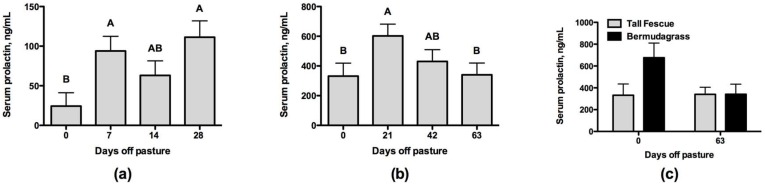
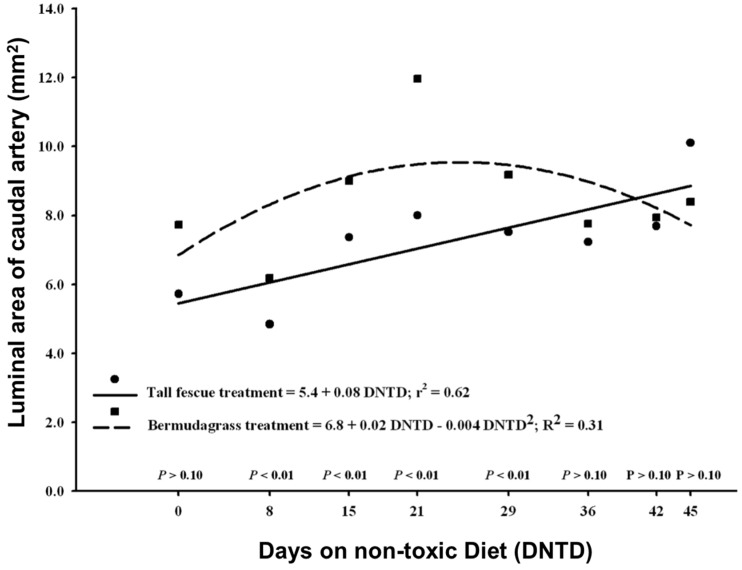
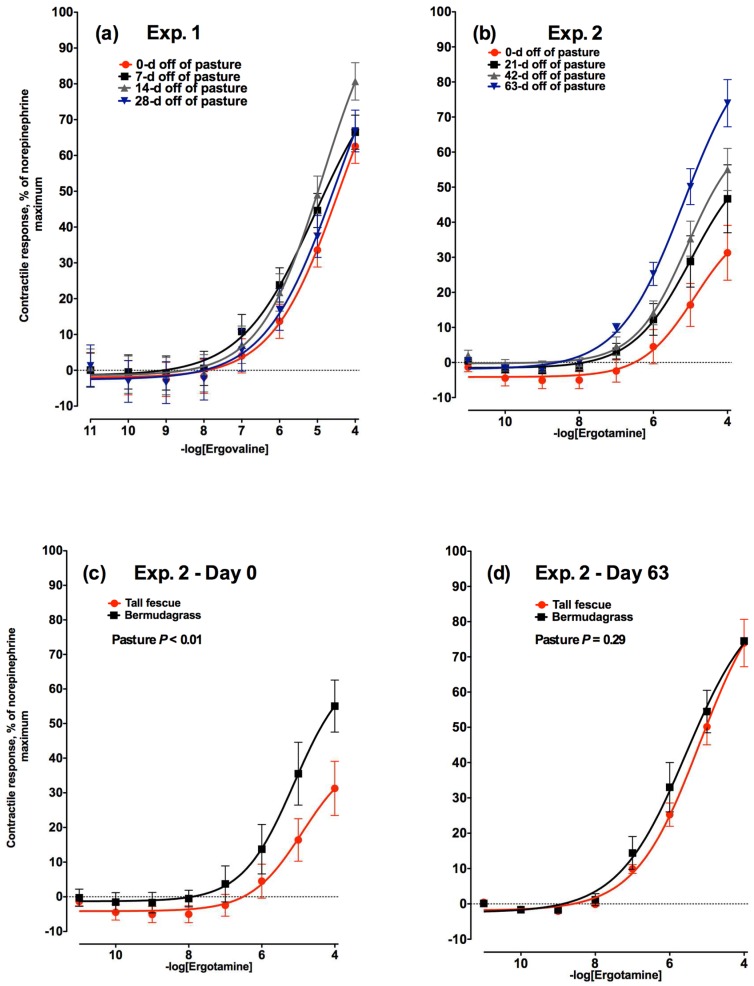
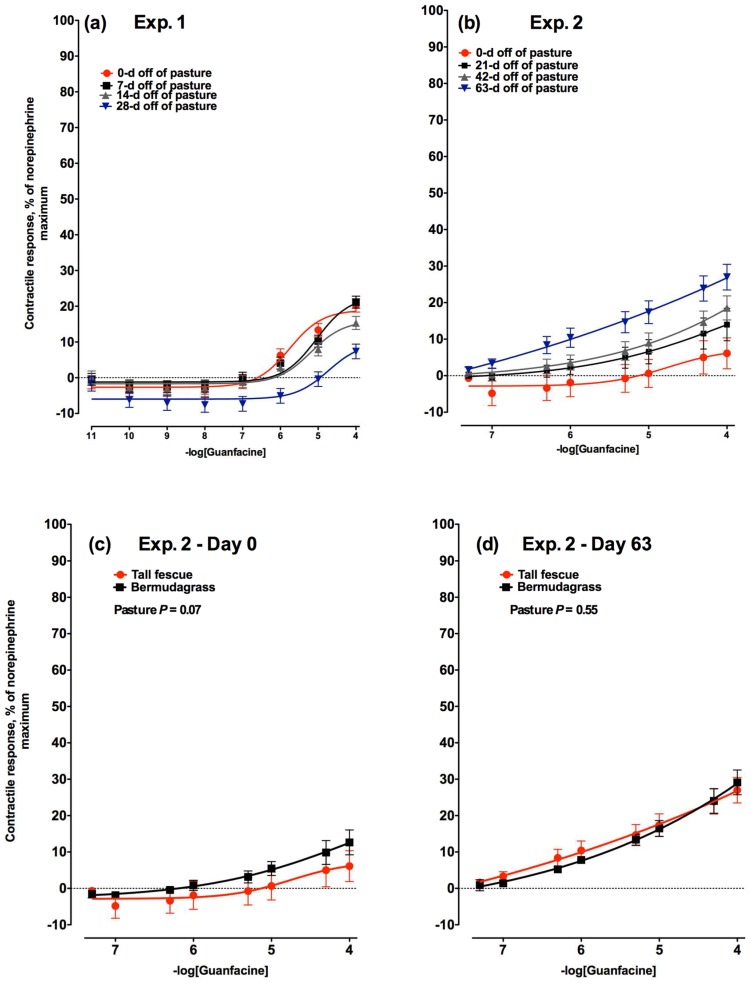
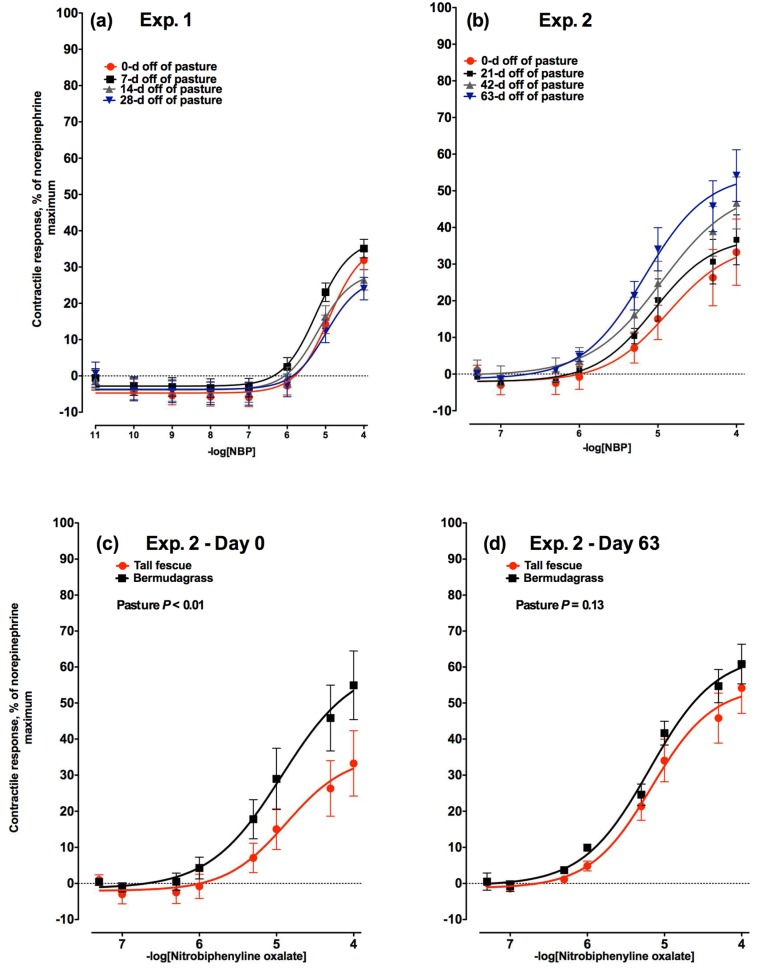
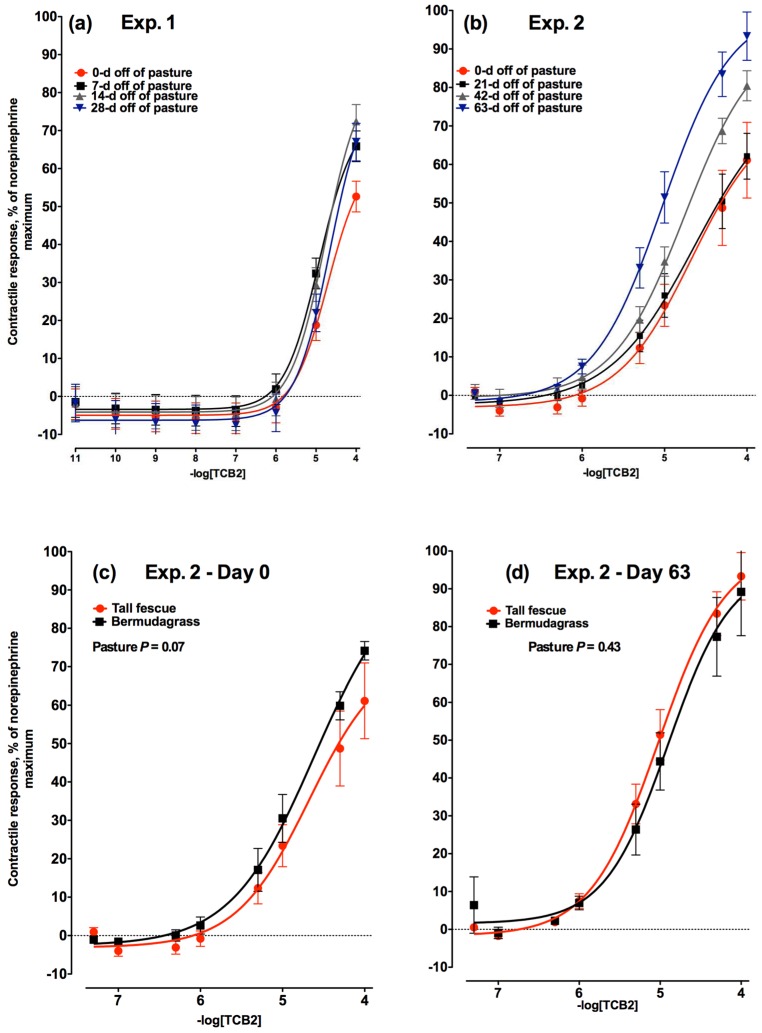
Previous research has indicated that serotonergic and α-adrenergic receptors in peripheral vasculature are affected by exposure of cattle grazing toxic endophyte-infected (E+; Epichlöe coenophialia) tall fescue (Lolium arundinaceum). The objective of this experiment was to determine the period of time necessary for the vascular effects of ergot alkaloids to subside. Two experiments were conducted to investigate changes in vascular contractile response and vasoconstriction over time relative to removal from an ergot alkaloid-containing E+ tall fescue pasture. In Experiment 1, lateral saphenous vein biopsies were conducted on 21 predominantly Angus steers (357 ± 3 kg body weight) at 0 (n = 6), 7 (n = 6), 14 (n = 5), or 28 days (n = 4) after removal from grazing pasture (3.0 ha; endpoint ergovaline + ergovalinine = 1.35 mg/kg DM) for 126 days. In Experiment 2, lateral saphenous veins were biopsied from 24 Angus-cross steers (361 ± 4 kg body weight) at 0, 21, 42, and 63 days (n = 6 per time point) following removal from grazing tall fescue pastures (3.0 ha; first 88 days endpoint ergovaline + ergovalinine = 0.15 mg/kg DM; last 18 days endpoint ergovaline + ergovalinine = 0.57 mg/kg DM) for 106 total days. Six steers (370 ± 18 kg body weight) off of bermudagrass pasture for the same time interval were also biopsied on Day 0 and Day 63 (n = 3 per time point). Additionally, in Experiment 2, cross-sectional ultrasound scans of caudal artery at the fourth coccygeal vertebra were taken on Days 0, 8, 15, 21, 29, 36, 42, and 45 to determine mean artery luminal area to evaluate vasoconstriction. In both experiments, steers were removed from pasture and housed in a dry lot and fed a corn silage diet for the duration of biopsies and ultrasound scans. Biopsied vessels used to evaluate vasoactivity were cleaned, incubated in a multimyograph, and exposed to increasing concentrations of 4-Bromo-3,6-dimethoxybenzocyclobuten-1-yl) methylamine hydrobromide (TCB2; 5HT2A agonist), guanfacine (GF; α2A-adrenergic agonist), and (R)-(+)-m-nitrobiphenyline oxalate (NBP; α2C-adrenergic agonist) in both experiments and ergovaline (ERV) and ergotamine (ERT) in Experiments 1 and 2, respectively. In Experiment 1, days off pasture × agonist concentration was not significant (p > 0.1) for all four compounds tested. In Experiment 2, GF, NBP, TCB2 and ERT were significant for days off pasture × agonist concentration interaction (p < 0.02) and vasoactivity increased over time. Vasoactivity to agonists was reduced (p < 0.05) when steers were initially removed from E+ tall fescue pasture compared to bermudagrass, but did not differ by Day 63 for any variable. Luminal areas of caudal arteries in steers grazed on E+ tall fescue relaxed and were similar to steers that had grazed bermudagrass for 36 days on non-toxic diet (p = 0.15). These data demonstrate changes in peripheral vasoactivity and recovery from vasoconstriction occur beyond five weeks off toxic pasture and 5HT2A receptors appear to be more dramatically affected in the lateral saphenous vein by grazing E+ tall fescue pasture than adrenergic receptors.
先前的研究表明,放牧感染了有毒内生真菌(E+;Epichlöe coenophialia)的高羊茅(Lolium arundinaceum)的牛,其外周血管中的血清素能和α-肾上腺素能受体会受到影响。本实验的目的是确定麦角生物碱的血管效应消退所需的时间。进行了两项实验,以研究相对于从含麦角生物碱的E+高羊茅牧场移出后,血管收缩反应和血管收缩随时间的变化。在实验1中,对21头主要为安格斯阉牛(体重357±3千克)在从放牧牧场(3.0公顷;终点麦角缬氨酸+麦角缬宁=1.35毫克/千克干物质)移出后的0(n = 6)、7(n = 6)、14(n = 5)或28天(n = 4)进行外侧隐静脉活检。在实验2中,对24头安格斯杂交阉牛(体重361±4千克)在从放牧高羊茅牧场(3.0公顷;前88天终点麦角缬氨酸+麦角缬宁=0.15毫克/千克干物质;最后18天终点麦角缬氨酸+麦角缬宁=0.57毫克/千克干物质)移出后的0、21、42和63天(每个时间点n = 6)进行外侧隐静脉活检。另外,6头在相同时间间隔内未放牧百慕大草牧场的阉牛(体重370±18千克)也在第0天和第63天进行活检(每个时间点n = 3)。此外,在实验2中,在第0、8、15、21、29、36、42和45天对第四尾椎处的尾动脉进行横断面超声扫描,以确定平均动脉腔面积来评估血管收缩。在两项实验中,阉牛从牧场移出后饲养在干燥栏中,并在活检和超声扫描期间饲喂玉米青贮饲料。用于评估血管活性的活检血管进行清洗,在多肌动描记器中孵育,并在两项实验中分别暴露于浓度递增的4-溴-3,6-二甲氧基苯并环丁烯-1-基)甲胺氢溴酸盐(TCB2;5HT2A激动剂)、胍法辛(GF;α2A-肾上腺素能激动剂)和(R)-(+)-间硝基联苯草酸酯(NBP;α2C-肾上腺素能激动剂),在实验1和实验2中分别暴露于麦角缬氨酸(ERV)和麦角胺(ERT)。在实验1中,对于所测试的所有四种化合物,离牧场天数×激动剂浓度不显著(p>0.1)。在实验2中,GF、NBP、TCB2和ERT对于离牧场天数×激动剂浓度相互作用显著(p<0.02),并且血管活性随时间增加。与百慕大草相比,当阉牛最初从E+高羊茅牧场移出时,对激动剂的血管活性降低(p<0.05),但在第63天任何变量均无差异。在E+高羊茅上放牧的阉牛的尾动脉腔面积松弛,与在无毒日粮上放牧百慕大草36天的阉牛相似(p = 0.15)。这些数据表明,外周血管活性的变化以及血管收缩的恢复发生在离开有毒牧场五周之后,并且放牧E+高羊茅牧场对外侧隐静脉中5HT2A受体的影响似乎比肾上腺素能受体更显著。