Franzo Giovanni, Tucciarone Claudia Maria, Blanco Angela, Nofrarías Miquel, Biarnés Mar, Cortey Marti, Majó Natàlia, Catelli Elena, Cecchinato Mattia
Department of Animal Medicine, Production and Health (MAPS), University of Padua, Viale dell'Università 16, 35020 Legnaro (PD), Italy.
Department of Animal Medicine, Production and Health (MAPS), University of Padua, Viale dell'Università 16, 35020 Legnaro (PD), Italy.
Vaccine. 2016 Nov 4;34(46):5670-5676. doi: 10.1016/j.vaccine.2016.09.014. Epub 2016 Sep 23.
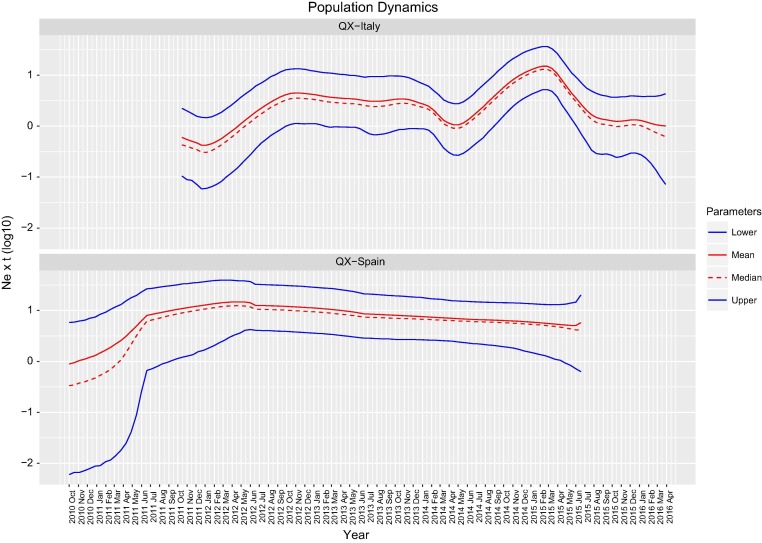
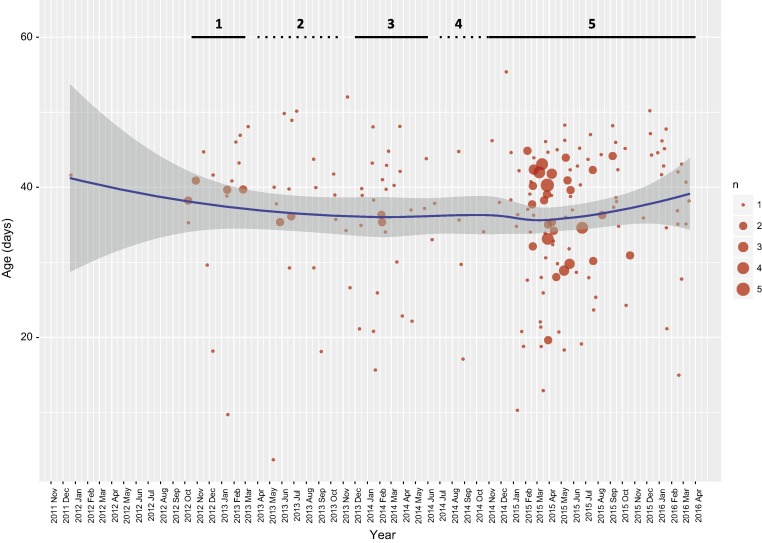
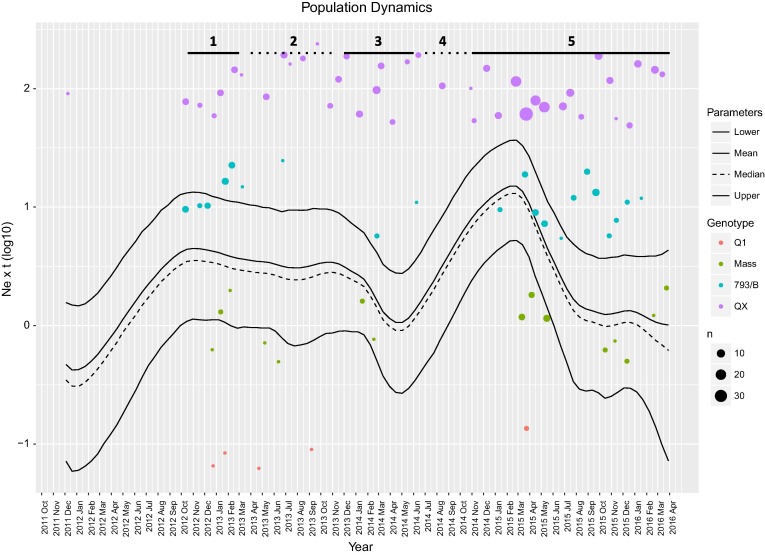
The extreme variability and rapid evolution of Infectious bronchitis virus (IBV) has always represented the key challenge for its control because of the limited cross-protection among different strains. Several experimental trials have proven a broadening of the protection spectrum when animals are vaccinated with multiple genotypes. Nevertheless, the conditions of vaccine administration in field are so different that the generalization of experimental results is, at least, questionable. In the present study a large scale epidemiological-phylodynamic approach was used to reconstruct the demographic history of the major field genotype (i.e. the QX one) circulating in Italy and Spain. These two countries were selected because, even if they share a comparable epidemiological scenario, the implemented vaccination protocols did not vary in Spain while changed dramatically in Italy over the time period considered. One hundred and ninety-five Italian and 98 Spanish non-recombinant sequences of the hyper-variable region of the S1 gene obtained between 2012 and 2016 were analyzed using a serial coalescent-based approach to reconstruct viral population history over time. While the IBV QX population dynamics remained constant in Spain, a much more complex pattern was evidenced in Italy; both in terms of viral population size and clinical outbreak frequency. Remarkably, a strong association with changes in vaccination strategies was recognized. This allowed demonstrating, by accomplishing all Hill's criteria for causation, the cause-effect relationship between the vaccine administration/withdrawal and the variation in viral population dynamics and, above all, IBV related outbreaks. Thus, a robust confirmation about the efficacy of IBV vaccination in field conditions was provided. Additionally, the history herein reported testifies the primary importance of rigorously planning not only the intervention strategies but also their monitoring and evaluation.
传染性支气管炎病毒(IBV)的极端变异性和快速进化一直是其防控的关键挑战,因为不同毒株之间的交叉保护有限。多项实验证明,当用多种基因型对动物进行疫苗接种时,保护谱会拓宽。然而,现场疫苗接种条件差异极大,实验结果的推广至少是值得怀疑的。在本研究中,采用了大规模的流行病学 - 系统动力学方法来重建在意大利和西班牙流行的主要田间基因型(即QX基因型)的种群历史。选择这两个国家是因为,即使它们具有可比的流行病学情况,但在所考虑的时间段内,西班牙实施的疫苗接种方案没有变化,而意大利的方案却发生了巨大变化。使用基于序列合并的方法分析了2012年至2016年间获得的195个意大利和98个西班牙S1基因高变区的非重组序列,以重建病毒种群随时间的历史。虽然IBV QX种群动态在西班牙保持不变,但在意大利却呈现出更为复杂的模式,无论是在病毒种群规模还是临床暴发频率方面。值得注意的是,发现其与疫苗接种策略的变化有很强的关联。通过满足所有希尔因果标准,这证明了疫苗接种/停用与病毒种群动态变化之间的因果关系,尤其是与IBV相关的暴发之间的因果关系。因此,为现场条件下IBV疫苗接种的有效性提供了有力的证实。此外,本文报道的历史证明了不仅要严格规划干预策略,还要对其进行监测和评估的首要重要性。