Uono Shota, Sato Wataru, Kochiyama Takanori, Sawada Reiko, Kubota Yasutaka, Yoshimura Sayaka, Toichi Motomi
Graduate School of Medicine, Kyoto University, 53 Shogoin-Kawahara-cho, Sakyo-ku, Kyoto 606-8507, Japan.
ATR Brain Activity Imaging Center, 2-2-2, Hikaridai, Seika-cho, Souraku-gun, Kyoto 619-0288, Japan.
Soc Cogn Affect Neurosci. 2017 Mar 1;12(3):487-495. doi: 10.1093/scan/nsw142.
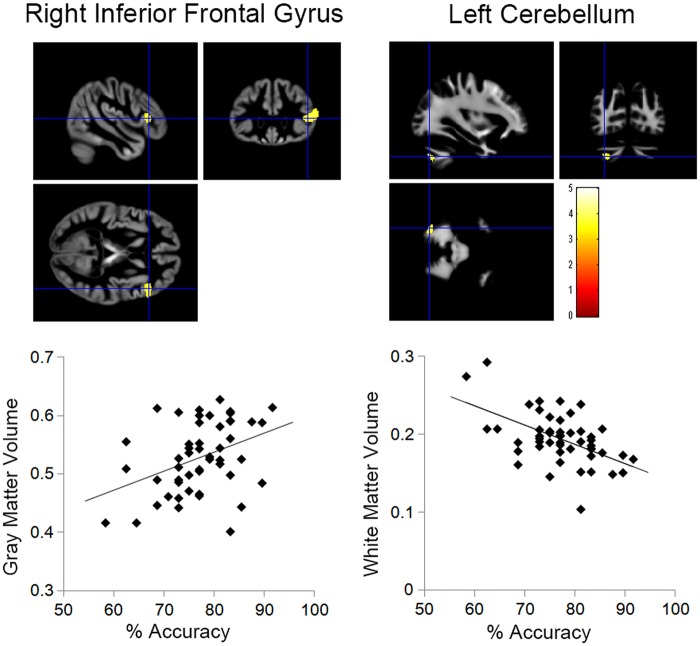
The recognition of facial expressions of emotion is adaptive for human social interaction, but the ability to do this and the manner in which it is achieved differs among individuals. Previous functional neuroimaging studies have demonstrated that some brain regions, such as the inferior frontal gyrus (IFG), are active during the response to emotional facial expressions in healthy participants, and lesion studies have demonstrated that damage to these structures impairs the recognition of facial expressions. However, it remains to be established whether individual differences in the structure of these regions could be associated with differences in the ability to recognize facial expressions. We investigated this issue using acquired structural magnetic resonance imaging, and assessed the performance of healthy adults with respect to recognition of the facial expressions of six basic emotions. The gray matter volume of the right IFG positively correlated with the total accuracy of facial expression recognition. This suggests that individual differences in the ability to recognize facial expressions are associated with differences in the structure of the right IFG. Furthermore, the mirror neuron activity of the IFG may be important for establishing efficient facial mimicry to facilitate emotion recognition.
识别面部情绪表情对人类社交互动具有适应性,但个体在这方面的能力以及实现方式存在差异。先前的功能神经影像学研究表明,一些脑区,如下额回(IFG),在健康参与者对情绪面部表情的反应过程中会被激活,而损伤研究表明,这些结构受损会损害面部表情的识别。然而,这些区域结构的个体差异是否与面部表情识别能力的差异相关,仍有待确定。我们使用获取的结构磁共振成像来研究这个问题,并评估了健康成年人识别六种基本情绪面部表情的表现。右侧IFG的灰质体积与面部表情识别的总准确率呈正相关。这表明面部表情识别能力的个体差异与右侧IFG的结构差异有关。此外,IFG的镜像神经元活动可能对建立有效的面部模仿以促进情绪识别很重要。