Department of Psychological, Health and Territorial Sciences - University "G. d'Annunzio" of Chieti-Pescara, Chieti, Italy.
Cerebellum. 2024 Apr;23(2):545-553. doi: 10.1007/s12311-023-01574-w. Epub 2023 Jun 7.
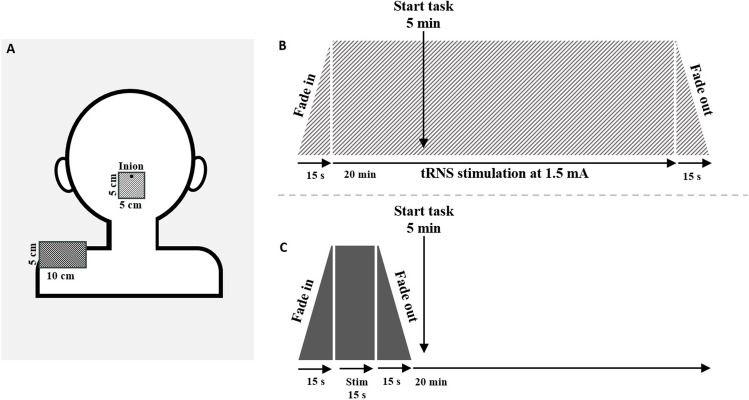
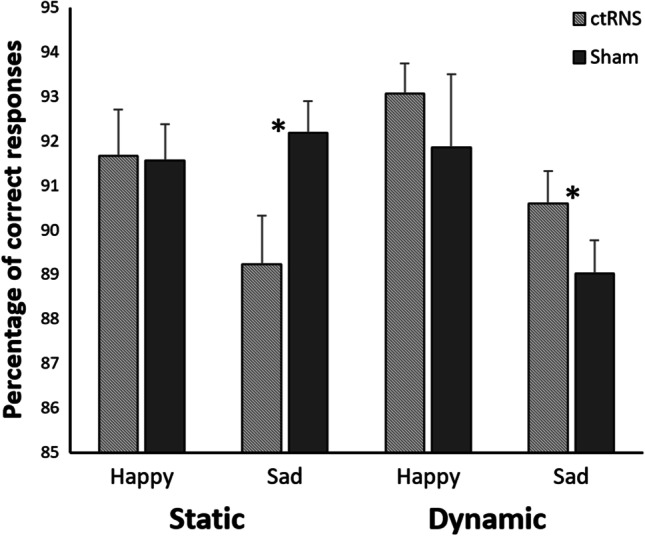
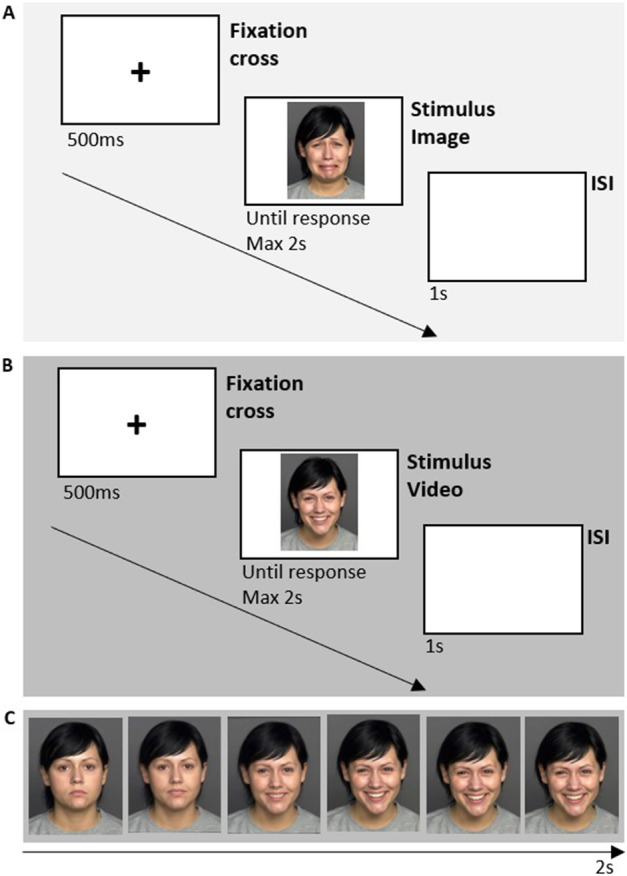
Recent studies have bolstered the important role of the cerebellum in high-level socio-affective functions. In particular, neuroscientific evidence shows that the posterior cerebellum is involved in social cognition and emotion processing, presumably through its involvement in temporal processing and in predicting the outcomes of social sequences. We used cerebellar transcranial random noise stimulation (ctRNS) targeting the posterior cerebellum to affect the performance of 32 healthy participants during an emotion discrimination task, including both static and dynamic facial expressions (i.e., transitioning from a static neutral image to a happy/sad emotion). ctRNS, compared to the sham condition, significantly reduced the participants' accuracy to discriminate static sad facial expressions, but it increased participants' accuracy to discriminate dynamic sad facial expressions. No effects emerged with happy faces. These findings may suggest the existence of two different circuits in the posterior cerebellum for the processing of negative emotional stimuli: a first-time-independent mechanism which can be selectively disrupted by ctRNS, and a second time-dependent mechanism of predictive "sequence detection" which can be selectively enhanced by ctRNS. This latter mechanism might be included among the cerebellar operational models constantly engaged in the rapid adjustment of social predictions based on dynamic behavioral information inherent to others' actions. We speculate that it might be one of the basic principles underlying the understanding of other individuals' social and emotional behaviors during interactions.
最近的研究增强了小脑在高级社会情感功能中的重要作用。特别是,神经科学证据表明,小脑后叶参与社会认知和情绪处理,大概是通过其对时间处理和预测社会序列结果的参与。我们使用针对小脑后叶的小脑经颅随机噪声刺激(ctRNS)来影响 32 名健康参与者在情绪辨别任务中的表现,包括静态和动态面部表情(即,从静态中性图像过渡到快乐/悲伤情绪)。与假刺激相比,ctRNS 显著降低了参与者辨别静态悲伤面部表情的准确性,但增加了参与者辨别动态悲伤面部表情的准确性。对于快乐面孔,没有出现效果。这些发现可能表明,小脑后叶存在两种不同的处理负性情绪刺激的回路:一种是第一次独立的机制,ctRNS 可以选择性地破坏该机制,另一种是预测性“序列检测”的二次时间依赖机制,ctRNS 可以选择性地增强该机制。这种后一种机制可能被包括在小脑的操作模型中,这些模型不断根据他人行为中固有的动态行为信息,对社会预测进行快速调整。我们推测,这可能是理解互动中他人社会和情感行为的基本原则之一。