Shishikura Yutaka, Koarai Akira, Aizawa Hiroyuki, Yamaya Mutsuo, Sugiura Hisatoshi, Watanabe Mika, Hashimoto Yuichiro, Numakura Tadahisa, Makiguti Tomonori, Abe Kyoko, Yamada Mituhiro, Kikuchi Toshiaki, Hoshikawa Yasushi, Okada Yoshinori, Ichinose Masakazu
Department of Respiratory Medicine, Tohoku University Graduate School of Medicine, 1-1 Seiryo-machi, Aoba-ku, Sendai, 980-8574, Japan.
Department of Advanced Preventive Medicine for Infectious Disease Tohoku University Graduate School of Medicine, 1-1 Seiryo-machi, Aoba-ku, Sendai, 980-8575, Japan.
Respir Res. 2016 Sep 27;17(1):121. doi: 10.1186/s12931-016-0438-0.
In response to tissue damage or inflammation, adenosine-5'-triphosphate (ATP) is released into the extracellular compartment and has been demonstrated to augment inflammation via purinergic P2 receptors (P2Rs). Recently, ATP has been shown to be increased in the airways of COPD patients. In the present study, we examined the possible involvement of extracellular ATP in airway mucus hypersecretion during viral-induced COPD exacerbations.
The involvement of extracellular ATP in the release of a major airway mucin, MUC5AC, and its signal pathway was examined after stimulation with polyinosine-polycytidylic acid [poly(I:C)], a synthetic analog of dsRNA to mimic viral infection, and rhinovirus (RV) infection in NCI-H292 cells and differentiated airway epithelial cells from COPD patients.
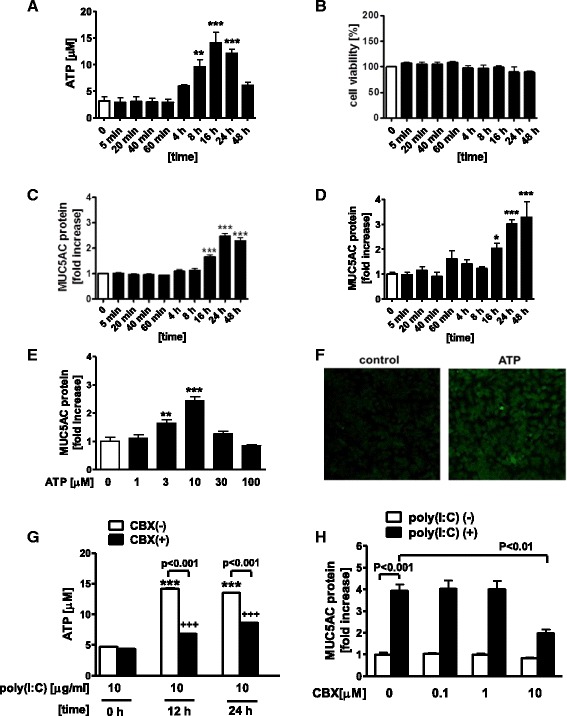
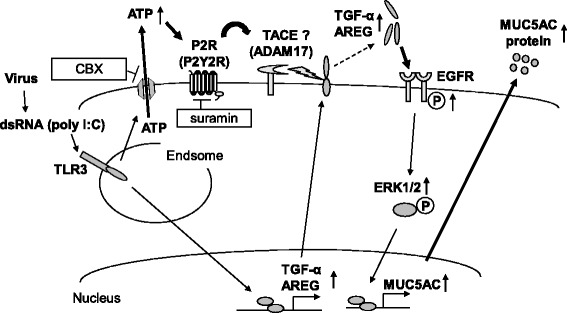
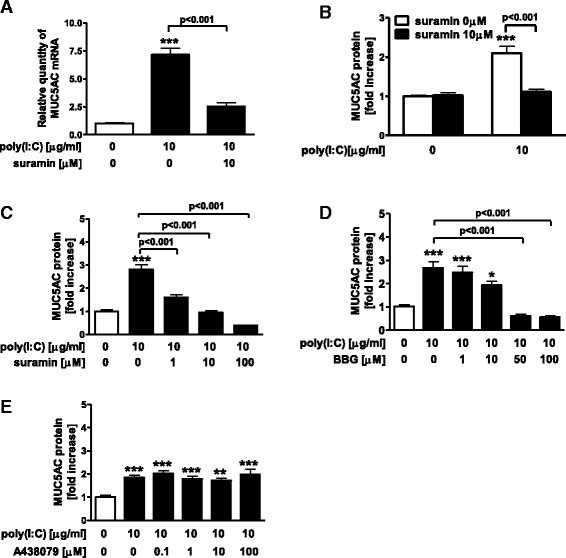
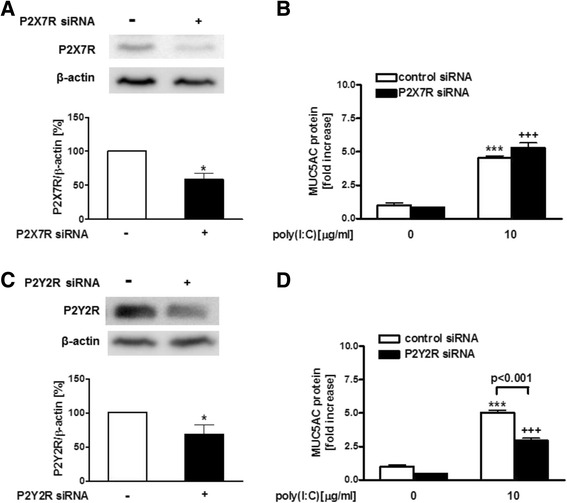
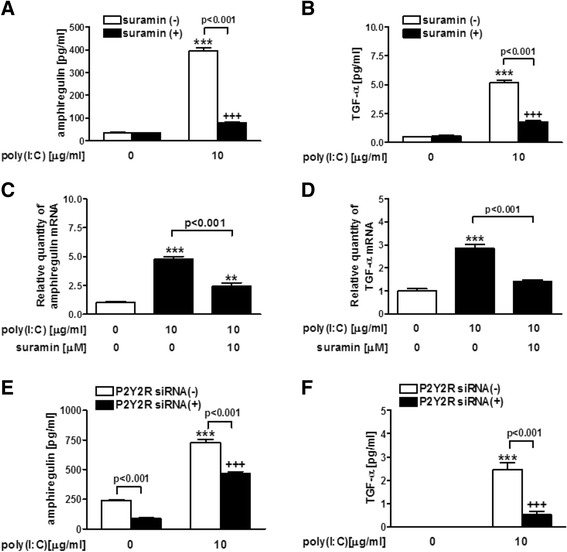
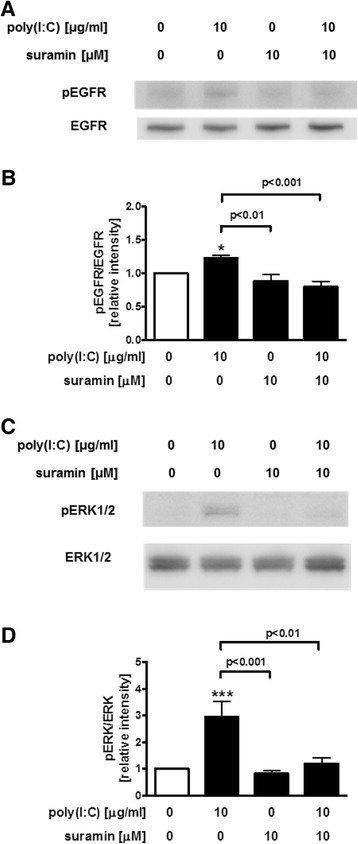
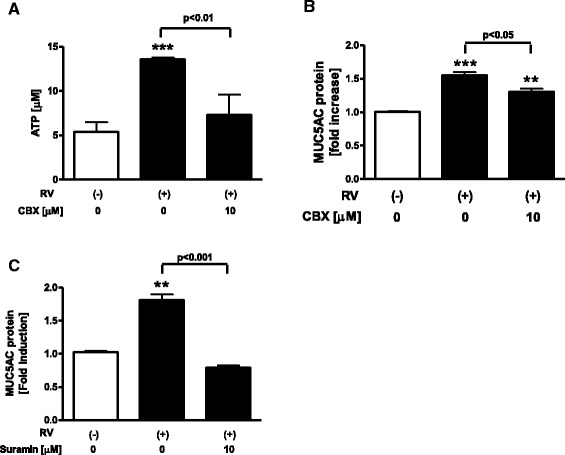
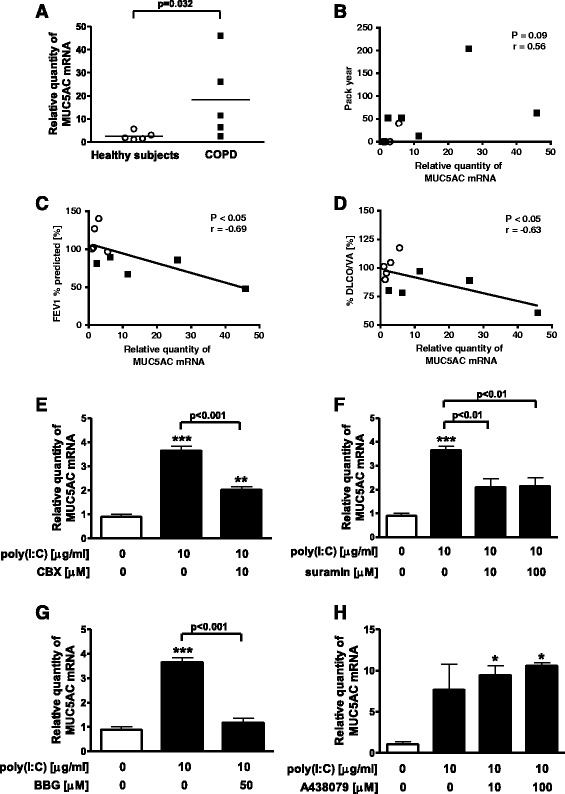
Treatment with poly(I:C) significantly increased the amount of extracellular ATP and induced MUC5AC release in NCI-H292 cells. Pre-treatment with a pannexin channel inhibitor, carbenoxolone (CBX), reduced the amount of extracellular ATP and suppressed MUC5AC release from poly(I:C)-treated cells. Pre-treatment with the P2R antagonist suramin significantly reduced the expression and release of MUC5AC. The inhibitory effects of CBX and suramin on the release of ATP and/or MUC5AC were replicated with RV infection. Pre-treatment with suramin also significantly reduced the expression and amount of extracellular EGFR ligands and the phosphorylation of EGFR and ERK in poly(I:C)-treated cells. In addition, pre-treatment with a P2Y2 receptor siRNA significantly suppressed the poly(I:C)-potentiated EGFR ligands and MUC5AC release. After poly(I:C) stimulation, the expression of MUC5AC in the differentiated cells from COPD patients was significantly higher than those from healthy subjects and the values of MUC5AC expression were inversely related with forced expiratory volume in 1 s (FEV1) % predicted. The inhibitory effects of CBX and suramin on poly(I:C)-potentiated MUC5AC expression were confirmed in differentiated airway epithelium from COPD patients.
These results demonstrate that dsRNA induces the release of ATP via pannexin channel and that the extracellular ATP is involved in the expression and release of MUC5AC, mainly via P2Y2R, in an autocrine manner. Modulation of this pathway could be a therapeutic target for viral-induced mucus hypersecretion in COPD exacerbations.
作为对组织损伤或炎症的反应,腺苷-5'-三磷酸(ATP)释放到细胞外间隙,并已证明可通过嘌呤能P2受体(P2R)增强炎症反应。最近,研究表明慢性阻塞性肺疾病(COPD)患者气道中的ATP水平升高。在本研究中,我们探讨了细胞外ATP在病毒诱导的COPD急性加重期气道黏液高分泌中的可能作用。
用聚肌苷酸-聚胞苷酸[poly(I:C)](一种双链RNA的合成类似物,用于模拟病毒感染)和鼻病毒(RV)感染NCI-H292细胞以及COPD患者的分化气道上皮细胞,研究细胞外ATP在主要气道黏蛋白MUC5AC释放及其信号通路中的作用。
用poly(I:C)处理显著增加了NCI-H292细胞中细胞外ATP的量,并诱导了MUC5AC的释放。用泛连接蛋白通道抑制剂甘草次酸(CBX)预处理可减少细胞外ATP的量,并抑制poly(I:C)处理细胞中MUC5AC的释放。用P2R拮抗剂苏拉明预处理显著降低了MUC5AC的表达和释放。CBX和苏拉明对ATP和/或MUC5AC释放的抑制作用在RV感染中也得到了验证。用苏拉明预处理还显著降低了poly(I:C)处理细胞中细胞外表皮生长因子受体(EGFR)配体的表达和量,以及EGFR和细胞外信号调节激酶(ERK)的磷酸化。此外,用P2Y2受体小干扰RNA(siRNA)预处理显著抑制了poly(I:C)增强的EGFR配体和MUC5AC的释放。poly(I:C)刺激后,COPD患者分化细胞中MUC5AC的表达显著高于健康受试者,且MUC5AC表达值与1秒用力呼气容积(FEV1)预测值呈负相关。在COPD患者的分化气道上皮中证实了CBX和苏拉明对poly(I:C)增强的MUC5AC表达的抑制作用。
这些结果表明,双链RNA通过泛连接蛋白通道诱导ATP释放,细胞外ATP主要通过P2Y2R以自分泌方式参与MUC5AC的表达和释放。调节该信号通路可能是治疗病毒诱导的COPD急性加重期黏液高分泌的靶点。