Lynch Anne M, Wagner Brandie D, Mandava Naresh, Palestine Alan G, Mourani Peter M, McCourt Emily A, Oliver Scott C N, Abman Steven H
Department of Ophthalmology, University of Colorado School of Medicine, Aurora, Colorado, United States.
Department of Biostatistics and Informatics, Colorado School of Public Health, Aurora, Colorado, United States.
Invest Ophthalmol Vis Sci. 2016 Sep 1;57(11):5076-5082. doi: 10.1167/iovs.16-19653.
Retinopathy of prematurity (ROP) is a vision-threatening disease associated with abnormal retinal vascular development. Proteins from the insulin-like growth factor pathway are related to ROP. However, there is a paucity of research on the role of other proteins in ROP. The aim of this study was to identify plasma proteins related to clinically significant ROP.
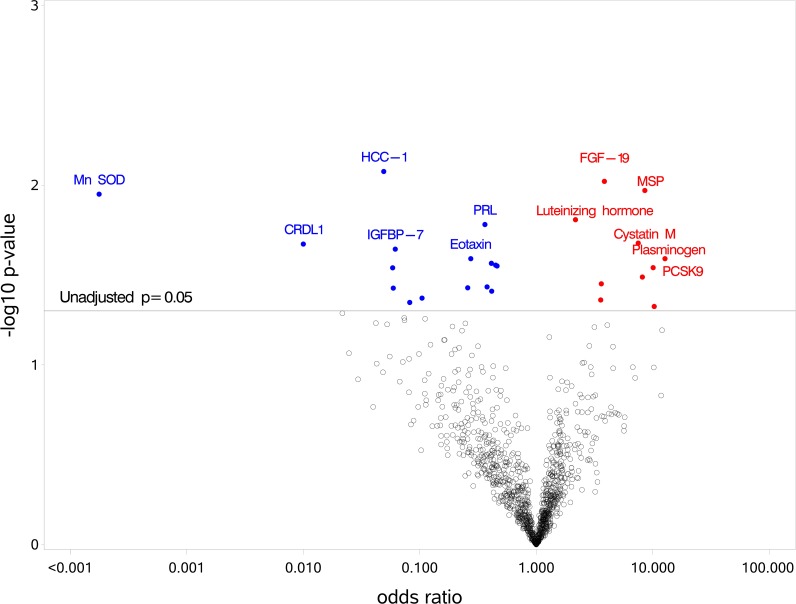
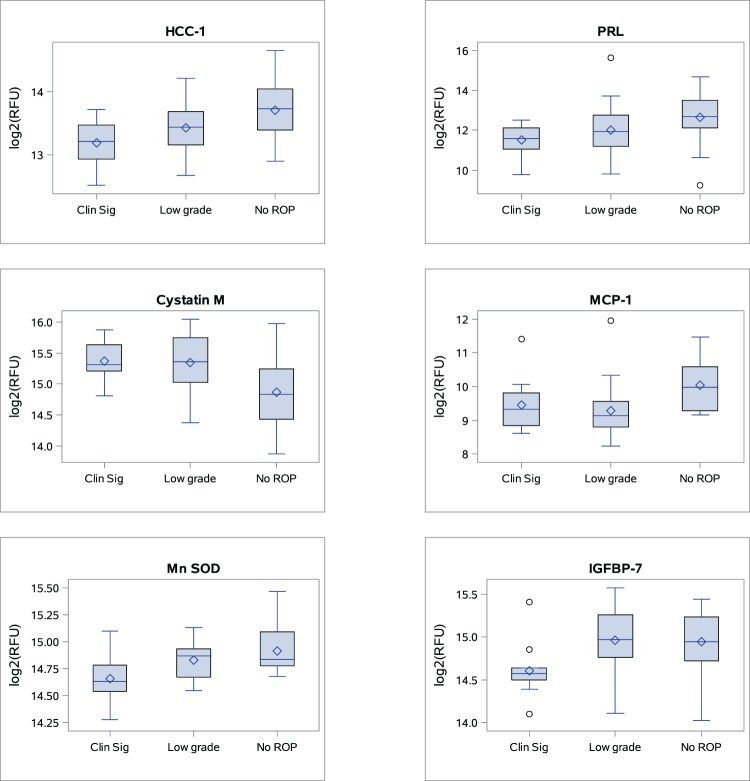
We measured 1121 plasma proteins in the early neonatal period in infants at risk for ROP using an aptamer-based proteomic technology. The primary aim of the study was to compare plasma protein concentrations in infants who did (n = 12) and did not (n = 23) subsequently develop clinically significant ROP using logistic regression. As a secondary aim, we examined patterns in the proteins across categories of clinically significant, low-grade, and no ROP groups.
Lower levels of 16 proteins were associated with an increased risk of clinically significant ROP. In this group, superoxide dismutase (Mn), mitochondrial (MnSOD), and chordin-like protein 1 (CRDL1) were highly ranked. Other proteins in this group included: C-C motif chemokine 14 (HCC-1), prolactin, insulin-like growth factor-binding protein 7 (IGFBP-7), and eotaxin. Higher levels of 12 proteins were associated with a higher risk for ROP. Fibroblast growth factor 19 (FGF-19) was the top-ranked protein target followed by hepatocyte growth factor-like protein (MSP), luteinizing hormone (LH), cystatin M, plasminogen, and proprotein convertase subtilisin/kexin type 9 (PCSK9). We also noted different patterns in the trend of concentrations of proteins across the clinically significant, low-grade, and no ROP groups.
We discovered plasma proteins with novel associations with clinically significant ROP (MnSOD, CRDL1, PCSK9), proteins with links to established ROP signaling pathways (IGFBP-7), and proteins such as MnSOD that may be a target for future therapeutic interventions.
早产儿视网膜病变(ROP)是一种威胁视力的疾病,与视网膜血管发育异常有关。胰岛素样生长因子途径的蛋白质与ROP相关。然而,关于其他蛋白质在ROP中的作用的研究较少。本研究的目的是鉴定与具有临床意义的ROP相关的血浆蛋白质。
我们使用基于适体的蛋白质组学技术在ROP高危婴儿的新生儿早期测量了1121种血浆蛋白质。该研究的主要目的是使用逻辑回归比较随后发生(n = 12)和未发生(n = 23)具有临床意义的ROP的婴儿的血浆蛋白质浓度。作为次要目的,我们检查了具有临床意义、低度和无ROP组中蛋白质的模式。
16种蛋白质水平较低与具有临床意义的ROP风险增加相关。在该组中,线粒体超氧化物歧化酶(Mn)(MnSOD)和类腱蛋白1(CRDL1)排名靠前。该组中的其他蛋白质包括:C-C基序趋化因子14(HCC-1)、催乳素、胰岛素样生长因子结合蛋白7(IGFBP-7)和嗜酸性粒细胞趋化因子。12种蛋白质水平较高与ROP风险较高相关。成纤维细胞生长因子19(FGF-19)是排名最高的蛋白质靶点,其次是肝细胞生长因子样蛋白(MSP)、黄体生成素(LH)、胱抑素M、纤溶酶原和前蛋白转化酶枯草杆菌蛋白酶/kexin 9型(PCSK9)。我们还注意到在具有临床意义、低度和无ROP组中蛋白质浓度趋势的不同模式。
我们发现了与具有临床意义的ROP有新关联的血浆蛋白质(MnSOD、CRDL1、PCSK9)、与已确立的ROP信号通路相关的蛋白质(IGFBP-7)以及可能成为未来治疗干预靶点的蛋白质,如MnSOD。