D Ramakrishna, Rao Pragna
Department of Biochemistry, Kamineni Institute of Medical Sciences , Sreepuram, Narketpally, Nalgonda-508 254.
Department of Biochemistry, Kasturba Medical College , Manipal, Karnataka.
EJIFCC. 2011 Dec 22;22(4):92-101. eCollection 2011 Dec.
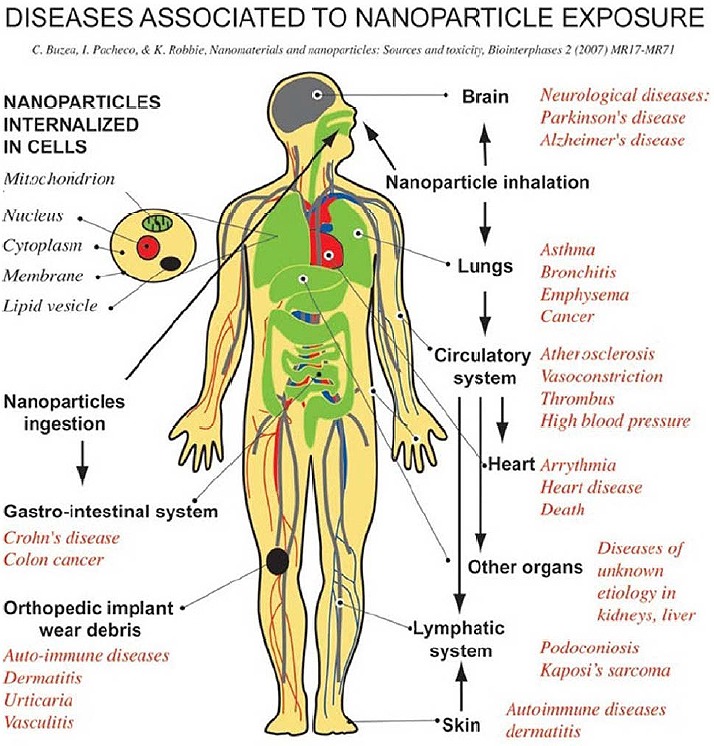
Nanotechnology involving manipulation of atoms and molecules at the nanoscale is one of the frontier areas of research in modern science. During the last few years, nanotechnology has witnessed breakthroughs in the fields of medicine, environment, therapeutics, drug development and biotechnology. This is due to the unique properties of nanomaterials (e.g. chemical, mechanical, optical, magnetic, and biological) which make them desirable for commercial and medical applications. Considering the theory and practice of using nanoparticles, nanotechnology has a great potential in improving treatment of various disorders and in vitro diagnostics. However, there is not much information available on the toxicity of nanoparticles in relation to human health. Toxic effect of nanomaterials on humans is the primary concern of the health industry. Nanomaterials are able to cross biological membranes and access cells, tissues and organs that larger-sized particles normally cannot. Nanomaterials can gain access to the blood stream via inhalation or ingestion. This may lead to both genotoxicity and biochemical toxicity. In this review we try to show which types, sizes and concentrations of nanoparticles are safe for human use and this will help in developing diagnostic, prognostic and therapeutic models using nanoparticles.
涉及在纳米尺度上操纵原子和分子的纳米技术是现代科学研究的前沿领域之一。在过去几年中,纳米技术在医学、环境、治疗学、药物开发和生物技术等领域取得了突破。这是由于纳米材料具有独特的性质(如化学、机械、光学、磁性和生物学性质),使其在商业和医学应用中具有吸引力。考虑到使用纳米颗粒的理论和实践,纳米技术在改善各种疾病的治疗和体外诊断方面具有巨大潜力。然而,关于纳米颗粒对人类健康的毒性,目前可用的信息并不多。纳米材料对人类的毒性作用是健康行业主要关注的问题。纳米材料能够穿过生物膜并进入较大尺寸颗粒通常无法进入的细胞、组织和器官。纳米材料可通过吸入或摄入进入血流。这可能导致遗传毒性和生化毒性。在本综述中,我们试图表明哪些类型、尺寸和浓度的纳米颗粒对人类使用是安全的,这将有助于开发使用纳米颗粒的诊断、预后和治疗模型。