Schiavon Michela, Berto Chiara, Malagoli Mario, Trentin Annarita, Sambo Paolo, Dall'Acqua Stefano, Pilon-Smits Elizabeth A H
Department of Agronomy, Food, Natural Resources, Animals and the Environment, University of PadovaLegnaro, Italy; Biology Department, Colorado State UniversityFort Collins, MS, USA.
Department of Pharmaceutical and Pharmacological Sciences, University of Padova Padova, Italy.
Front Plant Sci. 2016 Sep 14;7:1371. doi: 10.3389/fpls.2016.01371. eCollection 2016.
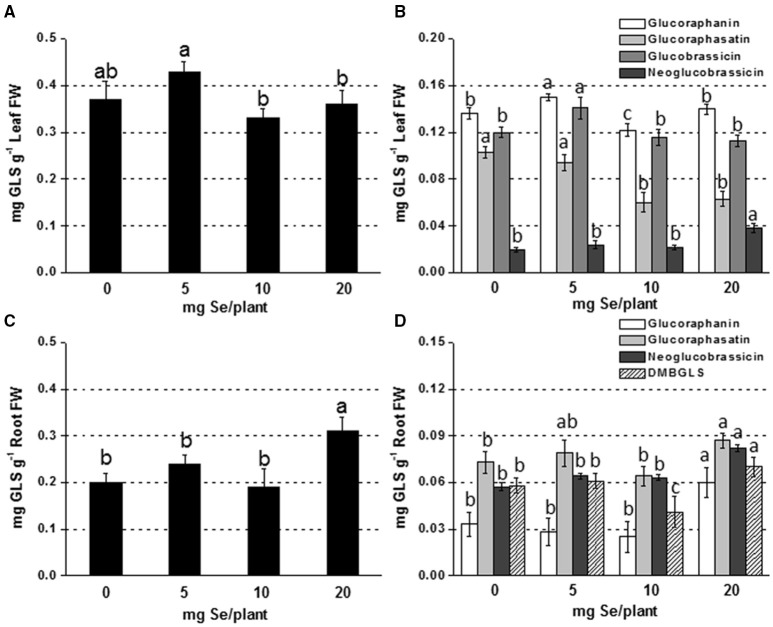
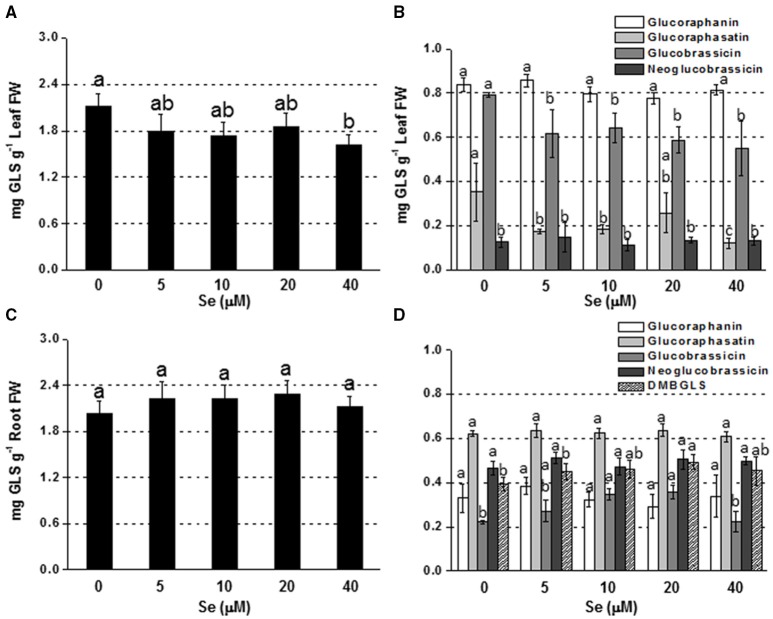
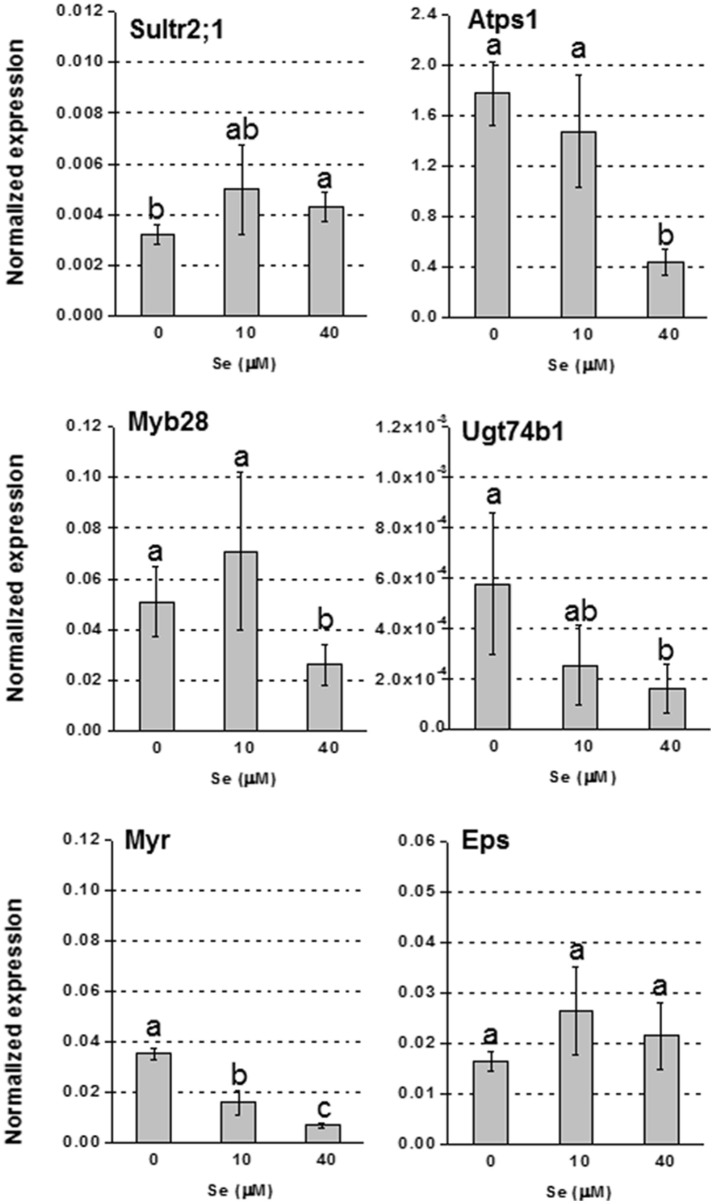
Two selenium (Se) fertilization methods were tested for their effects on levels of anticarcinogenic selenocompounds in radish (Raphanus sativus), as well as other nutraceuticals. First, radish was grown on soil and foliar selenate applied 7 days before harvest at 0, 5, 10, and 20 mg Se per plant. Selenium levels were up to 1200 mg Se/kg DW in leaves and 120 mg Se/kg DW in roots. The thiols cysteine and glutathione were present at 2-3-fold higher levels in roots of Se treated plants, and total glucosinolate levels were 35% higher, due to increases in glucoraphanin. The only seleno-aminoacid detected in Se treated plants was Se-methyl-SeCys (100 mg/kg FW in leaves, 33 mg/kg FW in roots). The levels of phenolic aminoacids increased with selenate treatment, as did root total nitrogen and protein content, while the level of several polyphenols decreased. Second, radish was grown in hydroponics and supplied with 0, 5, 10, 20, or 40 μM selenate for 1 week. Selenate treatment led to a 20-30% increase in biomass. Selenium concentration was 242 mg Se/kg DW in leaves and 85 mg Se/kg DW in roots. Cysteine levels decreased with Se in leaves but increased in roots; glutatione levels decreased in both. Total glucosinolate levels in leaves decreased with Se treatment due to repression of genes involved in glucosinolates metabolism. Se-methyl-SeCys concentration ranged from 7-15 mg/kg FW. Aminoacid concentration increased with Se treatment in leaves but decreased in roots. Roots of Se treated plants contained elevated transcript levels of sulfate transporters (Sultr) and ATP sulfurylase, a key enzyme of S/Se assimilation. No effects on polyphenols were observed. In conclusion, Se biofortification of radish roots may be achieved via foliar spray or hydroponic supply. One to ten radishes could fulfill the daily human requirement (70 μg) after a single foliar spray of 5 mg selenate per plant or 1 week of 5-10 μM selenate supply in hydroponics. The radishes metabolized selenate to the anticarcinogenic compound Se-methyl-selenocysteine. Selenate treatment enhanced levels of other nutraceuticals in radish roots, including glucoraphanin. Therefore, Se biofortification can produce plants with superior health benefits.
测试了两种硒(Se)施肥方法对萝卜(Raphanus sativus)中抗癌硒化合物以及其他营养保健品含量的影响。首先,萝卜种植在土壤中,在收获前7天进行叶面喷施硒酸盐,每株植物的施用量分别为0、5、10和20毫克硒。叶片中的硒含量高达1200毫克硒/千克干重,根部为120毫克硒/千克干重。经硒处理的植物根部中硫醇半胱氨酸和谷胱甘肽的含量高出2至3倍,由于萝卜硫素增加,总硫代葡萄糖苷含量高出35%。在经硒处理的植物中检测到的唯一硒氨基酸是硒甲基硒代半胱氨酸(叶片中为100毫克/千克鲜重,根部为33毫克/千克鲜重)。随着硒酸盐处理,酚类氨基酸的含量增加,根部总氮和蛋白质含量也增加,而几种多酚的含量则下降。其次,萝卜采用水培法种植,供应0、5、10、20或40微摩尔的硒酸盐,持续1周。硒酸盐处理使生物量增加了20%至30%。叶片中的硒浓度为242毫克硒/千克干重,根部为85毫克硒/千克干重。叶片中半胱氨酸的含量随硒含量的增加而下降,但根部增加;谷胱甘肽的含量在两者中均下降。由于参与硫代葡萄糖苷代谢的基因受到抑制,叶片中总硫代葡萄糖苷含量随硒处理而下降。硒甲基硒代半胱氨酸浓度在7至15毫克/千克鲜重之间。氨基酸浓度在叶片中随硒处理而增加,但在根部下降。经硒处理的植物根部中硫酸盐转运蛋白(Sultr)和ATP硫酸化酶(S/Se同化的关键酶)的转录水平升高。未观察到对多酚的影响。总之,可通过叶面喷施或水培供应实现萝卜根部的硒生物强化。在每株植物单次叶面喷施5毫克硒酸盐或在水培中供应5至10微摩尔硒酸盐1周后,一到十个萝卜就能满足人体每日需求(70微克)。萝卜将硒酸盐代谢为抗癌化合物硒甲基硒代半胱氨酸。硒酸盐处理提高了萝卜根部中其他营养保健品的含量,包括萝卜硫素。因此,硒生物强化能够培育出对健康更有益的植物。