Zhou Youlian, Chen Huiting, He Hanchang, Du Yanlei, Hu Jiaqi, Li Yingfei, Li Yuyuan, Zhou Yongjian, Wang Hong, Chen Ye, Nie Yuqiang
aDepartment of Gastroenterology, Guangzhou Digestive Disease Center, Guangzhou First People's Hospital, Guangzhou Medical University, Guangzhou bThe First People's Foshan Hospital, Chancheng District, Foshan, Guangdong cDepartment of Pediatrics, Guangzhou First People's Hospital, Guangzhou Medical University dGuangdong Provincial Key Laboratory of Gastroenterology, Department of Gastroenterology, Nanfang Hospital, Southern Medical University, Guangzhou, P. R. China.
Medicine (Baltimore). 2016 Sep;95(39):e5019. doi: 10.1097/MD.0000000000005019.
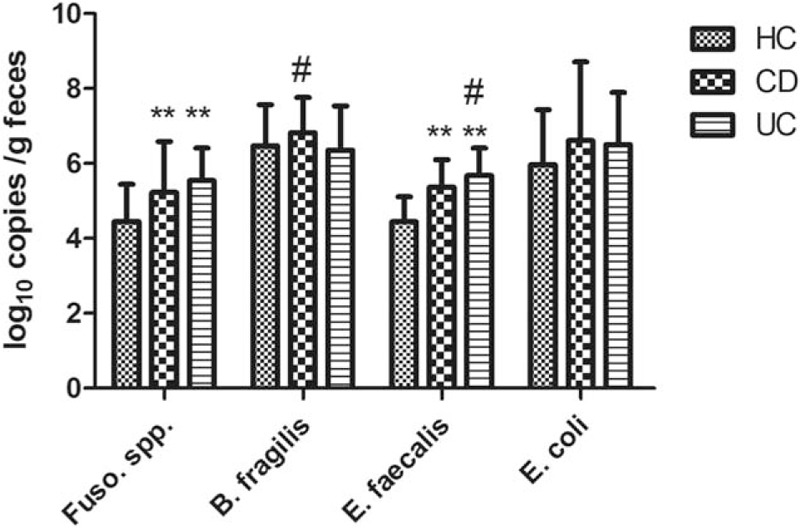
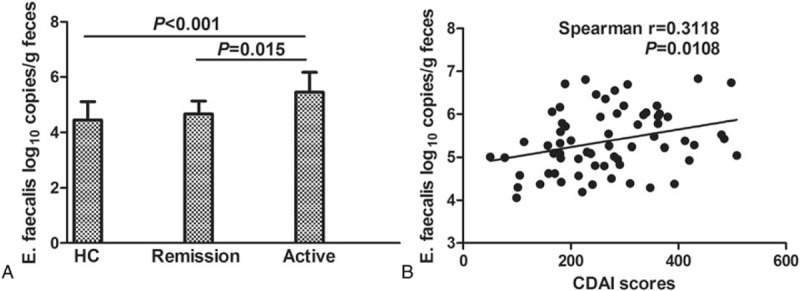
This study was performed to investigate the relationship between the abundance of pathogenic gut microbes in Chinese patients with inflammatory bowel disease (IBD) and disease severity.We collected clinical data and fecal samples from 47 therapy-naive Chinese patients with ulcerative colitis (UC), 67 patients with Crohn disease (CD), and 48 healthy volunteers. Bacteria levels of Fusobacterium species (spp), enterotoxigenic Bacteroides fragilis (B fragilis), enteropathogenic Escherichia coli (E coli), and Enterococcus faecalis (E faecalis) were assessed by quantitative real-time PCR (qRT-PCR). Spearman correlation coefficients were calculated to test associations between bacterial content and clinical parameters.Compared to healthy controls, the levels of both Fusobacterium spp and E faecalis were significantly increased in the feces of patients with IBD (P < 0.01). B fragilis levels were higher (P < 0.05) and E faecalis levels lower (P < 0.05) in patients with CD compared to those with UC. Increased E faecalis colonization in CD associated positively with disease activity (P = 0.015), Crohn disease activity index (CDAI; R = 0.3118, P = 0.0108), and fecal calprotectin (P = 0.016).E faecalis and Fusobacterium spp are significantly enriched in patients with IBD, and increased E faecalis infection is associated with clinically active CD.
本研究旨在探讨中国炎症性肠病(IBD)患者肠道致病微生物丰度与疾病严重程度之间的关系。我们收集了47例初治的中国溃疡性结肠炎(UC)患者、67例克罗恩病(CD)患者及48名健康志愿者的临床资料和粪便样本。采用定量实时聚合酶链反应(qRT-PCR)检测具核梭杆菌(Fusobacterium species,spp)、产肠毒素脆弱拟杆菌(Bacteroides fragilis,B fragilis)、肠致病性大肠杆菌(Escherichia coli,E coli)和粪肠球菌(Enterococcus faecalis,E faecalis)的细菌水平。计算Spearman相关系数以检验细菌含量与临床参数之间的相关性。与健康对照相比,IBD患者粪便中具核梭杆菌spp和粪肠球菌的水平均显著升高(P<0.01)。与UC患者相比,CD患者的脆弱拟杆菌水平更高(P<0.05),粪肠球菌水平更低(P<0.05)。CD患者中粪肠球菌定植增加与疾病活动度呈正相关(P = 0.015)、与克罗恩病活动指数(CDAI;R = 0.3118,P = 0.0108)及粪便钙卫蛋白呈正相关(P = 0.016)。IBD患者中粪肠球菌和具核梭杆菌spp显著富集,粪肠球菌感染增加与临床活动期CD相关。