Xie Qihai, Wei Tong, Huang Chenglin, Liu Penghao, Sun Mengwei, Shen Weili, Gao Pingjin
State Key Laboratory of Medical Genomics, Shanghai Key Laboratory of Hypertension, Department of Hypertension Ruijin Hospital, Shanghai Jiaotong University School of Medicine, Shanghai, China.
Department of Cardiology, Shanghai Jiading District Central Hospital, Shanghai, China.
Sci Rep. 2016 Sep 30;6:34326. doi: 10.1038/srep34326.
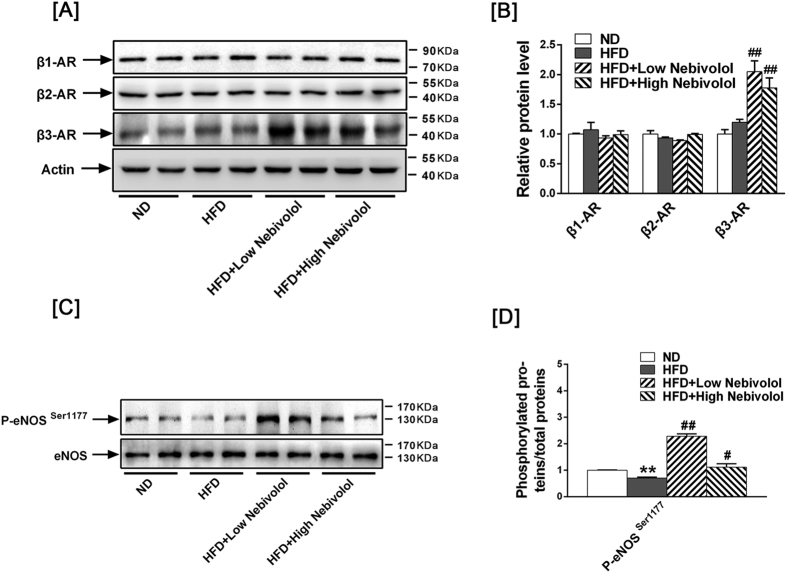
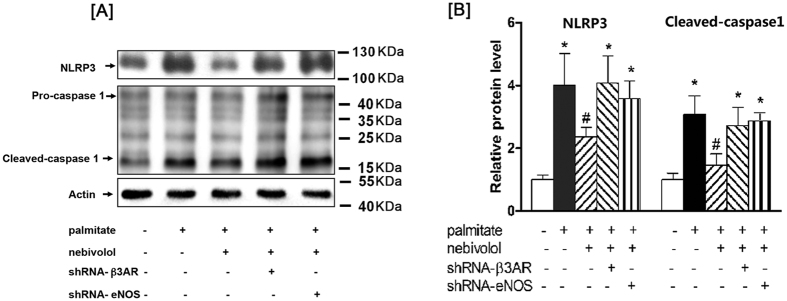
NLRP3 is involved in obesity-induced cardiac remodeling and dysfunction. In this study, we evaluated whether the cardiac protective effects of nebivolol relied on attenuating NLRP3 activation in a juvenile-adolescent animal model of diet-induced obesity. Weaning male Sprague-Dawley rats were fed with either a standard chow diet (ND) or a high-fat diet (HFD) for 8 weeks. The obese rats were subsequently subdivided into three groups: 1) HFD control group; 2) HFD with low-dose nebivolol (5 mg/kg/d); 3) HFD with high-dose nebivolol (10 mg/kg/d). Treatment with nebivolol prevented HFD-induced obesity associated excess cardiac lipid accumulation as well as myocardial mitochondrial dysfunction. Nebivolol attenuated pro-inflammatory cytokines secretion and NLRP3 inflammasome activation in myocardium of obese rats. In parallel, nebivolol treatment of obese animals increased cardiac β3-AR expression, reversing the reduction of endothelial nitric oxide synthase (eNOS). In vitro, nebivolol treatment of palmitate-incubated H9C2 cells suppressed autophagy, restored mitochondrial biogenesis, leading to decreased mitochondrial reactive oxygen species (mtROS) generation, and suppressed NLRP3 inflammasome activation. Meanwhile the presence of shRNA against β3-AR or against eNOS deteriorated the protective effects of nebivolol. These data suggest the beneficial effect of nebivolol on myocardial lipotoxicity contributing to inhibiting NLRP3 inflammasome activation possibly via improved mitochondrial dysfunction.
NLRP3参与肥胖诱导的心脏重塑和功能障碍。在本研究中,我们评估了奈必洛尔的心脏保护作用是否依赖于在饮食诱导肥胖的幼年-青少年动物模型中减弱NLRP3的激活。将断奶的雄性Sprague-Dawley大鼠用标准饲料(正常饮食组)或高脂饮食喂养8周。随后将肥胖大鼠分为三组:1)高脂饮食对照组;2)低剂量奈必洛尔(5毫克/千克/天)高脂饮食组;3)高剂量奈必洛尔(10毫克/千克/天)高脂饮食组。奈必洛尔治疗可预防高脂饮食诱导的肥胖相关的过量心脏脂质积累以及心肌线粒体功能障碍。奈必洛尔可减轻肥胖大鼠心肌中促炎细胞因子的分泌和NLRP3炎性小体的激活。同时,对肥胖动物进行奈必洛尔治疗可增加心脏β3-肾上腺素能受体(β3-AR)的表达,逆转内皮型一氧化氮合酶(eNOS)的减少。在体外,用奈必洛尔处理棕榈酸孵育的H9C2细胞可抑制自噬,恢复线粒体生物合成,导致线粒体活性氧(mtROS)生成减少,并抑制NLRP3炎性小体的激活。同时,针对β3-AR或eNOS的短发夹RNA(shRNA)的存在会削弱奈必洛尔的保护作用。这些数据表明奈必洛尔对心肌脂毒性具有有益作用,可能通过改善线粒体功能障碍来抑制NLRP3炎性小体的激活。