Berzingi Seher, Newman Mackenzie, Yu Han-Gang
Department of Biology, West Virginia University, Morgantown, WV 26506 USA.
Department of Physiology & Pharmacology, West Virginia University, Morgantown, WV 26506 USA.
Cancer Cell Int. 2016 Sep 22;16:72. doi: 10.1186/s12935-016-0348-8. eCollection 2016.
Membrane depolarization is associated with breast cancer. Depolarization-activated voltage-gated ion channels are directly implicated in the initiation, proliferation, and metastasis of breast cancer.
In this study, the role of voltage-gated potassium and calcium ion channel modulation was explored in two different invasive ductal human carcinoma cell lines, MDA-MB-231 (triple-negative) and MCF7 (estrogen-receptor-positive).
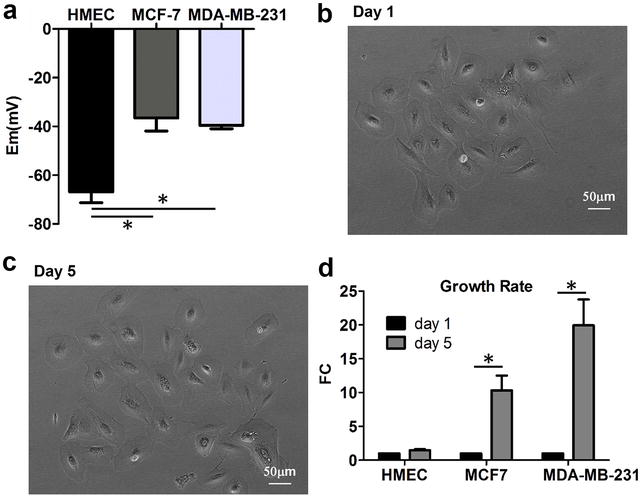
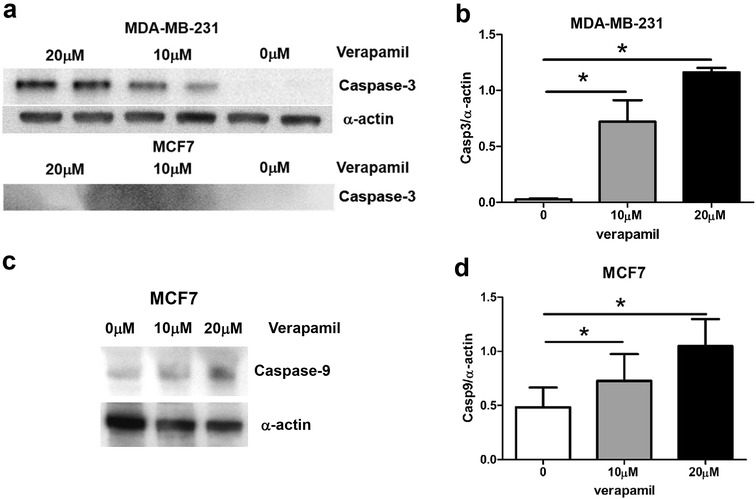
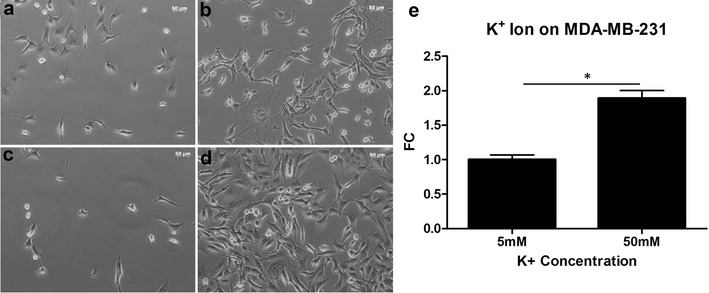
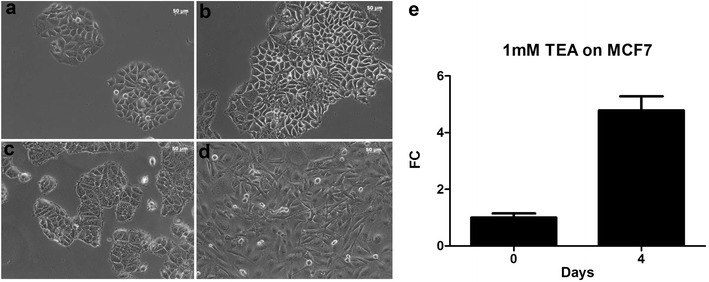
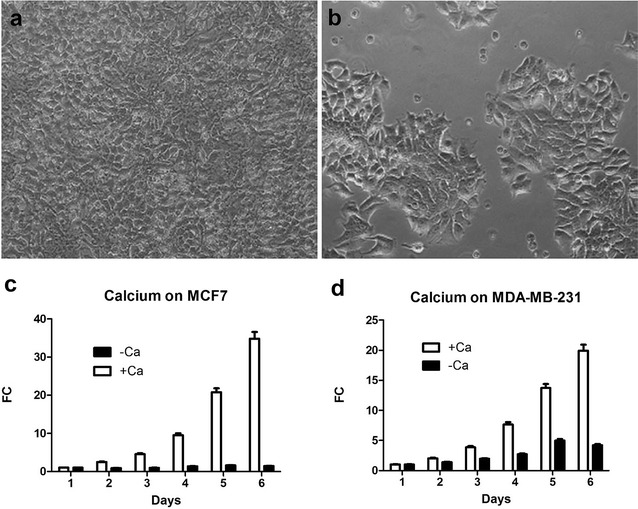
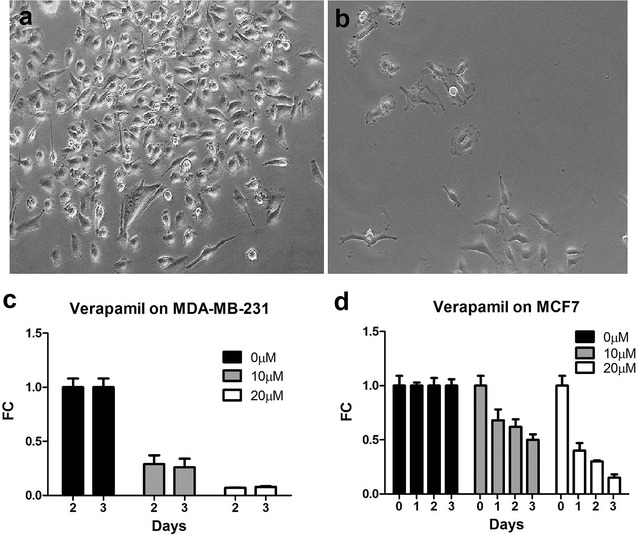
Resting membrane potential is more depolarized in MCF7 and MDA-MB-231 cells compared to normal human mammary epithelial cells. Increasing extracellular potassium concentration up to 50 mM depolarized membrane potential and greatly increased cell growth. Tetraethylammonium (TEA), a non-specific blocker of voltage-gated potassium channels, stimulated growth of MCF7 cells (control group grew by 201 %, 1 mM TEA group grew 376 %). Depolarization-induced calcium influx was hypothesized as a requirement for growth of human breast cancer. Removing calcium from culture medium stopped growth of MDA and MCF7 cells, leading to cell death after 1 week. Verapamil, a blocker of voltage-gated calcium channels clinically used in treating hypertension and coronary disease, inhibited growth of MDA cells at low concentration (10-20 μM) by 73 and 92 % after 1 and 2 days, respectively. At high concentration (100 μM), verapamil killed >90 % of MDA and MCF7 cells after 1 day. Immunoblotting experiments demonstrated that an increased expression of caspase-3, critical in apoptosis signaling, positively correlated with verapamil concentration in MDA cells. In MCF7, caspase-9 expression is increased in response to verapamil.
Our results support our hypotheses that membrane depolarization and depolarization-induced calcium influx stimulate proliferation of human breast cancer cells, independently of cancer subtypes. The underlying mechanism of verapamil-induced cell death involves different caspases in MCF7 and MDA-MB-231. These data suggest that voltage-gated potassium and calcium channels may be putative targets for pharmaceutical remediation in human invasive ductal carcinomas.
膜去极化与乳腺癌相关。去极化激活的电压门控离子通道直接参与乳腺癌的起始、增殖和转移。
在本研究中,探讨了电压门控钾离子和钙离子通道调节在两种不同的人浸润性导管癌细胞系MDA-MB-231(三阴性)和MCF7(雌激素受体阳性)中的作用。
与正常人乳腺上皮细胞相比,MCF7和MDA-MB-231细胞的静息膜电位去极化程度更高。将细胞外钾离子浓度提高至50 mM会使膜电位去极化,并显著增加细胞生长。四乙铵(TEA)是一种电压门控钾通道的非特异性阻滞剂,可刺激MCF7细胞生长(对照组增长201%,1 mM TEA组增长376%)。去极化诱导的钙内流被认为是人类乳腺癌生长所必需的。从培养基中去除钙会使MDA和MCF7细胞停止生长,1周后导致细胞死亡。维拉帕米是一种临床上用于治疗高血压和冠心病的电压门控钙通道阻滞剂,在低浓度(10 - 20 μM)时,分别在1天和2天后抑制MDA细胞生长73%和92%。在高浓度(100 μM)时,维拉帕米在1天后杀死了>90%的MDA和MCF7细胞。免疫印迹实验表明,凋亡信号传导中的关键蛋白caspase-3表达增加与MDA细胞中维拉帕米浓度呈正相关。在MCF7细胞中,维拉帕米会使caspase-9表达增加。
我们的结果支持我们的假设,即膜去极化和去极化诱导的钙内流刺激人类乳腺癌细胞增殖,与癌症亚型无关。维拉帕米诱导细胞死亡的潜在机制涉及MCF7和MDA-MB-231中不同的半胱天冬酶。这些数据表明,电压门控钾通道和钙通道可能是人类浸润性导管癌药物治疗的潜在靶点。