Leisi Remo, Von Nordheim Marcus, Ros Carlos, Kempf Christoph
Department of Chemistry and Biochemistry, University of Bern, Bern 3012, Switzerland.
CSL Behring AG, Bern 3014, Switzerland.
Viruses. 2016 Sep 28;8(10):265. doi: 10.3390/v8100265.
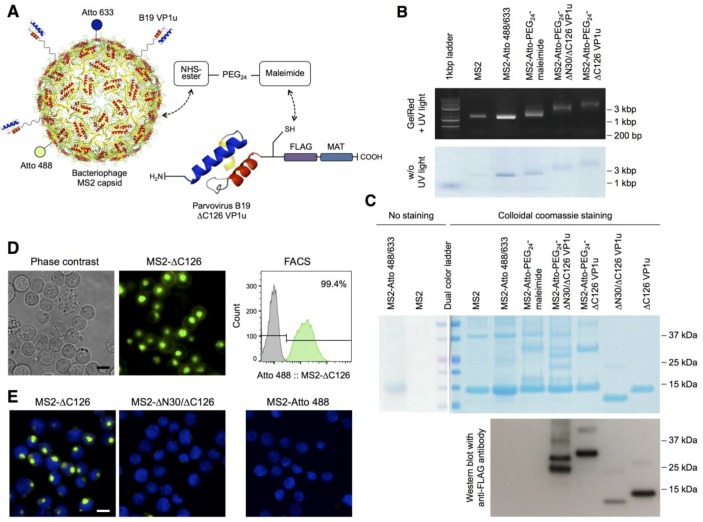
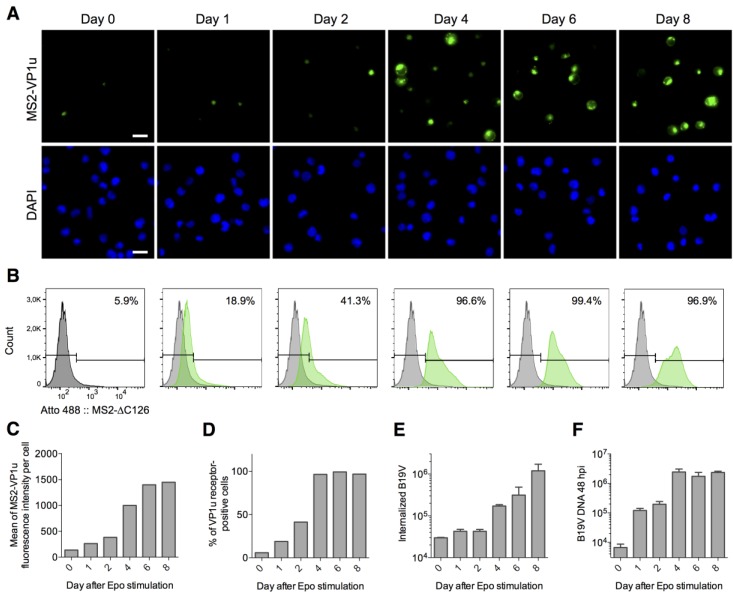
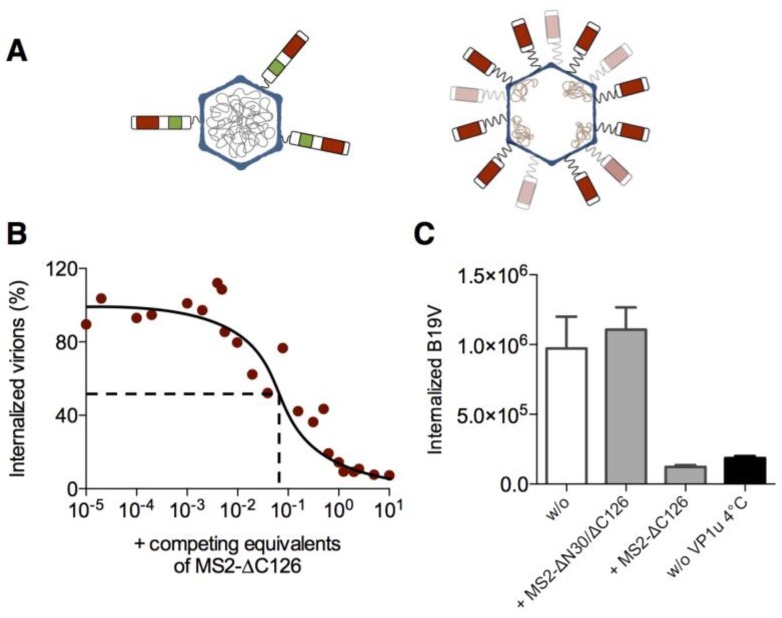
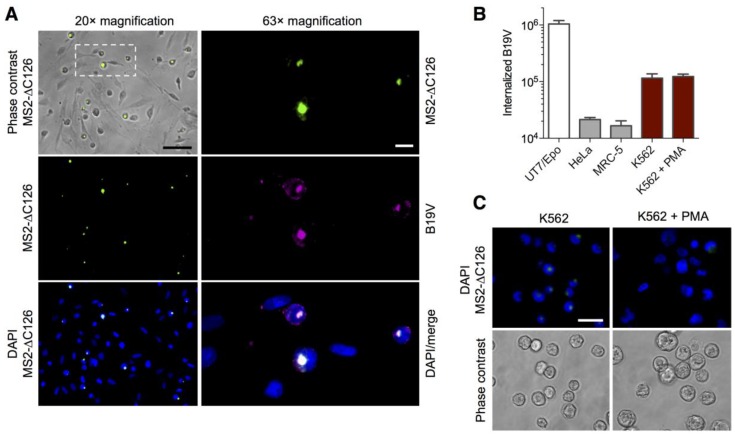
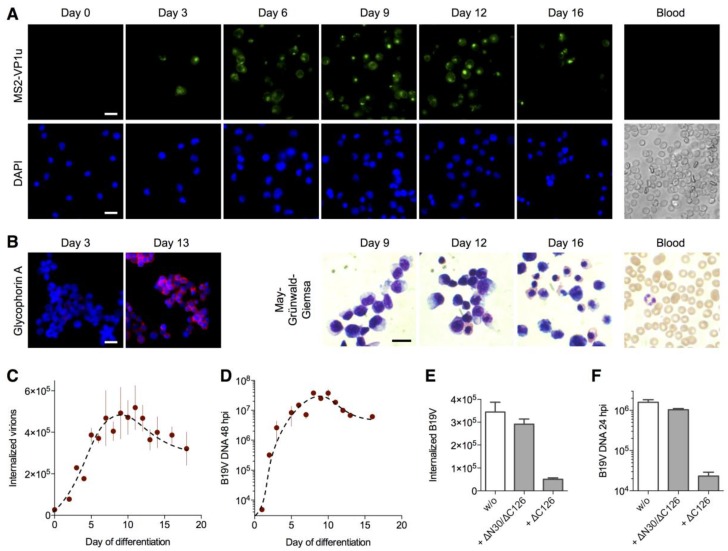
Parvovirus B19 (B19V) is a small non-enveloped virus and known as the causative agent for the mild childhood disease . B19V has an extraordinary narrow tissue tropism, showing only productive infection in erythroid precursor cells in the bone marrow. We recently found that the viral protein 1 unique region (VP1u) contains an N-terminal receptor-binding domain (RBD), which mediates the uptake of the virus into cells of the erythroid lineage. To further investigate the role of the RBD in connection with a B19V-unrelated capsid, we chemically coupled the VP1u of B19V to the bacteriophage MS2 capsid and tested the internalization capacity of the bioconjugate on permissive cells. In comparison, we studied the cellular uptake and infection of B19V along the erythroid differentiation. The results showed that the MS2-VP1u bioconjugate mimicked the specific internalization of the native B19V into erythroid precursor cells, which further coincides with the restricted infection profile. The successful mimicry of B19V uptake demonstrates that the RBD in the VP1u is sufficient for the endocytosis of the viral capsid. Furthermore, the recombinant VP1u competed with B19V uptake into permissive cells, thus excluding a significant alternative uptake mechanism by other receptors. Strikingly, the VP1u receptor appeared to be expressed only on erythropoietin-dependent erythroid differentiation stages that also provide the necessary intracellular factors for a productive infection. Taken together, these findings suggest that the VP1u binds to a yet-unknown erythroid-specific cellular receptor and thus restricts the virus entry to permissive cells.
细小病毒B19(B19V)是一种小型无包膜病毒,是儿童轻度疾病的病原体。B19V具有非常狭窄的组织嗜性,仅在骨髓中的红系前体细胞中表现出有效感染。我们最近发现,病毒蛋白1独特区域(VP1u)包含一个N端受体结合域(RBD),该结构域介导病毒进入红系谱系细胞。为了进一步研究RBD在与B19V无关的衣壳中的作用,我们将B19V的VP1u化学偶联到噬菌体MS2衣壳上,并测试了生物偶联物在允许细胞上的内化能力。相比之下,我们研究了B19V在红系分化过程中的细胞摄取和感染情况。结果表明,MS2-VP1u生物偶联物模拟了天然B19V向红系前体细胞的特异性内化,这与受限的感染谱进一步吻合。成功模拟B19V摄取表明,VP1u中的RBD足以实现病毒衣壳的内吞作用。此外,重组VP1u与B19V摄取进入允许细胞的过程竞争,从而排除了其他受体的重要替代摄取机制。引人注目的是,VP1u受体似乎仅在依赖促红细胞生成素的红系分化阶段表达,该阶段也为有效感染提供了必要的细胞内因子。综上所述,这些发现表明VP1u与一种未知的红系特异性细胞受体结合,从而限制病毒进入允许细胞。