Liu Shuaibin, Hao Xiaoming, Ouyang Xiaolan, Dong Xiaojing, Yang Yixuan, Yu Tinghe, Hu Jianguo, Hu Lina
Department of Obstetrics and Gynecology, The Second Affiliated Hospital of Chongqing Medical University, Chongqing, PR China.
Department of Infectious Diseases, The Second Affiliated Hospital of Chongqing Medical University, Chongqing, PR China.
Oncotarget. 2016 Nov 15;7(46):75468-75481. doi: 10.18632/oncotarget.12258.
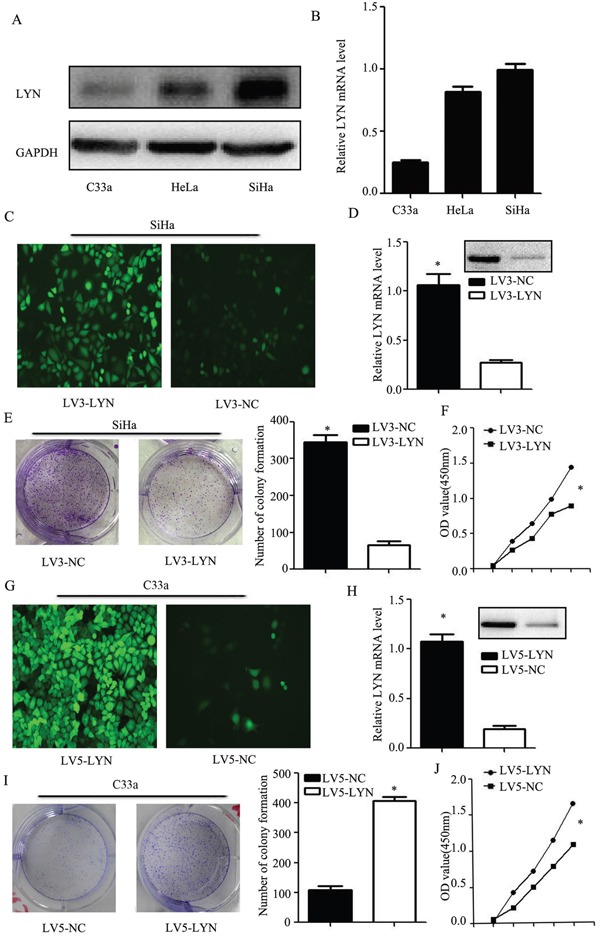
Cervical cancer is one of the most common malignant tumor in women. The mechanisms of cervical cancer are intricate and have not been fully understood. Therefore, we employed iTRAQ to obtain novel proteins profile which participates in the tumor oncogenesis of cervical cancer. 3300 proteins were identified aberrantly expressed in cervical cancer, and western bolt was performed to validate the results of iTRAQ. Then, we selected LYN for further study. Immunohistochemistry identified that LYN expression was significantly increased in cervical cancer tissues than that in cancer adjacent normal cervical tissues and normal cervical tissues. The increased LYN expression was significantly correlated with cancer differentiation and FIGO stage. Silencing LYN inhibited cell proliferation, migration and invasion, conversely, overexpression LYN promoted cell proliferation, migration and invasion. In terms of mechanism, LYN could also promote cervical cancer cells metastasis through activating IL-6/STAT3 pathway. In vivo study, overexpression LYN promoted tumor growth, meanwhile knockdown LYN inhibited tumor growth. These results indicate that LYN tyrosine kinase is an oncogenic gene and can serve as a novel target for cervical cancer research and therapy.
宫颈癌是女性最常见的恶性肿瘤之一。宫颈癌的发病机制错综复杂,尚未完全明确。因此,我们采用iTRAQ技术来获取参与宫颈癌肿瘤发生过程的新蛋白质谱。共鉴定出3300种在宫颈癌中异常表达的蛋白质,并通过蛋白质免疫印迹法验证iTRAQ的结果。然后,我们选择LYN进行进一步研究。免疫组织化学检测发现,宫颈癌组织中LYN的表达明显高于癌旁正常宫颈组织和正常宫颈组织。LYN表达的增加与癌症分化和国际妇产科联盟(FIGO)分期显著相关。沉默LYN可抑制细胞增殖、迁移和侵袭,相反,过表达LYN则促进细胞增殖、迁移和侵袭。在机制方面,LYN还可通过激活IL-6/STAT3信号通路促进宫颈癌细胞转移。在体内研究中,过表达LYN促进肿瘤生长,而敲低LYN则抑制肿瘤生长。这些结果表明,LYN酪氨酸激酶是一种致癌基因,可作为宫颈癌研究和治疗的新靶点。