Callahan Sean J, Xia Meng, Murray Susan, Flaherty Kevin R
Division of Pulmonary and Critical Care Medicine, Department of Internal Medicine, University of Virginia Health System, P.O. Box 800546, Charlottesville, VA 22908, USA.
Department of Biostatistics, University of Michigan, 1415 Washington Heights, Ann Arbor, MI 48109, USA.
Respir Med. 2016 Oct;119:96-101. doi: 10.1016/j.rmed.2016.08.028. Epub 2016 Aug 31.
A group of patients with idiopathic pulmonary fibrosis (IPF) presents with disease affecting one lung markedly more than the other. At this time, it is unclear how this population differs from those who present with more symmetric disease. We sought to explain the characteristics of the asymmetric group and how their disease progresses.
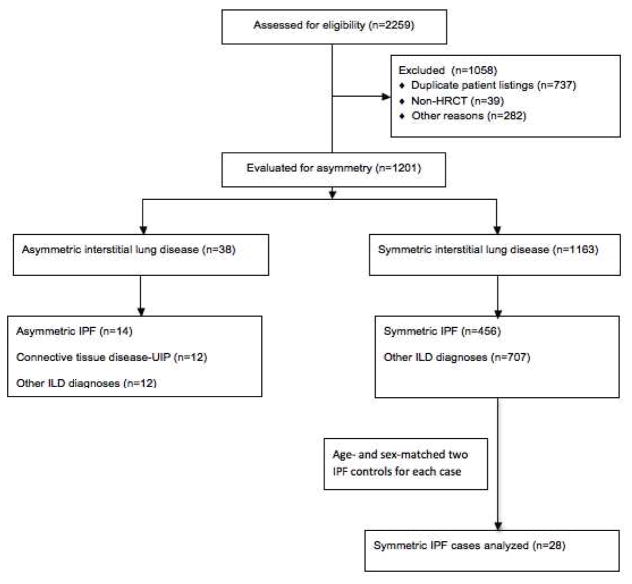
In this retrospective case-control study we accessed an interstitial lung disease (ILD) database and identified 14 asymmetric IPF cases via high-resolution computed tomography (HRCT) scoring of each lung lobe's disease severity. We identified 28 symmetric IPF controls from the same database using the same methods, and compared the clinical features of each group.
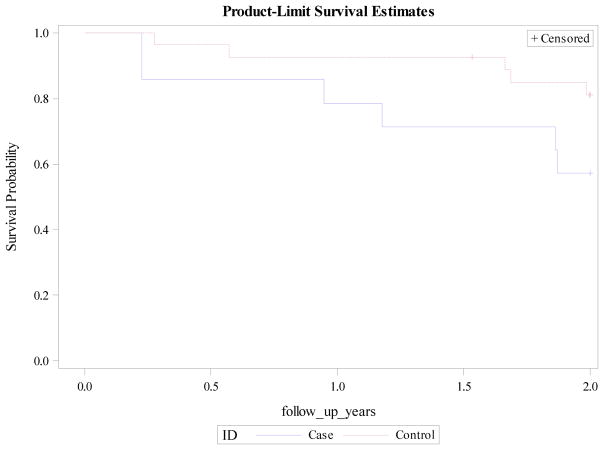
Patients with asymmetric disease exhibited similar demographics as those in the general IPF population; they were predominantly male (64%), elderly (69 years old), and used tobacco (57%). We found a trend toward significantly increased all-cause mortality in the case population two years following diagnosis (p = 0.089). Pulmonary function tests were significantly lower in the case group at the time of diagnosis, then both groups experienced gradual decline. We found no statistically significant differences in number of IPF exacerbations (cases 43%, controls 39%, p = 0.824) and gastro-esophageal reflux (both groups 50%).
Patients with asymmetric IPF resemble patients in the general IPF population but may have a lower overall survival rate. Further systemic factors may be studied to identify reasons for disease asymmetry and clinical decline in this population.
一组特发性肺纤维化(IPF)患者的疾病在一侧肺的表现明显比另一侧更严重。目前尚不清楚这一群体与那些表现出更对称疾病的患者有何不同。我们试图解释不对称组的特征及其疾病进展情况。
在这项回顾性病例对照研究中,我们访问了一个间质性肺病(ILD)数据库,并通过对每个肺叶疾病严重程度进行高分辨率计算机断层扫描(HRCT)评分,确定了14例不对称IPF病例。我们使用相同方法从同一数据库中确定了28例对称IPF对照,并比较了每组的临床特征。
不对称疾病患者的人口统计学特征与一般IPF人群相似;他们主要为男性(64%)、老年人(69岁)且有吸烟史(57%)。我们发现病例组在诊断后两年全因死亡率有显著增加的趋势(p = 0.089)。诊断时病例组的肺功能测试结果显著更低,之后两组均逐渐下降。我们发现IPF急性加重次数(病例组43%,对照组39%,p = 0.824)和胃食管反流(两组均为50%)在统计学上无显著差异。
不对称IPF患者与一般IPF人群相似,但总体生存率可能较低。可进一步研究系统性因素,以确定该人群疾病不对称和临床病情恶化的原因。