James Bryan D, Wilson Robert S, Boyle Patricia A, Trojanowski John Q, Bennett David A, Schneider Julie A
Rush Alzheimer's Disease Center, Rush University Medical Center, Department of Internal Medicine, 600 s. Paulina Street, Chicago, IL 60612, USA.
Rush Alzheimer's Disease Center, Rush University Medical Center, Department of Neurological Sciences, 600 s. Paulina Street, Chicago, IL 60612, USA.
Brain. 2016 Nov 1;139(11):2983-2993. doi: 10.1093/brain/aww224.
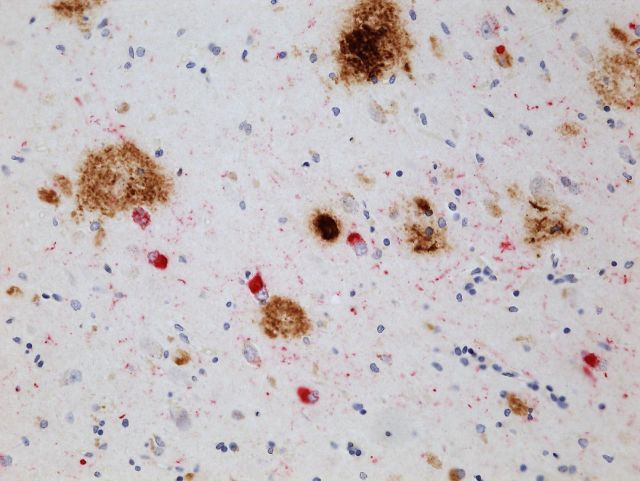
Hyperphosphorylated transactive response DNA-binding protein 43 (TDP-43, encoded by TARDBP ) proteinopathy has recently been described in ageing and in association with cognitive impairment, especially in the context of Alzheimer's disease pathology. To explore the role of mixed Alzheimer's disease and TDP-43 pathologies in clinical Alzheimer's-type dementia, we performed a comprehensive investigation of TDP-43, mixed pathologies, and clinical Alzheimer's-type dementia in a large cohort of community-dwelling older subjects. We tested the hypotheses that TDP-43 with Alzheimer's disease pathology is a common mixed pathology; is related to increased likelihood of expressing clinical Alzheimer's-type dementia; and that TDP-43 pathologic stage is an important determinant of clinical Alzheimer's-type dementia. Data came from 946 older adults with ( n = 398) and without dementia ( n = 548) from the Rush Memory and Aging Project and Religious Orders Study. TDP-43 proteinopathy (cytoplasmic inclusions) was present in 496 (52%) subjects, and the pattern of deposition was classified as stage 0 (none; 48%), stage 1 (amygdala; 18%), stage 2 (extension to hippocampus/entorhinal; 21%), or stage 3 (extension to neocortex; 14%). TDP-43 pathology combined with a pathologic diagnosis of Alzheimer's disease was a common mixed pathology (37% of all participants), and the proportion of subjects with clinical Alzheimer's-type dementia formerly labelled 'pure pathologic diagnosis of Alzheimer's disease' was halved when TDP-43 was considered. In logistic regression models adjusted for age, sex, and education, TDP-43 pathology was associated with clinical Alzheimer's-type dementia (odds ratio = 1.51, 95% confidence interval = 1.11, 2.05) independent of pathological Alzheimer's disease (odds ratio = 4.30, 95% confidence interval = 3.08, 6.01) or other pathologies (infarcts, arteriolosclerosis, Lewy bodies, and hippocampal sclerosis). Mixed Alzheimer's disease and TDP-43 pathologies were associated with higher odds of clinical Alzheimer's-type dementia (odds ratio = 6.73, 95% confidence interval = 4.18, 10.85) than pathologic Alzheimer's disease alone (odds ratio = 4.62, 95% confidence interval = 2.84, 7.52). In models examining TDP-43 stage, a dose-response relationship with clinical Alzheimer's-type dementia was observed, and a significant association was observed starting at stage 2, extension beyond the amygdala. In this large sample from almost 1000 community participants, we observed that TDP-43 proteinopathy was very common, frequently mixed with pathological Alzheimer's disease, and associated with a higher likelihood of the clinical expression of clinical Alzheimer's-type dementia but only when extended beyond the amygdala.
近年来,人们发现过度磷酸化的反式激活应答DNA结合蛋白43(TDP - 43,由TARDBP编码)蛋白病与衰老以及认知障碍有关,尤其是在阿尔茨海默病病理学背景下。为了探究阿尔茨海默病和TDP - 43病理学混合状态在临床阿尔茨海默型痴呆中的作用,我们对一大群社区居住的老年受试者中的TDP - 43、混合病理学以及临床阿尔茨海默型痴呆进行了全面调查。我们检验了以下假设:伴有阿尔茨海默病病理学的TDP - 43是一种常见的混合病理学;与临床阿尔茨海默型痴呆表达可能性增加有关;并且TDP - 43病理分期是临床阿尔茨海默型痴呆的重要决定因素。数据来自拉什记忆与衰老项目和宗教团体研究中的946名有(n = 398)和无痴呆(n = 548)的老年人。496名(52%)受试者存在TDP - 43蛋白病(细胞质内包涵体),沉积模式分为0期(无;48%)、1期(杏仁核;18%)、2期(扩展至海马体/内嗅区;21%)或3期(扩展至新皮质;14%)。TDP - 43病理学与阿尔茨海默病的病理诊断相结合是一种常见的混合病理学(占所有参与者的37%),当考虑TDP - 43时,以前被标记为“阿尔茨海默病纯病理诊断”的临床阿尔茨海默型痴呆受试者比例减半。在调整了年龄、性别和教育程度的逻辑回归模型中,TDP - 43病理学与临床阿尔茨海默型痴呆相关(比值比 = 1.51,95%置信区间 = 1.11,2.05),独立于病理性阿尔茨海默病(比值比 = 4.30,95%置信区间 = 3.08,6.01)或其他病理学(梗死、小动脉硬化、路易体和海马硬化)。阿尔茨海默病和TDP - 43病理学混合状态与临床阿尔茨海默型痴呆的较高比值比(比值比 = 6.73,95%置信区间 = 4.18,10.85)相关,高于单独的病理性阿尔茨海默病(比值比 = 4.62,95%置信区间 = 2.84,7.52)。在检查TDP - 43分期的模型中,观察到与临床阿尔茨海默型痴呆存在剂量反应关系,并且从2期(扩展超出杏仁核)开始观察到显著关联。在这个来自近1000名社区参与者的大样本中,我们观察到TDP - 43蛋白病非常常见,经常与病理性阿尔茨海默病混合,并且与临床阿尔茨海默型痴呆的临床表达可能性较高相关,但仅当扩展超出杏仁核时。
