Barillari Giovanni, Palladino Clelia, Bacigalupo Ilaria, Leone Patrizia, Falchi Mario, Ensoli Barbara
Department of Clinical Sciences and Translational Medicine, University 'Tor Vergata', I-00133 Rome, Italy.
National AIDS Center, National Institute of Health, I-00161 Rome, Italy.
Oncol Lett. 2016 Oct;12(4):2389-2394. doi: 10.3892/ol.2016.4921. Epub 2016 Jul 29.
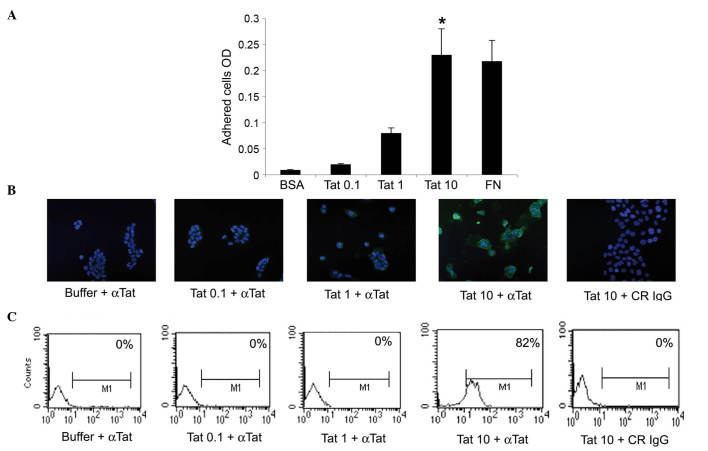
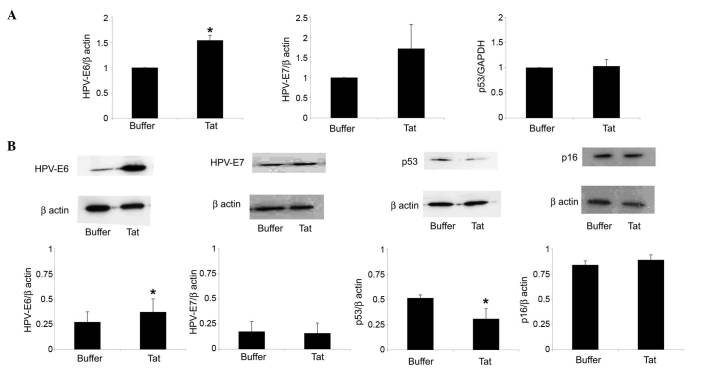
The infection of uterine cervical epithelial cells by oncogenic, high-risk human papilloma viruses (HR-HPVs) may lead to the development of cervical carcinoma. Of note, the incidence of this tumor is significantly increased in women infected by both HR-HPV and human immunodeficiency virus (HIV)-1. In this regard, previous studies have linked the HIV-1 Tat protein, a trans-activator of viral gene expression, to the pathogenesis of HIV-associated malignancies. In particular, it has been shown that upon its release by acutely infected cells, Tat protein can enter human cells, thus modifying their phenotype. Based on these findings, the present study evaluated whether extracellular Tat protein could be taken up by human uterine cervical carcinoma cells, and whether this could affect the expression of HPV (E6 or E7) or cellular (p16 or p53) molecules, which are key to cervical carcinoma development or progression. The results indicated that extracellular, biologically active HIV-1 Tat protein is taken up by human uterine cervical carcinoma cells, and that this is followed by an increase in the expression of the E6 protein of HPV, and by a reduction in the protein levels of the cellular oncosuppressor p53. Since p53 loss is associated with cell dedifferentiation and immortalization, these findings suggest a possible link between extracellular Tat protein and the high incidence and clinical aggressiveness of uterine cervical carcinoma observed in HIV/HPV doubly infected women.
致癌性高危人乳头瘤病毒(HR-HPVs)感染子宫颈上皮细胞可能导致宫颈癌的发生。值得注意的是,在同时感染HR-HPV和人类免疫缺陷病毒(HIV)-1的女性中,这种肿瘤的发病率显著增加。在这方面,先前的研究已将病毒基因表达的反式激活因子HIV-1 Tat蛋白与HIV相关恶性肿瘤的发病机制联系起来。特别是,已表明急性感染细胞释放Tat蛋白后,它可进入人体细胞,从而改变其表型。基于这些发现,本研究评估了细胞外Tat蛋白是否可被人子宫颈癌细胞摄取,以及这是否会影响HPV(E6或E7)或细胞(p16或p53)分子的表达,这些分子是宫颈癌发生或进展的关键。结果表明,细胞外具有生物活性的HIV-1 Tat蛋白被人子宫颈癌细胞摄取,随后HPV的E6蛋白表达增加,细胞抑癌蛋白p53的水平降低。由于p53缺失与细胞去分化和永生化有关,这些发现提示细胞外Tat蛋白与HIV/HPV双重感染女性中观察到的子宫颈癌高发病率和临床侵袭性之间可能存在联系。