Collado Anahí, Johnson Patrick S, Loya Jennifer M, Johnson Matthew W, Yi Richard
Alvord, Baker, and Associates, LLC, 3200 Tower Oaks Blvd, Suite 200, Rockville, MD, 20852, USA.
Psychology Department, California State University-Chico, Chico, CA, USA.
Arch Sex Behav. 2017 Oct;46(7):2187-2195. doi: 10.1007/s10508-016-0836-x. Epub 2016 Oct 3.
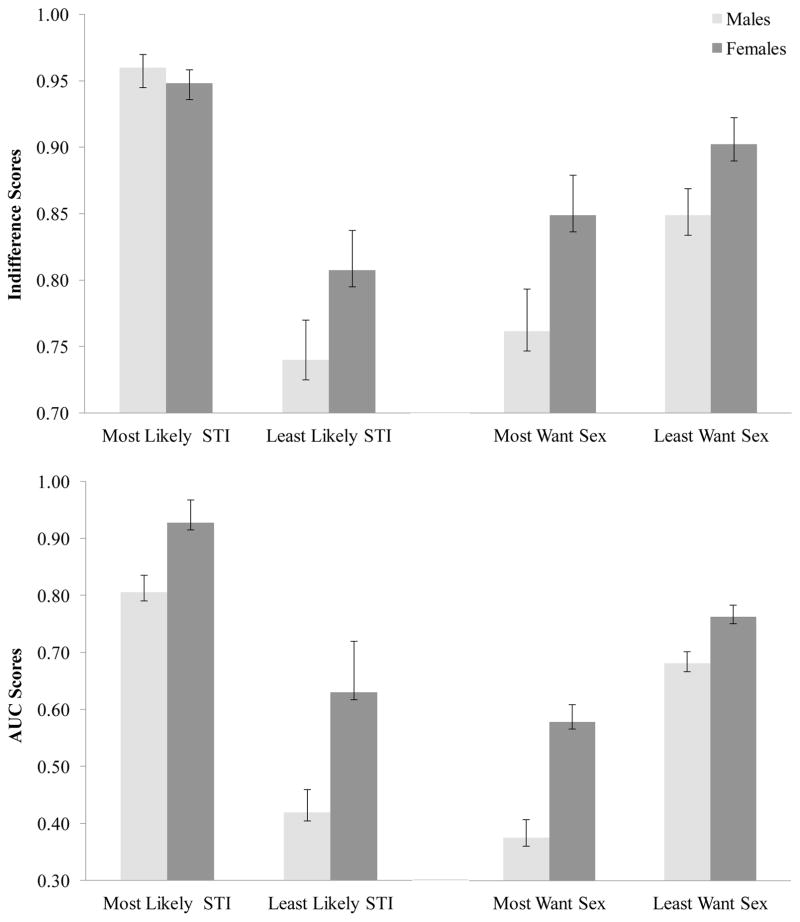
The study examined sexual delay discounting, or the devaluation of condom-protected sex in the face of delay, as a risk factor for sexually transmitted infection (STI) among college students. Participants (143 females, 117 males) completed the sexual delay discounting task (Johnson & Bruner, 2012) and questionnaires of risky sexual behavior, risk perception, and knowledge. Participants exhibited steeper sexual delay discounting (above and beyond general likelihood of having unprotected sex) when partners were viewed as more desirable or less likely to have a STI, with males demonstrating greater sexual delay discounting than females across most conditions. Importantly, greater self-reported risky sexual behaviors were associated with higher rates of sexual delay discounting, but not with likelihood of using a condom in the absence of delay. These results provide support for considering sexual delay discounting, with particular emphasis on potential delays to condom use, as a risk factor for STI among college students.
该研究考察了性延迟折扣,即面对延迟时对使用避孕套保护的性行为的贬值,作为大学生性传播感染(STI)的一个风险因素。参与者(143名女性,117名男性)完成了性延迟折扣任务(约翰逊和布鲁纳,2012年)以及关于危险性行为、风险认知和知识的问卷调查。当伴侣被认为更有吸引力或感染性传播感染的可能性更低时,参与者表现出更陡峭的性延迟折扣(超出无保护性行为的一般可能性),在大多数情况下,男性的性延迟折扣比女性更大。重要的是,自我报告的更高的危险性行为与更高的性延迟折扣率相关,但与在没有延迟的情况下使用避孕套的可能性无关。这些结果为将性延迟折扣,特别是对使用避孕套的潜在延迟,视为大学生性传播感染的一个风险因素提供了支持。