Chae Jung-Woo, Ng Terence, Yeo Hui Ling, Shwe Maung, Gan Yan Xiang, Ho Han Kiat, Chan Alexandre
Department of Pharmacy, National University of Singapore, Singapore.
Department of Pharmacy, National Cancer Centre Singapore, Singapore.
PLoS One. 2016 Oct 4;11(10):e0164204. doi: 10.1371/journal.pone.0164204. eCollection 2016.
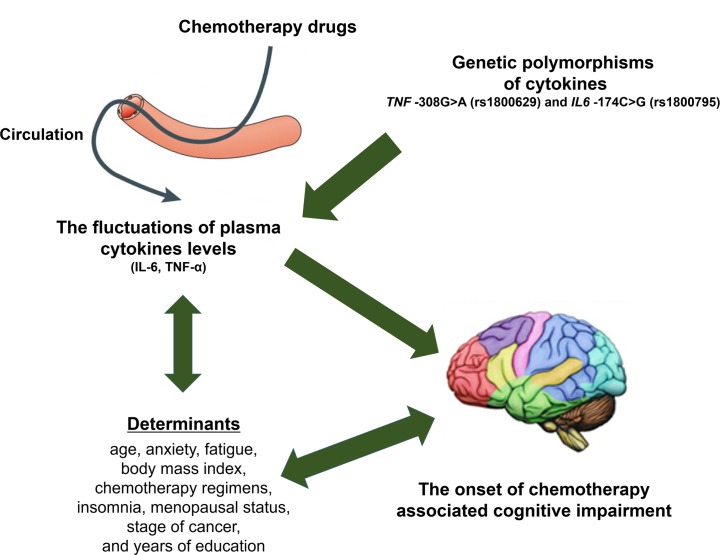
Expression of pro-inflammatory cytokines is influenced by single nucleotide polymorphisms (SNPs) in the promoter regions of the pro-inflammatory cytokine genes, and cytokines are associated with the occurrence of post-chemotherapy cognitive impairment. Hence, the aim of this study was to evaluate the associations between two common pro-inflammatory cytokine gene polymorphisms namely, IL6-174 (rs1800795 G>C) and TNF-308 (rs1800629 G>A), and chemotherapy-associated cognitive impairment (CACI) among Asian early-stage breast cancer patients. In addition, the differential effect of these SNPs on plasma IL-6 and TNF-α levels, and the associations of plasma IL-6 and TNF-α levels with CACI were also assessed.
Asian early-stage breast cancer patients (Stage I to III) receiving chemotherapy were prospectively recruited from two cancer centers in Singapore. Patients' cognitive function was longitudinally assessed using the validated FACT-Cog (ver. 3) and an objective computerized battery, Headminder™ at three-time points. Plasma IL-6 and TNF-α levels were analyzed using the multiplex immunoassay, and genotyping was performed using Sanger sequencing. Regression analyses and generalized estimating equation were utilized for statistical analysis.
A total of 125 patients were included (mean age: 50.3; Chinese: 80.8%; post-menopausal: 48.0%; 68.0% received anthracycline-based chemotherapy). 36.8% patients experienced self-perceived cognitive impairment, detected in memory (32.8%) and attention (34.2%) domains. Patients with higher levels of anxiety (p<0.001) and insomnia (p = 0.003) also reported more self-perceived cognitive impairment. Higher plasma concentrations of IL-6 were associated with greater severity of self-perceived cognitive impairment (p = 0.001). Polymorphisms of cytokine genes were not associated with expression of plasma cytokines.
Present findings further contribute to the growing evidence that supports the role of the pro-inflammatory cytokine IL-6 in the occurrence of cognitive impairment post-chemotherapy. However, genetic polymorphism of these cytokines did not play a major role to the cytokine fluctuations as well as cognitive impairment in this cohort. With an increasing evidence to support the cytokine hypothesis, future studies should investigate the role of anti-inflammatory agents in mitigating the cognitive impairment associated with chemotherapy.
促炎细胞因子的表达受促炎细胞因子基因启动子区域单核苷酸多态性(SNP)的影响,且细胞因子与化疗后认知功能障碍的发生有关。因此,本研究旨在评估亚洲早期乳腺癌患者中两种常见的促炎细胞因子基因多态性,即IL6 - 174(rs1800795 G>C)和TNF - 308(rs1800629 G>A)与化疗相关认知功能障碍(CACI)之间的关联。此外,还评估了这些SNP对血浆IL - 6和TNF -α水平的差异影响,以及血浆IL - 6和TNF -α水平与CACI的关联。
从新加坡的两个癌症中心前瞻性招募接受化疗的亚洲早期乳腺癌患者(I至III期)。使用经过验证的FACT - Cog(第3版)和客观计算机化测试组合Headminder™在三个时间点对患者的认知功能进行纵向评估。使用多重免疫测定法分析血浆IL - 6和TNF -α水平,并使用桑格测序法进行基因分型。采用回归分析和广义估计方程进行统计分析。
共纳入125例患者(平均年龄:50.3岁;华裔:80.8%;绝经后:48.0%;68.0%接受了基于蒽环类药物的化疗)。36.8%的患者经历了自我感知的认知功能障碍,在记忆(32.8%)和注意力(34.2%)领域被检测到。焦虑水平较高(p<0.001)和失眠(p = 0.003)的患者也报告了更多的自我感知认知功能障碍。血浆IL - 6浓度较高与自我感知认知功能障碍的严重程度较高相关(p = 0.001)。细胞因子基因多态性与血浆细胞因子的表达无关。
目前的研究结果进一步支持了越来越多的证据,即促炎细胞因子IL - 6在化疗后认知功能障碍的发生中起作用。然而,这些细胞因子的基因多态性在该队列中对细胞因子波动以及认知功能障碍并未起主要作用。随着越来越多的证据支持细胞因子假说,未来的研究应调查抗炎药物在减轻与化疗相关的认知功能障碍中的作用。