Tofangchi Alireza, Fan Anthony, Saif M Taher A
Department of Mechanical Engineering, University of Illinois at Urbana-Champaign, Urbana, Illinois.
Department of Mechanical Engineering, University of Illinois at Urbana-Champaign, Urbana, Illinois.
Biophys J. 2016 Oct 4;111(7):1519-1527. doi: 10.1016/j.bpj.2016.08.024.
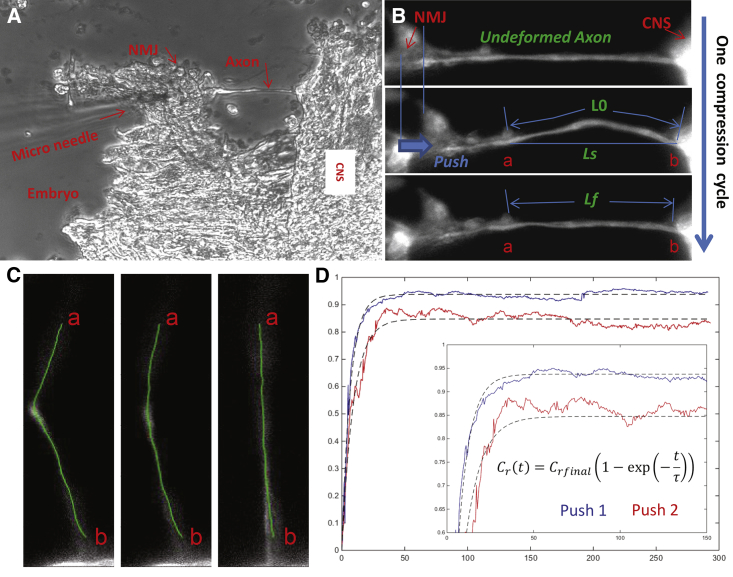
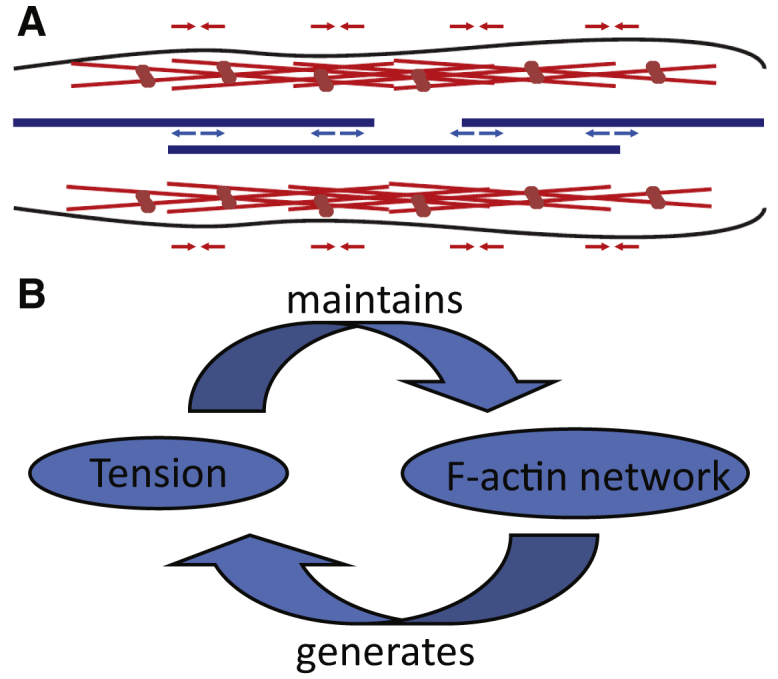
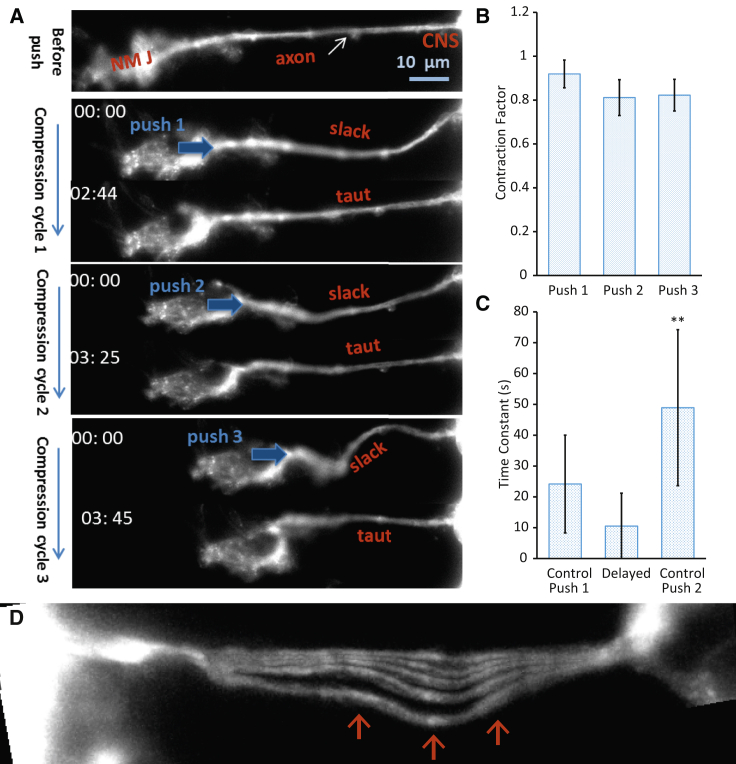
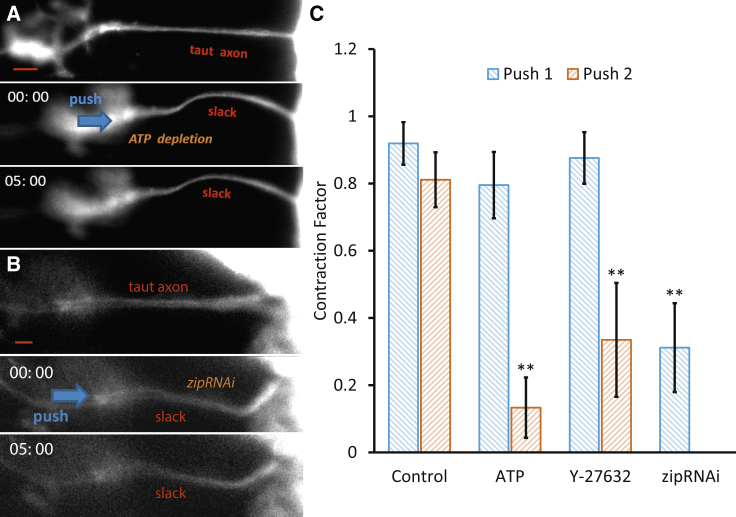
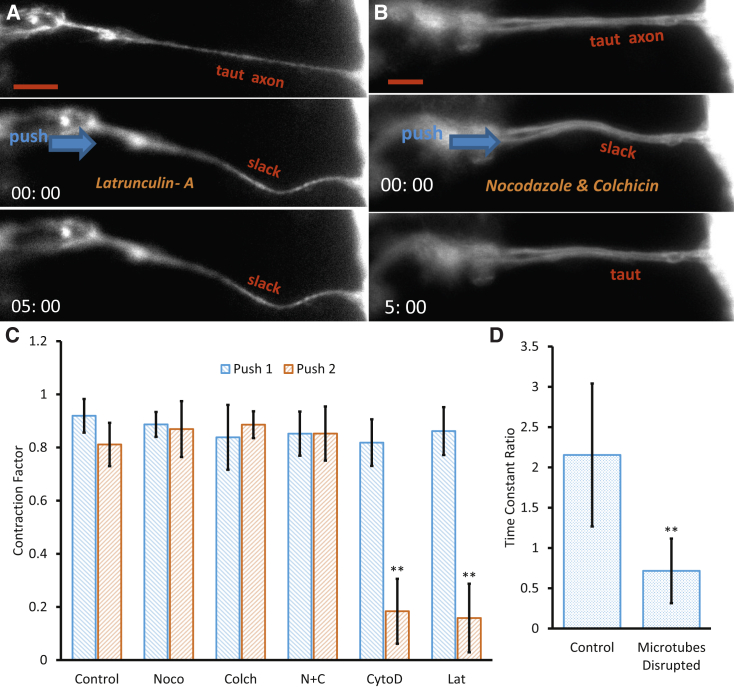
Several in vitro and limited in vivo experiments have shown that neurons maintain a rest tension along their axons intrinsically. They grow in response to stretch but contract in response to loss of tension. This contraction eventually leads to the restoration of the rest tension in axons. However, the mechanism by which axons maintain tension in vivo remains elusive. The objective of this work is to elucidate the key cytoskeletal components responsible for generating tension in axons. Toward this goal, in vivo experiments were conducted on single axons of embryonic Drosophila motor neurons in the presence of various drugs. Each axon was slackened mechanically by bringing the neuromuscular junction toward the central nervous system multiple times. In the absence of any drug, axons shortened and restored the straight configuration within 2-4 min of slackening. The total shortening was ∼40% of the original length. The recovery rate in each cycle, but not the recovery magnitude, was dependent on the axon's prior contraction history. For example, the contraction time of a previously slackened axon may be twice its first-time contraction. This recovery was significantly hampered with the depletion of ATP, inhibition of myosin motors, and disruption of actin filaments. The disruption of microtubules did not affect the recovery magnitude, but, on the contrary, led to an enhanced recovery rate compared to control cases. These results suggest that the actomyosin machinery is the major active element in axonal contraction, whereas microtubules contribute as resistive/dissipative elements.
多项体外实验和有限的体内实验表明,神经元在其轴突内固有地维持一种静息张力。它们在受到拉伸时生长,但在张力丧失时收缩。这种收缩最终导致轴突恢复静息张力。然而,轴突在体内维持张力的机制仍然不清楚。这项工作的目的是阐明负责在轴突中产生张力的关键细胞骨架成分。为了实现这一目标,在各种药物存在的情况下,对胚胎果蝇运动神经元的单个轴突进行了体内实验。通过多次将神经肌肉接头拉向中枢神经系统,每个轴突被机械性地松弛。在没有任何药物的情况下,轴突在松弛后2 - 4分钟内缩短并恢复到直线状态。总缩短量约为原始长度的40%。每个周期的恢复率而非恢复幅度取决于轴突先前的收缩历史。例如,先前松弛过的轴突的收缩时间可能是其首次收缩时间的两倍。ATP耗尽、肌球蛋白马达受抑制以及肌动蛋白丝被破坏会显著阻碍这种恢复。微管的破坏并不影响恢复幅度,但相反,与对照情况相比,会导致恢复率提高。这些结果表明,肌动球蛋白机制是轴突收缩中的主要活性成分,而微管作为抗性/耗散性成分发挥作用。